Autonomous video — 2026-06-28PUBLIC
The autonomous video pipeline: production is nearly free now, so the edge is what you point it at and the silent failures you catch
Making a video now costs cents, so production was never the moat. The real edges are what you point the machine at and the silent failures that pass as success. A guide to the pipeline, the build-vs-buy call, and the gates that catch a green dashboard lying.
≈ 23 min read
A representative old-way ledger (a composite of what creators report, not one real channel): $3,000 on editors and voiceover, monetized after eight months, revenue that settled at about $120 a month. Break-even was two years out.
That was the outsourced-human YouTube channel, a long, expensive bet on a payoff that might never land.
Now set that beside a self-built pipeline like the one this note describes, where direct metering puts a video at roughly a dime in compute and ninety seconds of finished footage in a few minutes of wall-clock time. What replaced the crew:
- no editor
- no voice actor
- one approval click
The cost of making a video fell off a cliff in the last year, and that single fact starts everything that follows. Here's the trap, though. Cheap production doesn't print money, it just removes the excuse that production was the hard part. The machine that spits out videos turned out to be the easy thing to build. What still decides whether a channel lives or dies is two things a pipeline cannot do for you:
- what you point it at
- whether it survives its own failures at 3 a.m. when an API rate-limits, the render is 90 percent done, and the dashboard helpfully reports that everything is fine
This is the field map for that machine, and for the two stations you can never leave empty.
CH.01
So what changed, and why is "automate everything" now the losing move?
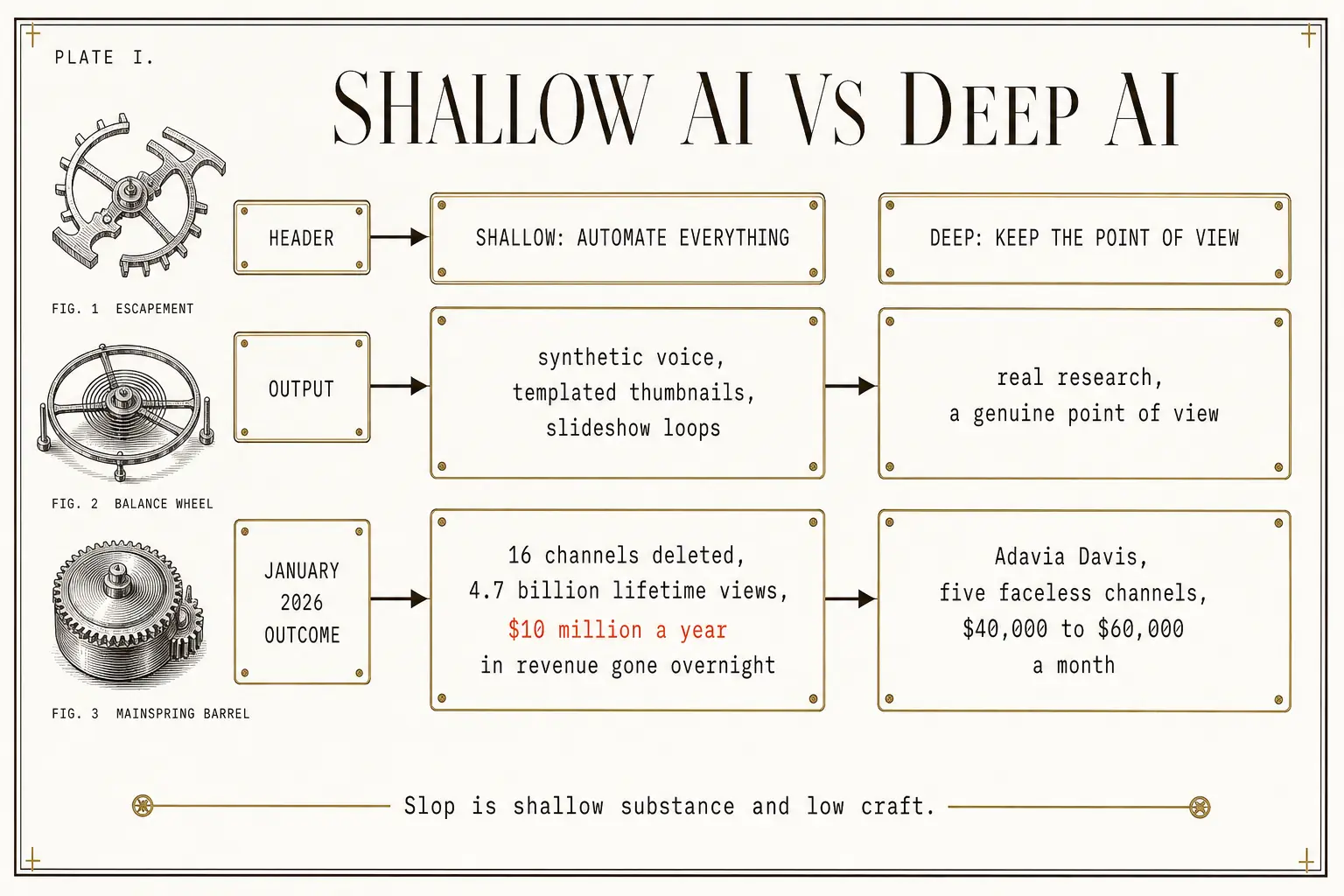
Production cost collapsed to near-zero, and at the same moment the platforms started deleting the channels that abused it. The move that won two years ago, generate on a schedule, flood every feed, is now the fastest route to a dead channel, because what gets punished is shallowness, not automation.
In January 2026, by widely-reported accounts, YouTube deleted 16 channels in one sweep. Combined, they reportedly held about 4.7 billion lifetime views and roughly $10 million a year in revenue. Gone overnight. Not for using AI, for using it the shallow way: synthetic voice, templated thumbnails, slideshow loops, output no human team could plausibly produce that fast.1
The verdict is measurable, not a vibe:
- "AI slop" was Merriam-Webster's word of the year for 2025, and 88 percent of Americans say it's harder than ever to tell what's real online.2
- A 2026 study of 408 people found trust falls off a cliff, from 3.33 to 2.01 on a 7-point scale, the moment hallucination crosses from low to medium, with perceived realism the strongest driver of trust at a coefficient of 0.856.3
- Raw AI output performs roughly a third worse in AI-search citations.4
But the rejection aims at thin, not at machines, and the honest counter proves it: a brand that pledged "no generative AI" watched organic traffic fall 34 percent over six months.5 So the lesson is narrow.
Slop is shallow substance and low craft.
Push the effort off the camera and into the system, and the only scarce inputs left, depth and a real point of view, are exactly the ones a machine can't fake. The deep end is also where the money is: Adavia Davis runs five faceless channels at a creator-reported $40,000–$60,000 a month, his biggest earner six-hour "Boring History" documentaries that reportedly cost as little as $60 each at high margins, shown with AdSense screenshots.6 No face. The whole game is keeping the depth while automating the production.
CH.02
What shape is the pipeline, really?
Every system reduces to the same six stations, research, script, voice, visuals, assembly, then per-platform cut and publish, and the technology to run all six exists today for cents. A pipeline is not a one-click button, it's a closed loop where each stage's output is the next stage's machine-readable input, state survives a crash, and the orchestration, not the model, is the part nobody sells you.
Strip the brand names and every field report is the same conveyor. Some model it as five stages, while Vidno counts a YouTube pipeline at 23 distinct steps.7 FFmpeg is the universal renderer everything else wraps. The canonical note-to-video move is a still looped under an audio track, and two flags eat an afternoon if you miss them:
- pad the images with
-r 1when the audio outlasts the visuals - write a variable-bitrate MP3 with
-write_xing 0or the trailer write fails withInvalid argument89
The load-bearing rule is to calculate each clip's length from the actual narration duration, never hardcode it, or your pictures finish before your sentence does.8
The architectures split three ways, and most "autonomous" systems are the fragile one wearing a costume:
| Pattern | Shape | The trade-off |
|---|---|---|
| Sequential chain | stage N feeds N+1 (what most tutorials ship) | easiest to build, first to break, one agent failure stops everything downstream |
| Data-sloshing transform | content morphs format to format (extract → script → audio → visuals → composite) | flexible, but no feedback |
| Closed-loop factory | production plus analytics feeding back into what you make next | the only shape that improves over time, costs the most to engineer |
The uncomfortable judgment, echoed across the field: most people fail by automating exactly one step and hand-doing the rest. The whole point is to automate the tedious middle and gate the two ends.
flowchart LR
  H1["HUMAN: angle + script"] --> R["Research / source"]
  R --> S["Script"]
  S --> V["Voice"]
  V --> X["Visuals"]
  X --> A["Assemble (FFmpeg)"]
  A --> C["Captions"]
  C --> G{"Gates"}
  G -->|pass| H2["HUMAN: QA before publish"]
  G -->|flag| F["Regenerate"]
  F --> G
  H2 --> P["Per-platform cut + publish"]
The orchestration harness is the part nobody sells you, and it's where the moat lives.
Feed it the writing you already have
The input is the writing you already produce: a 50-post archive is 50 video sources, and 500-to-3,000-word posts convert cleanest into 60-to-180-second videos.10 11
Of Vidno's 23 steps, only three genuinely need a human:
- topic selection
- research
- recording
Automating the rest cut active time per video by 77 percent across twelve developer channels, from 130 minutes to 30–35.7 Build the orchestration only if the workflow is your moat. (The production-craft toolchain itself, which models render which shots, the voice engine, captions, on-camera versus faceless, is its own subject in a companion note on AI video production and tools. This one is what to point the machine at, the build, the economics, and the failures.)
CH.03
Build it yourself, or buy an all-in-one?
Buy if you're repurposing content, build if the workflow itself is your moat. The decision is really which price you'd rather pay, money or hours, but one rule overrides taste: never build on a model you don't control, because the lease can end on a Tuesday.
flowchart TD
  Q1{"Repurposing existing content?"} -->|yes| BUY["Buy: all-in-one SaaS"]
  Q1 -->|no| Q2{"Is the workflow itself your moat?"}
  Q2 -->|no| BUY
  Q2 -->|yes| BUILD["Build: FFmpeg / Remotion / n8n + APIs"]
  BUILD --> RULE["Never build on a model you do not control"]
  RULE --> ABS["Abstract every model behind a thin interface"]
| Buy (all-in-one SaaS) | Build (FFmpeg / Remotion / n8n + APIs) | |
|---|---|---|
| Setup time (estimated ranges) | 1–2 hours | 1–2 weeks, up to 4–8 for an agentic build |
| Monthly floor | ~$31–109 | $5–50 hosting + per-video API |
| Marginal cost / video | $0.10–5 | near $0 (compute only) |
| Quality ceiling | 80–85% in 10–20 min | 90–95% in 60–90 min, after 65–105 hrs learning |
| Long-form + Shorts from existing audio | usually no single tool does both | yes, you control every stage |
| Maintenance | the vendor's | yours, forever |
The rule that settles it: done-for-you platforms "rarely match what a $30 freelancer produces."12 So you build only when the workflow is the thing competitors can't copy.
The model-tenant warning is named Sora. The reported burn was about $15 million a day in inference against a reported ~$2.1 million in lifetime revenue, a planned $1 billion Disney partnership was reportedly pulled on the economics, and the consumer app shut with the API scheduled to wind down.13 And the market is volatile enough that two reputable sources disagree on whether the model is even alive, one dates the shutdown earlier while OpenAI's own developer pricing page still listed live Sora 2 tiers as of June 22, 2026.14 The portable lesson from a builder writing as zsky: before you depend on any tool, ask three questions.
- Who owns the hardware?
- Does the company survive without venture funding?
- What happens to your outputs?
Then abstract every model behind a thin interface so a sunset is a one-line swap, not a rebuild.15 If your render step calls a vendor directly in twelve places, you don't have a pipeline, you have a hostage.
CH.04
Will the platform even pay you, or quietly kill the money?
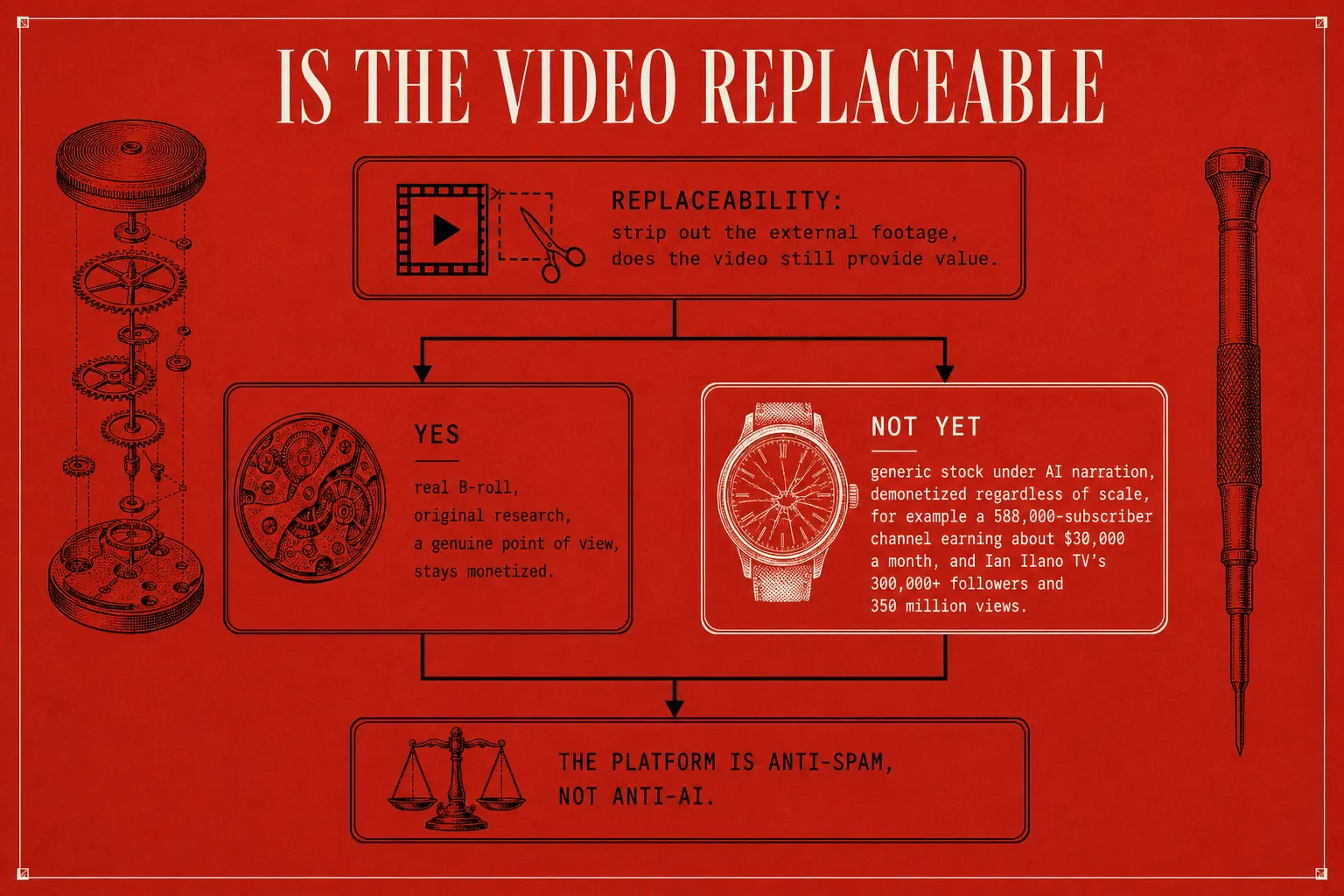
The pipeline being cheap and autonomous means nothing if YouTube rules your output "inauthentic" and demonetizes the channel, and in 2026 it is actively deciding exactly that. The rule is survivable, but only if you're deep: the platform is anti-spam, not anti-AI.
On July 15, 2025, the "repetitious content" rule became "inauthentic content," aimed squarely at mass-produced, template-driven video with no real creative input. Google was careful to say AI-using channels remain eligible to monetize.16 Then enforcement got real. A channel with 588,000 subscribers earning roughly $30,000 a month was fully demonetized for exactly that, and it still pulls close to a million views a month, the reach didn't vanish, only the money did.17
The test has a name: replaceability.
Strip out the external footage, and does the video still provide value?
A pipeline that pours AI narration over generic stock fails that test by design.18 The human cost has a face, Ian Ilano TV, 300,000+ followers and 350 million views, demonetized for "inauthentic content" despite owning the source books and recording nearly 3TB of his own B-roll. His appeal video drew one view in 48 hours.19
Disclosure and Content ID
Disclosure favors honesty over silence. YouTube now auto-applies AI labels to photorealistic or meaningfully altered content even when you don't, and failing to disclose triggers a three-strike path:
- warning
- 90-day monetization suspension
- removal
The relief for a narrated note: minor edits, captions, and cloning your own voice for voiceover don't require disclosure, and disclosing an AI voice doesn't demonetize.20 Then there's Content ID, the tax that fires even when you've done nothing wrong:
- a 28.4 percent false-positive rate in independent testing
- public-domain Beethoven recordings claimed on sight
- since October 15, 2024 a Short with an active claim is blocked outright regardless of the rightsholder's policy2122
The fix is the same judgment you can't automate at the front: an original angle, real research, fewer than 10 uploads a day. "Mostly hands-off" is allowed. "Entirely hands-off" is the thing the algorithm is built to catch.23
CH.05
The failures that cost real money don't crash, they succeed
You'll instrument the pipeline for errors. The errors aren't the problem. The expensive failure is the run that returns success while producing garbage, because that's the one your monitoring is blind to, a green badge is not evidence the work happened, only that nothing threw.
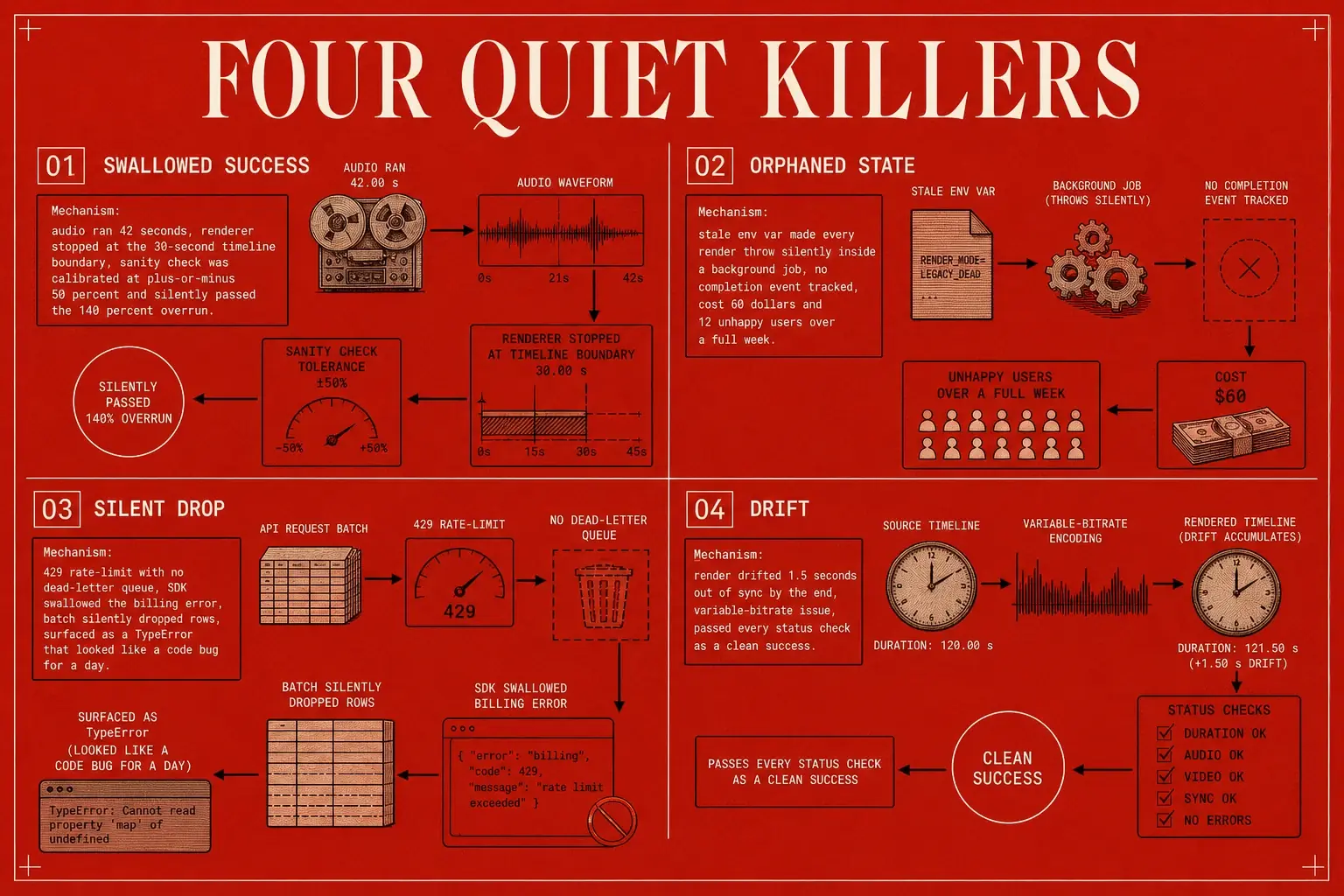
Trilogy AI shipped a batch of videos that were beautiful, captioned, and cut off mid-sentence: the video just stops talking. The visuals played to the end. The narration didn't. Their LLM had faithfully locked each video's duration to the 30- or 60-second target, exactly as instructed, but ElevenLabs returned longer audio, 42 seconds for a 30-second target, and the renderer stopped at the timeline boundary. A post-render sanity check existed, calibrated at plus-or-minus 50 percent, and it silently passed the 140 percent error because nobody had recalibrated it for the new code path.24
The durable lesson: LLM proposes, deterministic code reconciles, and you must audit every invariant before you hand an LLM authority over it.
Then there's Kazutaka, whose write-up should be required reading. A stale environment variable, an orphaned function name a version upgrade had left behind, made every render throw silently inside a background job. No client error. No completion event, because they tracked the start event but had never built the complete. The rising fal.ai charges actually looked like a healthy sign. It cost $60 and 12 unhappy users over a full week, and recovery was only possible because every stage had saved its output to the database first.25
Save every stage's output, or you cannot recover from the failure you didn't see.
The same author kept a tally of five more, each a quiet day-killer:
- a Vercel function's hard 300-second limit silently kills an 18-minute clip
- Kling 3.0 Pro takes about 18 minutes against docs that promise two to five
- one 35-second background track on ElevenLabs Music ate roughly 4,000 credits, more than 400 narrations, and failed with a 40126
The shape repeats across unrelated builders, and the most-repeated version is the swallowed 429:
- An LLM API returned rate-limit errors for 11 minutes with no dead-letter queue, so the batch silently dropped rows, and the SDK's swallowed billing error surfaced as a
TypeErrorthat looked like a code bug for a day. The fix is exponential backoff at the HTTP-client layer.27 - A multi-platform poster failed in total silence because a Google Drive link was set to "view" instead of "download", two hours to spot.28
- A clip channel posted reliably for weeks, then went dark when its auth tokens expired with no error, the builder only noticed when traffic dropped.29
- A render drifted instead of erroring, perfect for two minutes, 1.5 seconds behind by the end, a variable-bitrate sync issue fixed by re-encoding to constant bitrate.23
- Operators report that running an MCP server over SSE instead of stdio makes every tool call time out with no error, the kind of gotcha that eats a day before you find the cause.
76.5 percent of pipeline failures happen at the rendering stage.30 The through-line is to stop trusting silence. FFmpeg can be its own quality cop, blackdetect and freezedetect catch dead air, silencedetect finds gaps, a contact-sheet tile storyboards a render at a glance, so make a cheap is-it-good check first-class in every stage.31
I have run the overnight version of this. A supervisor I built for a Cinema 4D job drove two GPUs through 1,988 takes unattended, tracking every frame, converting finished renders before the disk filled, and restarting itself on crash. All 1,988 reached final format and nobody woke up. The lesson that transfers is not the supervisor, it is that the thing worth building was never the renderer. It was the part that assumes the renderer will die and knows what to do about it at 3 a.m.
CH.06
So where does the human actually stand?
You keep a headless pipeline from making slop not by trusting the model fully and not by reviewing every video, but by placing deterministic gates between stages and a human at the one irreversible step. Judgment goes in at the front, the angle and the script, and out at the back, the QA before publish. Everything between those stations is fair game, nothing outside them is.
Why the front gate is non-negotiable: a study turning research into video found about a third of AI-generated scripts contained inaccuracies needing correction.32 Remove the front-end human and roughly one in three of your videos is wrong before it ever renders, and the machine will narrate the error in a confident voice.
The hand-off is gradual, a trust gradient:
- review every output in weeks one and two
- spot-check one in three by the first month
- publish automatically by the second, but only on stages you've watched be right dozens of times7
You earn each piece of autonomy, you don't declare it.
The deterministic gates run in order, depth, then numbers, then craft.
flowchart TD
  D["Draft"] --> B{"Depth: insight nobody else has?"}
  B -->|no| K["Kill / re-research"]
  B -->|yes| N{"Numbers: every figure sourced?"}
  N -->|no| FX["Fix"]
  N -->|yes| AU{"AUDITOR: black frames, A/V drift, slideshow?"}
  AU -->|fail| FX
  AU -->|pass| HU["Human approve-tap"]
  HU --> PB["Publish"]
The depth gate is blunt: could a random person copy this in an afternoon? The numbers gate traces every figure to a source. The craft gate is where an AUDITOR earns its keep, one builder's hard-fails on black loading screens, menu leaks, footage that runs too close to the end, wrong orientations. One day it passed a broken cut anyway: a clip-format change had quietly added a field, and a regex had been silently approving everything for who knows how long.
The fix proved the meta-lesson, the gate itself can rot, so the gate needs a test.33
Place the human where risk is highest, low reversibility, high impact, which is the publish step.34 In 2026 that QA gate is also the compliance layer: a mandatory 2-to-3-minute check (audio sync at 2× speed, the hook tested without sound, captions against the mobile UI) is what keeps you off the inauthentic-content list, and operators who run it report rejecting roughly 1 in 15 to 20 videos straight back into regeneration.35
CH.07
Pick an end of the barbell, the middle is where videos die
The biggest predictor of failure isn't bad luck or weak production. It's landing in the mushy center between pure utility and pure humanity, the exact zone AI floods for free. You can't out-volume a machine there. Win at an end: a genuinely useful, citable answer, or a real human take. Then aim the depth at a niche specific enough that depth is the moat.
flowchart LR
  U["Utility end: factual, structured, citable answer"] --> WIN["Win at an end"]
  H["Humanity end: lived experience, a real take"] --> WIN
  M["Dead middle: competent-but-generic, AI floods it for free"] --> LOSE["Where videos die"]
The model to carry out of this is the barbell. One end is pure utility, factual, structured, the kind of thing an answer engine cites. The other is pure humanity, lived experience, a real take, a failure story told by the person it happened to. The middle, competent-but-generic, is precisely what AI generates by default in infinite quantity.36 The receipts for the dead middle sting: creators describe pouring weeks into a deep explainer that draws a couple thousand views, then watching a hasty meme reaction hit half a million. The lesson lands the wrong way unless you read it right. The answer is neither to chase the meme nor abandon the depth, it's to point the depth somewhere specific. The numbers flip hard with specificity:
- "Korean Drone Shows," 550,000 searches against only 6,800 channels, 500 search views in week one.37
- 5,000 tightly-niched views convert 5 to 10 percent of viewers into loyal followers where 100,000 viral views convert 0.1 percent, fifty-to-one on loyalty.38
The winners prove depth beats budget, and several are faceless or automated (figures creator-reported or estimated):
| Operator | What they run | Scale | The human part |
|---|---|---|---|
| Curious Droid | voice-only over archival footage | 2.4M subs, ~$20–50K/mo, since ~2015 | one narrator |
| Whatifalthist | voiceover + public-domain maps | 1M+ subs, $8–16 CPM | a 10,000-word script |
| Better Stack | AI as a research filter only, no AI script or voice | 139K subs, 30 videos/mo, 4 people, out-subscribes Datadog + Grafana + New Relic combined | the whole edit |
| Adavia Davis | Claude scripts + AI imagery + custom stitcher | $40–60K/mo, 6-hr docs ~$60 each, 85–89% margin | ~2 hrs/day oversight |
Read across it and the seam appears: none pairs an autonomous research engine with research-grade depth. Each winner is strong on one leg and missing another.3940416
The open lane is what one analysis calls augmented authenticity: automate the execution, keep human judgment as the entire value proposition. by one marketing roundup, the large majority of consumers trust human and user-generated content over advertising, and nearly nine in ten say AI video tools have decreased their trust in social content.42 The slop flood is doing your differentiation for you. Even the contempt is load-bearing, curl's maintainer Daniel Stenberg bans AI-slop bug reports instantly ("we are effectively being DDoSed") while the same tooling in skilled hands landed 22 real fixes.43
The tool isn't the problem. The absence of judgment is.
CH.08
How do you decide what to even make?
This is the input side of "what you point it at": before you choose an angle (that's the barbell above), you choose which raw material is worth studying. A recency-aware ranker surfaces the freshest high-signal videos on a topic so you read three transcripts instead of skimming thirty thumbnails. Sorting by views can't do it, raw view count is an all-time accumulator that rewards age, so it returns a museum, not a feed.
A four-year-old video has had four years to pile up views a three-week breakout never could.
For "what's good now," recency has to be in the score, pulling weight, not standing at the door checking IDs. The first wall is data: a plain yt-dlp search returns titles and view counts but hands back date=NA, and you can't decay what you can't date. The clean fix is a bulk metadata provider, an Apify YouTube scraper runs from its own infrastructure, sidestepping the per-IP 429 that blocks direct pulls, with a per-video metadata call as the no-token fallback.
Score each candidate as a weighted blend of five normalized signals:
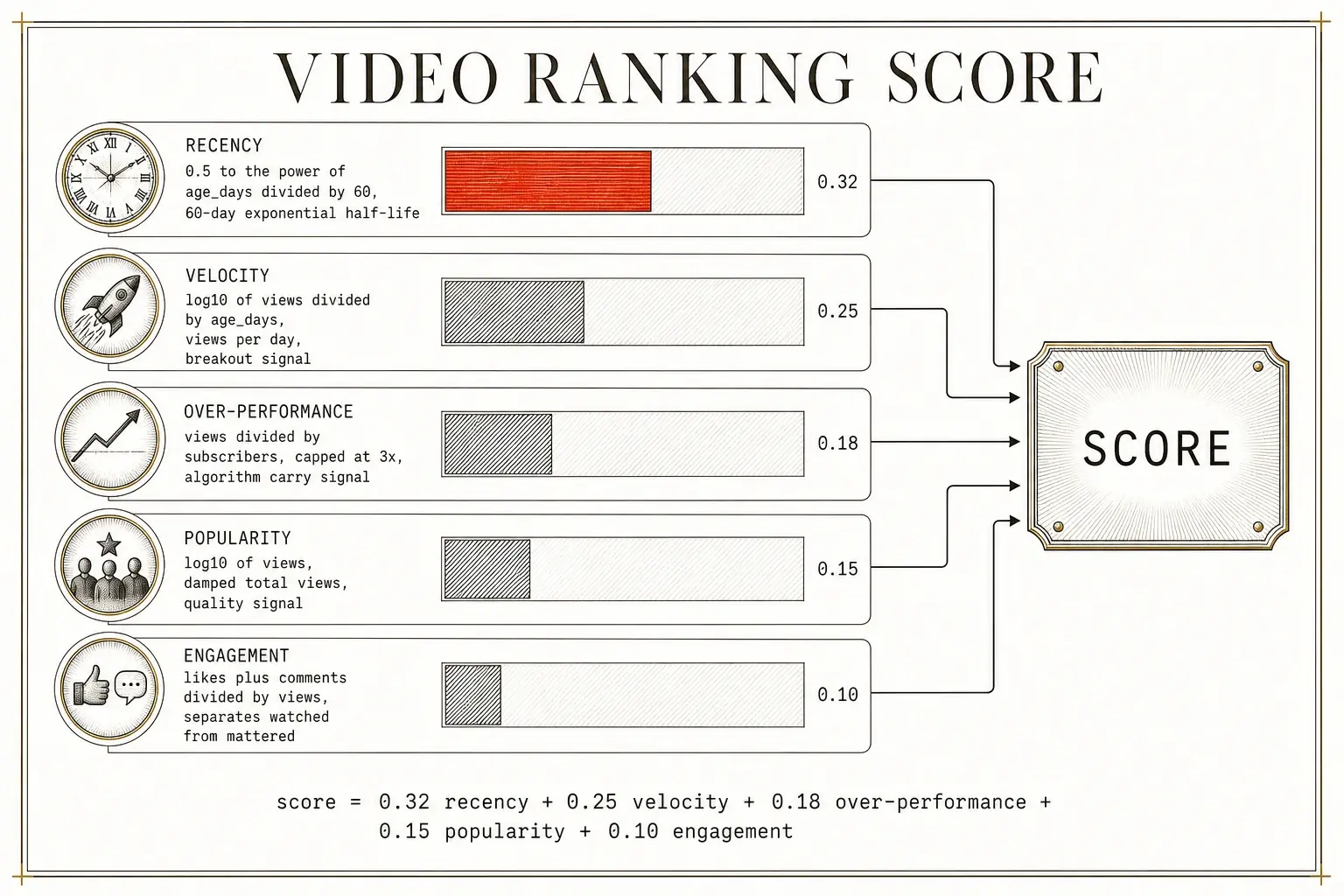
| Lever | Formula | Why it's there |
|---|---|---|
| Recency | 0.5 ^ (age_days / 60) |
exponential decay, 60-day half-life, makes it recency-aware, not recency-filtered |
| Velocity | log10(views / age_days), normalized |
views per day, the breakout signal |
| Over-performance | views / subscribers, capped at 3× |
beating your own audience means the algorithm carried you, demotes a big channel coasting on inertia |
| Popularity | log10(views), normalized |
damped total views, a quality signal, not the driver |
| Engagement | (likes + comments) / views |
separates "watched" from "mattered" |
The default blend is 0.32·recency + 0.25·velocity + 0.18·over-performance + 0.15·popularity + 0.10·engagement. Velocity, recency, and over-performance together carry 0.75 of the weight, they surface the fresh, genuinely-good winners, popularity and engagement hold the rest.
Notice what over-performance is really doing: it refuses to be impressed by a big number that a big audience explains on its own. Apply the same correction to the people teaching this and most of the field thins out fast, which is the whole method behind reading a creator's claims and their paid community honestly. A result you cannot divide by the audience that produced it is not a result yet.
The over-performance lever is the quiet hero: it pulls a 12k-subscriber channel's 40k-view sleeper up next to a household name's latest upload, because 40k views on 12k subs means the algorithm carried it well past the people already going to watch.
Apply hard filters first, so the score only ranks things already worth ranking. Then tune two knobs, because they reshape the entire result, the recency half-life and the max-age gate:
flowchart TD
  F["Hard filters first"] --> SC["Score: 5 weighted signals"]
  SC --> CAP["Cap each channel (default 3)"]
  CAP --> T["Fetch transcripts for the winners only"]
Finally, cap each channel (default 3) after scoring, so one prolific creator can't flood the page. The point of all of it is efficiency: rank cheaply on metadata alone, then fetch transcripts for the winners only. You read the right three instead of skimming thirty.
CH.09
Does the money actually show up?
Production costs cents, break-even can cost a year or two of your life, and Shorts barely pay at all. If you're a builder with something to sell, that math stops mattering, the video is a funnel, not a product, and one right viewer beats ten thousand passive ones.
The revenue split nobody mentions in the demos (figures are platform-reported ranges):
| Long-form | Shorts | |
|---|---|---|
| Revenue share | 55% of ad revenue | 45% of a pool (after music licensing) |
| RPM | $3–20 and up | $0.01–0.20 |
| Counts toward the 4,000-watch-hour bar | yes | no |
A 100×-to-1000× gap, which means one long-form video can earn what 10 viral Shorts do, and Shorts watch time doesn't even count toward the 1,000-subscriber, 4,000-hour monetization threshold, so you can rack up millions of Shorts views and still not qualify.4445
The death valley is the real enemy:
- the faceless success rate is about 3 percent
- most who ever monetize do it in months 7 to 10
- most who quit do so in months 4 to 6, which look identical to the unpaid months before them46
The ledgers are unforgiving:
- One creator spent $26,311 over 150 days and earned $15,218, a roughly $11,000 net loss despite 1.4 million views.47
- An audit found a channel earning $93.86 a month, an effective $3.20 an hour.48
- 80 to 90 percent of one course's students quit before month 12, because this is "managing a small media company," not passive income.49
The most-upvoted honesty on the topic: "Month 1 you will probably make nothing. Like actually nothing. Most people have already quit by then."50
So why do it? Because for a builder the goal was never AdSense, and the bar drops through the floor when traffic is the target. A solo builder mapped the Epstein files and hit 4.4 million views with $14,000 in donations in 48 hours.51 The attribution data quietly destroys the view-count obsession: one creator's UTM tracking showed TikTok drove 80 percent of sales though Instagram got more views.52 And the owned audience is the asset that survives an algorithm change:
- a newsletter subscriber is worth $5.23–7.26 a year against $1.52–2.45 for a YouTube subscriber
- email returns $36–68 per dollar against $2.80 for social
- switching a lead magnet from an ebook to a Notion template moved one builder's opt-in rate from 11 percent to 41 percent, because the people opting in were actually trying to do something5354
CH.10
Where to start, and the one thing to carry out
Don't flip to full autonomy on day one, and don't wait for perfect. Ship semi-manual, tighten the gates, hand the pipeline more rope as each one proves out, and budget for the valley, because almost everyone quits right before it pays.
Budget three to six months of semi-manual work to build the SOPs first, after which the payoff shows up two ways:
- one AI workflow cut a 285-hour, 20-video month to 7 or 8 hours, a 97 percent reduction55
- the system itself becomes content: documenting the build is an angle almost nobody shows, and a consultancy reports that 19 evergreen how-to videos published in one sprint had, two years later, hundreds of thousands of views and a large attributed lifetime value with no paid traffic (its own marketing case study, so read the exact figures as a vendor claim)56
Before, effort meant standing in front of a camera and grinding a timeline by hand. After, it means owning the depth on the way in and the craft on the way out, and gating everything between. The factory is cheap to run and genuinely fast at the mechanical middle. It has two stations you can never leave empty:
- the editorial judgment going in
- the QA catching the green-badge lie going out
Take a human off either one and you don't get a hands-off business, you get a channel the platform quietly demonetizes, the slop outcome this whole note is built to avoid. Automate the factory. Don't automate the author. In a feed full of channels pretending to be more than a scrape and a flat voice, that honesty is the rarest thing you can ship.
Sources · 57
Sources
-
What changes in YouTube monetization policy creators can expect in 2026 (milx.app), corroborated by Faceless YouTube in 2026 (vibedna.ai) and Why YouTube is cracking down on AI content in 2026 (scalelab.com) ↩
-
Psychological mechanisms linking AI hallucinations to user trust, PLS-SEM study of 408 participants (frontiersin.org) ↩
-
25 AI Tools for Content Creators in 2026 (createswowtech.com) ↩
-
5 People Making $10K+/Month With AI Video (aivideobootcamp.com) ↩ ↩2
-
FFmpeg Documentation and Combine one image + one audio file into a video using FFmpeg (superuser.com) ↩ ↩2
-
Building a Video Transcription Pipeline with Prefect and Nebius AI (rup12.net) ↩
-
Faceless YouTube Automation (faceless.my) and Build vs Buy (productschool.com) ↩
-
The AI Video Market After Sora: Runway, Kling, Veo 2026 (digitalapplied.com) and AI video generation reshaping creation in 2026 (cloud.tencent.com) ↩
-
Best Video Generation AI Models (pinggy.io), against OpenAI developer pricing (still listing live Sora 2 tiers as of 2026-06-22) ↩
-
YouTube monetization policy update, July 15 2025 (support.google.com) ↩
-
The Faceless YouTube Playbook Just Broke: What YouTube's 2026 Inauthentic Content Policy Says (medium.com) ↩
-
Reused Content on YouTube: Why Even Safe Channels Are Getting Flagged in 2026 (pingnetwork.in) ↩
-
Ian Ilano TV demonetized for "inauthentic content" (old.reddit.com r/cyberpunkred) ↩
-
Disclosing altered or synthetic content (support.google.com), Improving AI labels for viewers and creators (blog.youtube), and AI-generated video monetization policies (vexub.com) ↩
-
Can AI Music Get Copyright Claimed on YouTube? (undetectr.com) and Algorithmic (In)Tolerance: Beethoven on social platforms (transactions.ismir.net) ↩
-
YouTube Shorts and Long-Form Video Strategy: the complete 2026 guide (influenceflow.io) ↩
-
YouTube AI Content Monetization Policy 2026 Explained (lastplaydistro.com) ↩ ↩2
-
Our Videos Silently Failed for a Week: How a Stale Env Var Cost Us $60 and 12 Unhappy Users (dev.to / kazutaka) ↩
-
I Added AI Video Clips to My SaaS and It Broke Everything 5 Times (dev.to / kazutaka) ↩
-
Automated YouTube Video Scheduling and AI Metadata Generation (n8n.io workflow 3900) and Topics (nolongerset.com) ↩
-
Schedule and Auto-Post Videos to Instagram, LinkedIn and TikTok (n8n.io workflow 9786) ↩
-
YouTube to Shorts Pipeline: Real 2026 Workflow Guide (autoclip.dev) ↩
-
Research to Video for Academics (x-pilot.ai) and PaperTok, CHI 2026 (arxiv.org) ↩
-
Omar Kamel, My YouTube Editor Is a Claude Instance (omarkamel.com) ↩
-
I help small businesses with content (old.reddit.com r/NavigateMarketing) and Affiliate Marketing Statistics (optinmonster.com) ↩
-
Daniel Stenberg (curl) on banning AI-slop reports + 22 real AI-assisted fixes (simonwillison.net) ↩
-
YouTube Shorts and Long-Form Strategy Guide (influenceflow.io) and Long-Form vs Short-Form Video (posteverywhere.ai) ↩
-
5 People Making $10K+/Month With AI Video (aivideobootcamp.com) ↩
-
I mapped every connection in the Epstein files (old.reddit.com r/Epstein) ↩
-
Email List Building with Faceless Content (virvid.ai) and Affiliate Marketing Statistics (optinmonster.com) ↩
-
I built a 4,200-person email list selling digital products (old.reddit.com r/DigitalProductSellers) ↩
-
Full-Pipeline YouTube Video Automation (vidno.ai), Faceless YouTube Automation (faceless.my), and How Faceless YouTube Channels Make Money in 2026 (clippie.ai) ↩
-
Our Video Flywheel Lead Generation System (crotoncontent.com) ↩