Monetization & offers — 2026-06-27PUBLIC
How to package and price an AI automation service that clients actually pay for
Selling AI automation means selling the elimination of expensive manual labour, not intelligence. This field guide covers which boring offers close, how to pick a niche, validate by hand before building, price against ROI instead of hours, land first clients, and scale from gig to real business.
≈ 29 min read
Two ordinary businesses, two boring leaks:
- An accounting firm somewhere is paying a person to retype roughly two hundred invoices a week from PDFs into spreadsheets. Fifty hours, every week, moving numbers from one box to another. Run the arithmetic and that drudgery costs about $78,000 a year in wages.
- A heating-and-cooling company a few miles away misses twenty-odd calls every weekend. Each one is a homeowner with a dead furnace who just dialed the next name on the list.
Neither owner wakes up wanting "AI." One wants the retyping to stop. The other wants the phone answered. That gap (between what AI can do and what a busy founder, dentist, or e-commerce operator knows how to ask for) is the entire business. The money right now isn't in intelligence. It's in plumbing. The unglamorous, deeply boring operational leaks that cost real businesses real money every single day.
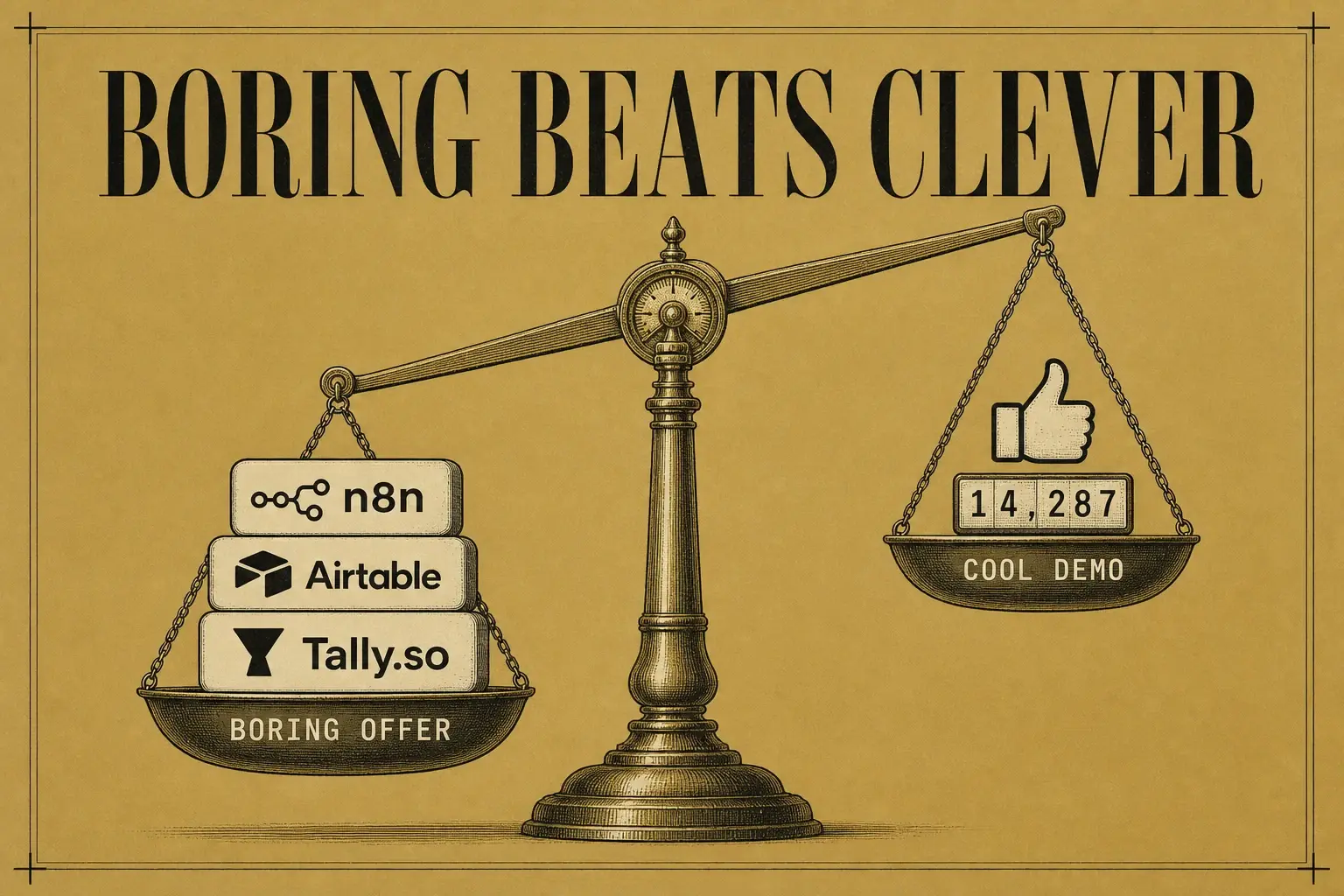
Cool demos collect upvotes. Boring offers collect wire transfers.
This is how to find offers that pass that filter, validate them without building anything, build them so they don't break, price them against the labour they replace, and turn one-off builds into something durable.
CH.01
Why do boring offers beat clever AI?
The operators making real money are not selling intelligence. They are selling the elimination of expensive, repetitive work to businesses that already know they have the problem. The qualifying question for any offer is whether the client can see, in concrete terms, that the system pays for itself. If yes, you have an offer. If no, you have a feature, and features don't close.
flowchart TD
    A["Client buys your build"] --> B{"What did they think they bought?"}
    B -->|"Software"| C["Compares it to cheap SaaS"]
    C --> D["Churns when a cheaper tool appears"]
    B -->|"A replaced labour cost"| E["Compares it to the expensive employee"]
    E --> F["Stays: the alternative is hiring the work back"]
The strategic move is to stop competing in the software market and compete in the labour market instead. Software is crowded and price-compressed. A buyer can find something close to your build for a fraction of the price, and the week a cheaper tool appears they churn. The labour market behaves differently. Businesses pay large, predictable amounts every month for people who do repetitive, structured, time-sensitive work, so when an automation does that work faster and cheaper, the client's reference point is not the cheap monthly SaaS. It's the expensive employee, or the deal that died because nobody followed up. A client who thinks they bought software leaves. A client who understands they replaced a labour cost stays, because the alternative is hiring the work back.
You are also paid for the knowledge gap.
- The field cites a "61-point skill gap": around 86% of CEOs say their staff have AI skills against roughly 25% of staff who actually use AI day to day (creator-reported survey figures, treat the exact numbers as directional, but the shape is real).
- Your buyer is a small business, often 5–500 employees and $500K–$10M in revenue, in an industry quiet enough that the big consultancies ignore it.
- Small and mid-sized firms are reported to make up around 62% of US jobs (creator-reported, directional).
They know AI matters, lack the time to learn it, and have nobody selling to them. The gap is widest there, and the gap is your margin.
There's a sharper way to say all of this, and it's the one defensible idea in the whole field: people sell the hammer, not the house. Sell "AI writing" and you compete with every free chatbot user alive. Sell prompts and you sell a commodity the models now generate themselves. The trap is selling inputs (hours, tokens, prompts) instead of outputs (booked calls, recovered revenue, a report that writes itself). Technical capability has collapsed as a barrier. It is no longer the moat. Orchestration and packaging are.
CH.02
Which automations do businesses actually pay for?
The offers that close are unglamorous and repeatable. The AI is invisible, the outcome is the whole pitch, and in every one the client can already name the cost the automation kills.
| Offer | What it kills | The anchor the client already counts |
|---|---|---|
| Speed-to-lead voice / form agent | Slow replies that land after the prospect picked a competitor | Lost deals per month |
| Document & invoice processing | Staff hours retyping PDFs into spreadsheets | Staff hours + error-correction cost |
| Follow-up & nurture | Deals that die because nobody made the 3rd–7th contact | Unworked contacts sitting in the CRM |
| Lead reactivation | A dormant contact list nobody is working | Booked appointments, no new ad spend |
| Missed-call recovery / AI receptionist | Calls ringing out to voicemail at a phone-booked business | Average job value × missed calls per month |
| Review management | The owner drafting review replies at midnight | Reputation upkeep hours |
| Internal reporting & dashboards | Staff compiling weekly numbers from several systems | Pure overhead (often no model needed, just clean data plumbing) |
| Risk & governance audit | Non-compliance exposure against emerging rules like the EU AI Act | Cost of non-compliance, not a cheaper tool |
That right-hand column is the whole table. Read 1,560 live marketplace listings with real budgets attached and the same pattern comes back with numbers on it: the postings that name a price name a cost the buyer already funds, and the ones selling the technology itself sit unfilled.
The first row is the one I have actually built and shipped. Leadline is a speed-to-lead system running in production that answers, qualifies and books a new lead in seconds. It does four things, in order:
- answers a web-form or email lead in seconds, before the prospect has moved on
- qualifies it in conversation, scored against the business's own definition of a good lead
- books the good ones straight into a calendar and pings a human the moment a hot one lands
- writes every message, decision and timestamp into a per-lead audit record
The first real production lead got a context-aware answer in 16.98 seconds, measured server-side from logged timestamps. That is one lead, not a benchmark, and worth exactly what a sample of one is worth. What it does prove is the shape of the pitch: the client counts lost deals per month, the system moves that number, and nobody in the room has to care which model is underneath.
Most practitioners narrow this to three or four they sell repeatedly. @0xTria runs a solo agency on exactly three:
- Lead generation (scrape, qualify, outreach).
- Internal knowledge bases (turning docs into searchable memory).
- Support automation (handling repeat tickets).
Three categories where businesses already have budget, pain, and a low bar for "better than what we have now." His reported take is $10–15K/month. The honest read: lead gen and support automation sell easiest because the ROI is arithmetic ("we saved 40 hours/month = $6,400 in labor costs"). Knowledge bases are harder until a key employee quits and the institutional memory walks out the door.
The cases operators report, with the dollar figures creator-reported and directional:
- A $4,500 deal with an HVAC business missing 20-plus calls every weekend, where the agent answers, qualifies, and books around the clock.
- An accounting firm where the automation compresses 15 minutes of invoice drudgery into a 2-minute human verification. It doesn't replace the person, it replaces the slog.
- A dentist in Polanco, where @SolaraAi77792 deployed via WhatsApp Business and the agent booked 4 appointments and handled 8 consultations over a weekend while the office was offline.
- A $12,000 AI concierge for a membership business.
The pattern never changes: replace an intern's repetitive work at a fraction of the cost while keeping perfect history.
Honest read on the marketing. The categories are sound and the mechanism is real. These are genuinely repetitive, structured, high-frequency tasks. The numbers are where to keep your guard up. The classic "reply in 5 minutes vs 30 raises contact likelihood ~10x and qualification ~21x" figure predates LLMs by a decade and gets recycled as if it were new. Use these stats to size the pain in a conversation. Never promise a client an outcome you haven't reproduced yourself.
CH.03
How do you pick a niche worth selling to?
Niche choice is the highest-impact early decision. Pick on three axes (large deal size, high pain density, low technical sophistication) then segment until it feels almost uncomfortably narrow.
- Large deal size means revenue per transaction is high enough that improving one part of the conversion process has an outsized effect. A law firm billing thousands per engagement, a car dealership, an insurance broker earning commission per policy. These buyers absorb setup fees because the math on even marginal improvement is obvious. A restaurant selling low-ticket meals can't.
- High pain density means the problem is expensive, obvious, and already acknowledged. You shouldn't have to convince anyone it exists.
- Low technical sophistication shortens the sale: a buyer who can't interrogate your implementation evaluates it by whether it works, which moves the conversation from architecture to outcomes.
The discipline that separates a niche from a category is ruthless segmentation. "Restaurants" is not a niche. "Cantonese restaurants in Austin" is barely one. In crowded categories the field claims 20–50 AI tools already chase each industry, so going small is the only moat a newcomer has. One test before you commit: can you reach a meaningful pool of realistic prospects through cold outreach inside 30 days? If the niche is too narrow, too fragmented, or too hard to find, your go-to-market becomes the problem even when the offer is good.
Then commit.
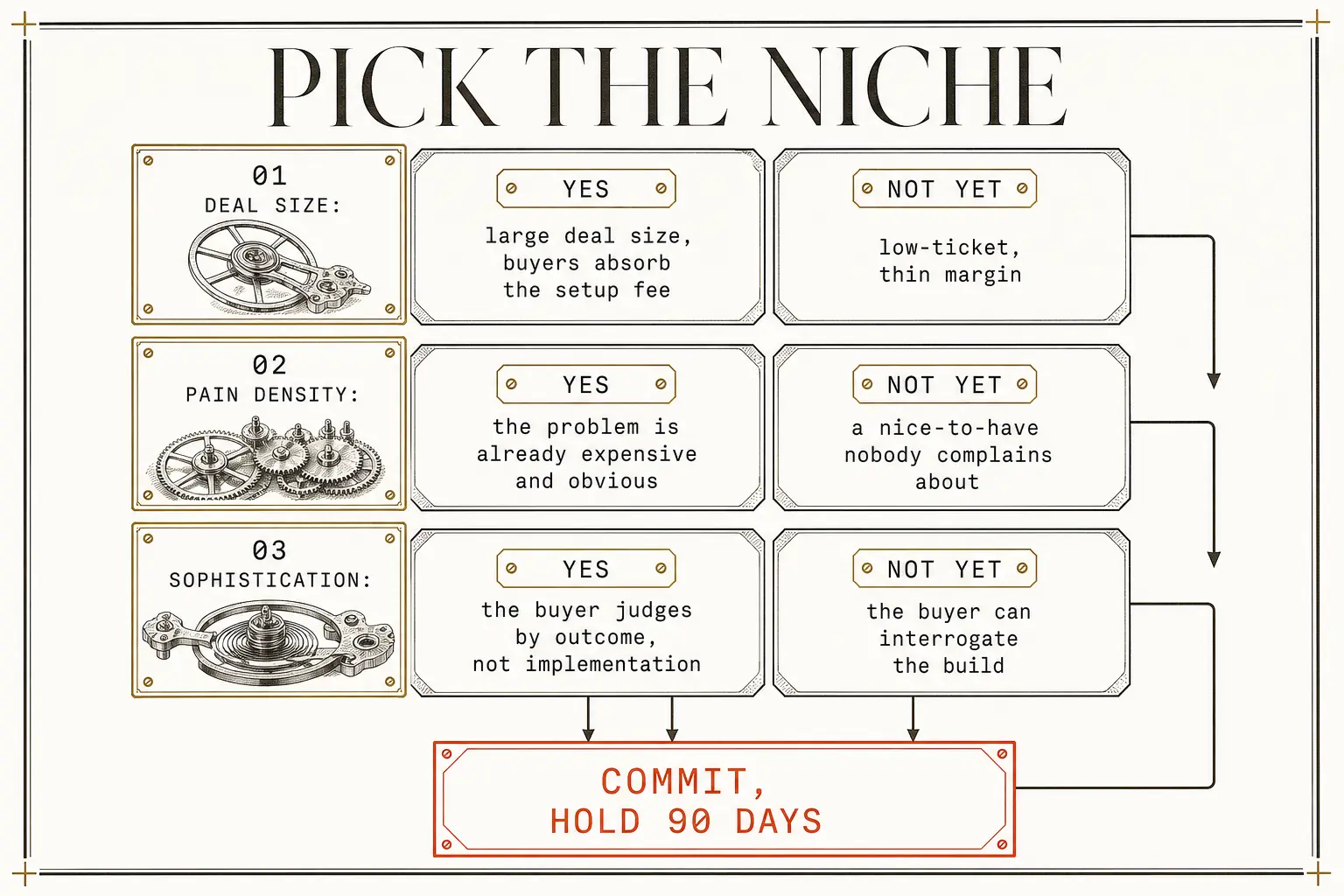
The 90-day rule: pick one niche and one offer and hold for 90 days before evaluating a pivot. Switching early is the single most common reason operators never gain traction. Referrals, case studies, and outreach all compound inside a niche, and none of it compounds if you move every three weeks. The people still at zero a year in are almost always the ones who jumped methods every fortnight.
A short avoid-list:
- Restaurants.
- Small e-commerce without meaningful revenue.
- Hobby creators.
- Any business without a calendar-based workflow.
The labour cost being replaced is too low to price high enough to justify the sales effort. Choosing a niche by personal interest rather than willingness to pay is a quieter version of the same mistake. The buyers who work are the boring ones (HVAC, dental, real estate, insurance, med-spas) where owners feel acute pain from missed calls, slow follow-up, or manual data entry but have zero technical sophistication and no time to fix it.
CH.04
How do you validate demand before building anything?
Validate the value before you write a line of code, by delivering the result by hand first. Most beginners fail the same way: they design an interface, wire a database, then go hunting for a buyer. Reverse it.
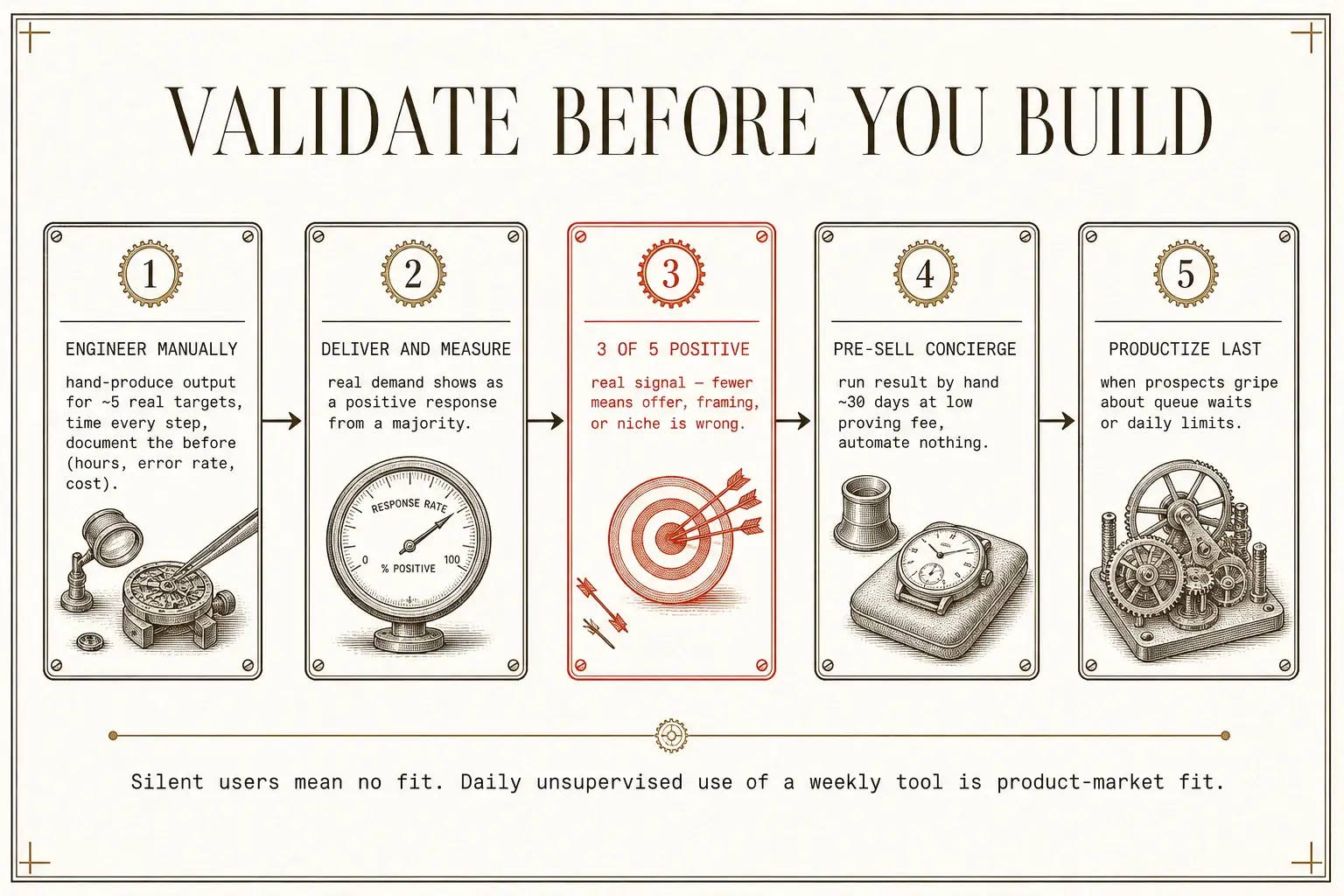
The mechanism has a name: the Engineered Result. Instead of building software, you use AI off-screen to hand-produce the final output (a researched lead list, a batch of qualifying emails, a set of review replies, extracted invoice data) and deliver it directly to the prospect. You're testing whether the outcome is valued, not whether the interface works. A founder behind a clipping tool reportedly validated demand by editing clips by hand and emailing them to prospects, getting "more than 60% positive feedback" before building anything. That single move de-risks the whole venture.
The sequence:
- Engineer the result manually. Hand-produce the output for around five real targets and time every step. Document the "before" state: hours, error rate, cost.
- Deliver and measure. Real demand shows as a positive response from a majority. Three of five responding positively is real signal. Fewer means the offer, framing, or niche is wrong, and you learned it in a week, not a quarter.
- Pass the short-explanation test. "We book missed calls automatically for trades businesses" passes. "We use AI to streamline your communication and operational workflows" does not. If you can't compress it to a sentence the buyer repeats back, the positioning isn't sharp enough to close fast.
- Pre-sell the concierge. Run the result by hand for roughly 30 days at a low proving fee (say $500), customising manually and proving a real transaction while automating nothing. This is where you discover the true edge cases, the real budget threshold, and the real value. You pay for those requirements with your own labour instead of guessing at them in code.
- Listen for the good complaints, then productize. When prospects start griping about queue waits or daily limits, that's product-market fit shouting. They want more than your hands can deliver. Silent users mean no fit. Productize last. Doing it first is the most common way people fail.
The harder version of "validate" comes from the build-in-public crowd, and it's the highest-signal test there is. @davide_losso_: "I stopped asking for opinions and started asking for deposits. The answers got a lot more honest." Before you build the full thing, offer early access at 50–70% off. If nobody will pre-pay at a steep discount, they won't pay full price. @DeRonin_ lists pre-payments as a non-negotiable step too. @_Khushi23 puts the demo discipline plainly: "Always build a working demo before pitching." And @WasimShips gives the cheapest gut-check of all: if you can't articulate the problem clearly enough for a landing page, you don't understand it well enough to build the solution.
Before you scope anything, run @dashboardlim's four discovery questions:
- Where does the time actually go?
- Who needs to see this?
- What happens when it breaks?
- What does "done" look like?
If the client can't answer the last one, the project will bleed scope creep and you'll eat the cost.
CH.05
What do you actually build, and why does workflow beat agent?
When you finally write code, the make-or-break call is workflow versus agent. Most offers that print money are deterministic logic wearing an AI costume. Keep them that way.
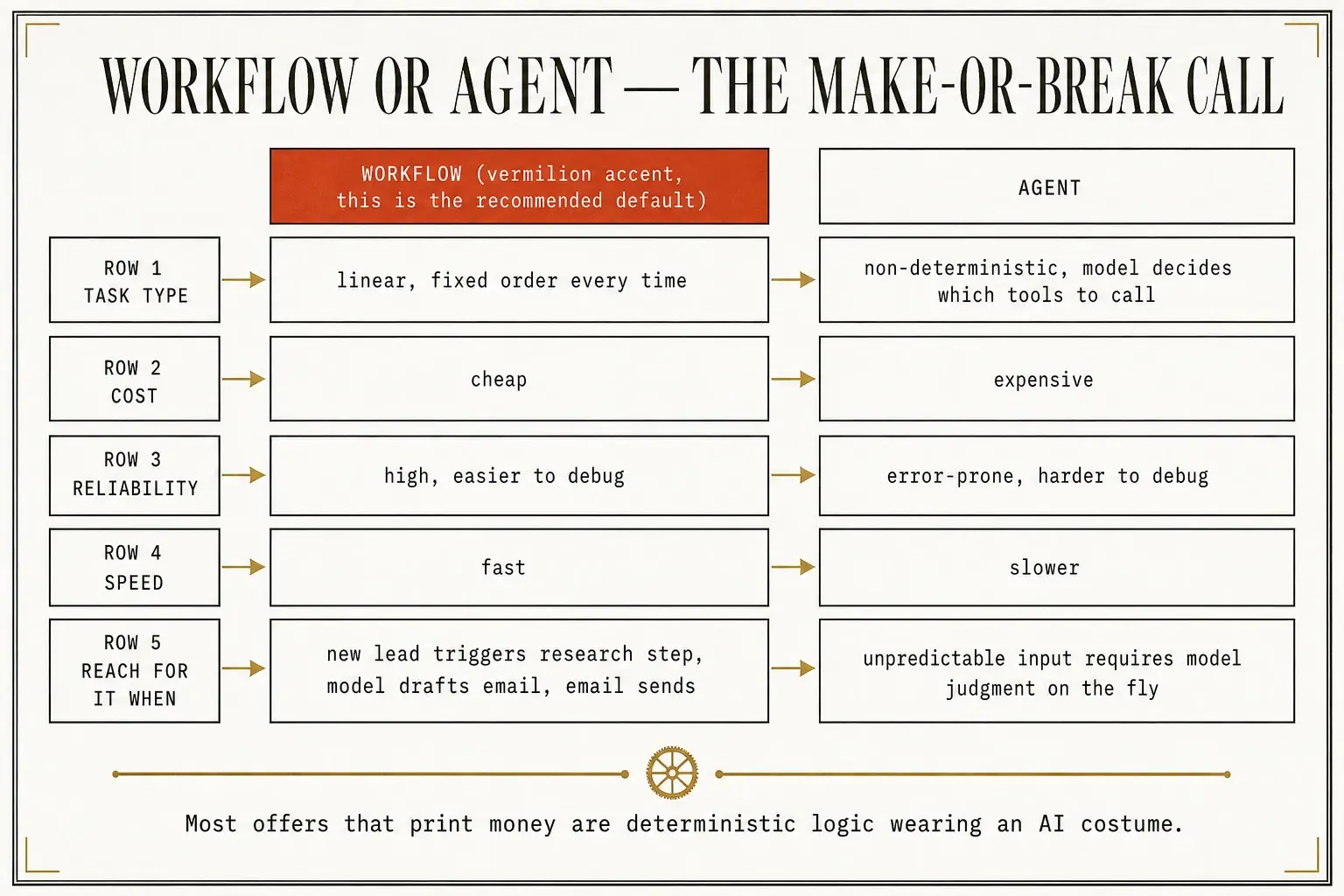
Use a workflow for linear, sequential processes where the steps run in a fixed order every time: a new HubSpot lead triggers a Perplexity research step, a model drafts an email, the email sends. Workflows are more reliable, cheaper, and far easier to debug. Reserve an agent for genuinely non-deterministic tasks where a model must decide on the fly which tools to call from unpredictable input. Agents are slower, pricier, more error-prone. The most expensive beginner mistake is reaching for an autonomous agent when a deterministic workflow is what the job needs.
The MVP is rarely a full application. It's a single workflow, a Slack or Discord integration, or a bot inside a tool the client already uses. Low-friction surfaces let you focus on reliability and save interface polish for later. The artifact the field keeps converging on is the lead qualifier, assembled in an afternoon:
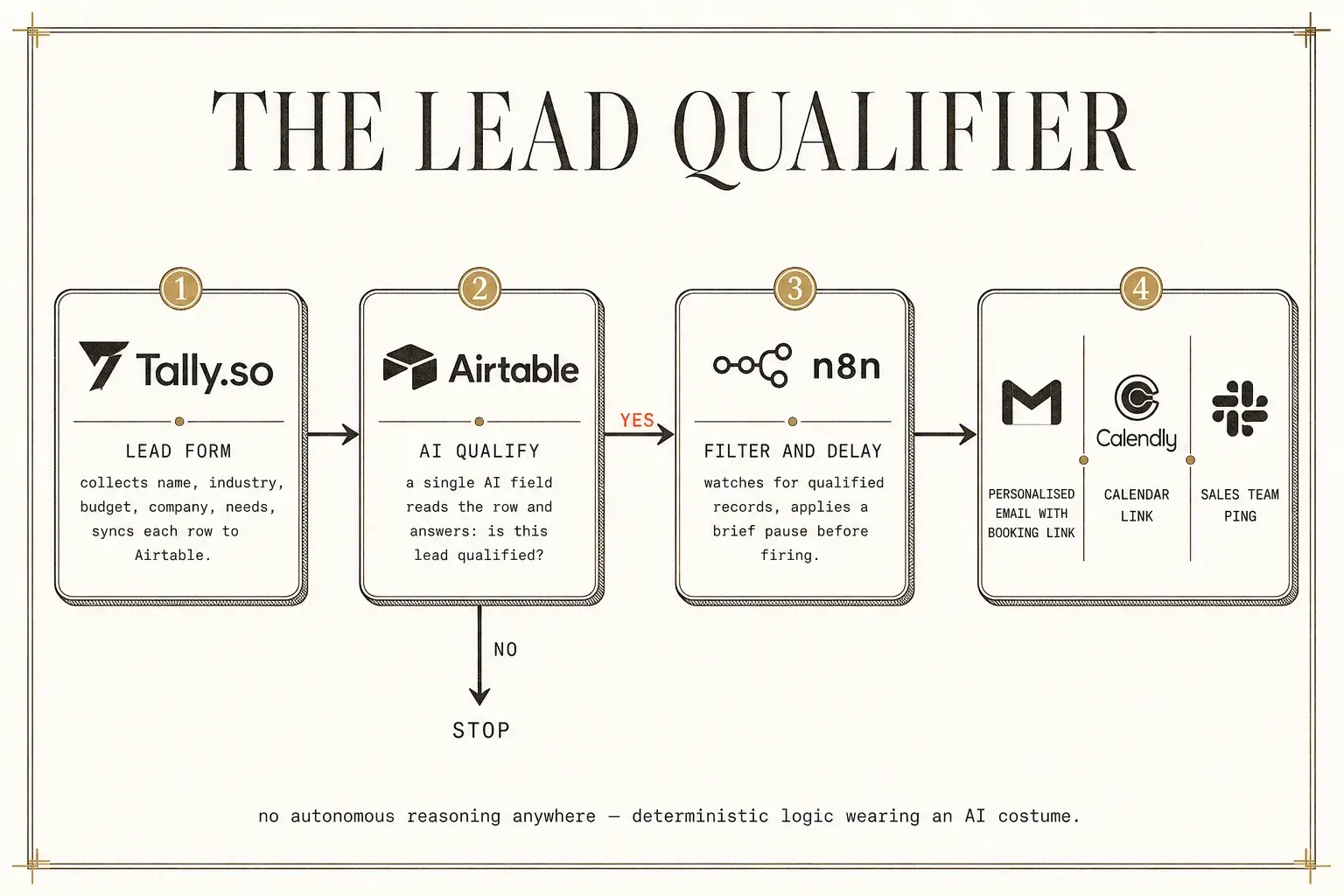
- Trigger. A Tally form collects lead details (name, industry, budget, company, needs) and each submission syncs to an Airtable row.
- Intelligence layer. Airtable's built-in AI field reads the row and answers one dumb question: is this lead qualified? Two small touches matter more than the model.
- Filter and action. n8n or Make watches for new records, filters on
qualified, and only then fires a Gmail node with a personalised Calendly link plus a Slack ping to the sales team.
That single workflow reportedly displaces 2–3 hours of sales-development work a day, with no autonomous reasoning anywhere in it. Run the loop manually across a few clients first (form to spreadsheet to a hand-written qualifying email) and rebuild it as the automated version only once the manual loop runs clean.
On tooling, the field's default for serious work is n8n over Make and Zapier, for stated reasons: it's model-agnostic (swap between OpenAI, Anthropic, or local Ollama), allows native JavaScript in any field, claims 15–25x more integrations, and is free when self-hosted. That's roughly $5–10/month on a VPS against Zapier Team at about $103/month. Make is the friendlier on-ramp for an absolute beginner. The ceiling is lower. The client doesn't care either way. They're buying the booked appointment, not the platform.
| Layer | Tool | Purpose |
|---|---|---|
| Reasoning / LLM | Claude, GPT-4, Kimi K2.6 | Complex reasoning, drafting, classification |
| Automation engine | n8n (self-hosted) | Triggers, filters, actions |
| Voice | ElevenLabs, Retell AI | AI phone agents |
| Database / CRM | Airtable, Google Sheets | Lightweight, client-facing data |
| Scheduling | Cal.com, Calendly | Appointment booking |
| Messaging | Twilio, WhatsApp, iMessage, Slack | Where the client already lives |
| Documents | Gamma, Google Docs | Proposals, audits, deliverables |
Meet clients on the interface they already use, never a new dashboard. And build reliability in from day one. @AiCamila_ prescribes canary deployments and easy rollback plans, while @NeoOpenGPU names the real failure mode: "Most AI agents fail at the boring part. Not the model. The plumbing."
CH.06
What stops a competitor from copying your workflow?
Once these tools scaffold a workflow in minutes, the workflow is not the asset. The moat is distribution, trust, compliance, and a memory layer no competitor can clone.
flowchart TD
    A["A workflow scaffolded in minutes"] --> B{"Wrapped in a moat?"}
    B -->|"No"| C["Runs cold, generic output"]
    C --> D["A competitor copies it"]
    B -->|"Yes: distribution, trust, memory"| E["Output specific to this client"]
    E --> F["Sticky retainer, hard to reproduce"]
The warm relationships, the documented before-and-after proof, the vendor reputation, and the legal infrastructure to handle client data responsibly are what make an operator irreplaceable. The person who understands the business problem, owns the relationship, and can prove the return keeps the account. This game is not a multi-agent arms race. It's a distribution-and-trust arms race.
The memory layer
The single most important delivery mechanism for defending a premium retainer is a persistent memory layer, or context vault. A workflow run cold produces generic output, because the model has no idea who the client is. Wire in a persistent store of the client's brand voice, offers, customer profiles, and past work. Have every step read it on every run, and the output stops being generic.
- @bonsaixyt builds a shared persistent layer so every agent reads from and writes to the same knowledge base.
- @AiCamila_ splits it into short-term, long-term, and episodic memory over a vector DB plus graph.
The same automation a competitor copies in minutes now produces work specific to this client and hard to reproduce without their accumulated context. That's what turns commodity AI work into a sticky retainer.
The second lever: autonomy, not chat
The second lever is the gap between a system that answers and one that completes the action (books the appointment, files the record, sends the follow-up). Autonomy, not chat, is what removes the labour cost the client is paying you to remove. Build the memory layer and the retainer holds. Skip it and you're selling a workflow anyone can clone.
CH.07
How do you price it so clients actually pay?
Price the market value of the outcome, never your hours, never the tokens. The client doesn't care that an output rendered in seconds. They care that they needed it yesterday. Anchoring to your old hourly rate puts you at the bottom of the market by default. As one operator confessed about going too cheap early:
"I anchored on my hourly rate and my proposals were always at the bottom of the market."
The defensible mechanism under every price is ROI. Break down what the process costs the client in time or money, then price against the return. Worked example: a founder's time is worth $50/hour. Your outreach agent saves about 8 hours a month, roughly $400/month. A $1,650 build pays back in about four months and saves around $5,000 over the year. You aren't selling software for $1,650. You're selling a $5,000 return. A speed-to-lead system replaces the work of a roughly $45K/year SDR (illustrative). The field's heuristic is the 5x ROI rule: price so the client gains at least five times your fee in value. If the system saves $10,000/month in payroll, $2,000/month is an easy yes. As @coreyganim puts it:
"Clients will ALWAYS pay MORE for a solution that makes them more money vs. solutions that only save them time."
Three mechanics reinforce the number:
- Tiered anchoring. Offer Starter / Growth / Scale and lead with the Scale anchor so Growth reads as reasonable. The anchor's real job is to stop the client mentally comparing you to a $15/hour freelancer or a $20/hr beginner. @elewachii scaled from $20/hr to $1,000+ minimums exactly this way, with a clean rule: "if $1k isn't worth my time on the project, I'll decline."
- Bundle the tool cost in, silently. Fold software into one clean number rather than itemising it. A confused client doesn't buy. (Your COGS can be tiny: @Sprytixl routes routine tasks to Kimi K2.6 at $0.09 and keeps complex work on Opus at $1.41, and reports replacing $5,280/year in subscriptions with a one-time $1,700 Mac Mini M4 running Ollama.)
- Watch the close-rate signal.
The structural choice that compounds is setup-plus-retainer over project-only. A one-time setup fee funds the build and de-risks the relationship. The retainer compounds month over month. @coreyganim's "AI Chief of Staff" is the cleanest example: $1,500 setup plus $500/month, with the client's only interface being iMessage. It works because it demands zero technical skill: they text "what's on my calendar tomorrow?" and the agent answers. Churn drops to near zero because removing the system means the owner goes back to managing their day by hand.
The directional asking ranges below are what operators target: asking prices and market calibration, not closed-deal data. Numbers-sacred still applies: every figure traces to a source, none are forecasts of what you'll earn.
CH.08
How do you land your first clients?
You can't cold-DM a stranger into a $10,000 transformation. You climb a trust ladder, and the first rung is people who already know your name.
- Warm connections are the base. List friends, former colleagues, and past clients, and reach out plainly: "Hey, I'm doing this AI thing, interested in a chat?" Your first client is worth far more as a specific testimonial than as revenue, so it's often right to deliver it at a reduced rate or free in exchange for documented proof and referrals. A generic testimonial is worth almost nothing in a niche. One that names the buyer type and the concrete outcome is itself a close.
- The content flywheel is the middle. Publishing your real work in public is what manufactures that warm network when you don't have one (the next chapter is the mechanism). One operator, Rory Ridges, reportedly posted simple Make tutorials into his community and generated leads every time he shipped one.
- The "simple agency" is the top. Once you have case studies, pick exactly one service for exactly one niche, deliverable fast and repeatedly. Lead with results, never features: not "I build voice agents" but "we help local home-service businesses win more booked jobs."
- The two-stage QA cycle is the lock-in. Internal QA runs the build against sample and real client data to catch edge cases before the client ever sees them. Client QA then gives the client about a week to test in production. This protects you from the dreaded "it doesn't work" after handover and earns the trust to expand a single automation into a partnership. Hold it with calls roughly every two weeks. Skip the communication and operators report churn around 20–30%, with clients lasting only about three months (creator-reported).
That partnership has a shape. You graduate from educating the client, to consulting on their operations, to implementing across them. Sell that progression only after trust is established, never in the first conversation.
For acquisition at scale, three methods recur. The highest-conversion (and most work per prospect) is Loom cold outreach, the @_Khushi23 method. Where to mine the pain:
- Sales-call transcripts, Clutch reviews, G2 complaints, and Reddit pain posts.
- The YouTube search hack ("[ niche] + Zapier tutorial," read the comments for failures).
- Target companies already spending $5K+/month on tools but still paying VAs for manual work.
The pitch is a 2–4 minute Loom: Problem (30s) → Solution walkthrough (2m) → ROI punch (30s). The money line is "this automation saves 40 hours/month = $6,400 in labor costs," kept raw and unedited to build trust. Subject line: "Built a system that fixes [specific problem]." Embedding the Loom thumbnail in the email reportedly gets 4x the click rate of a plain link.
Then qualify before you ever talk: a Notion doc with system overview, stack, and three use cases, plus a Typeform asking for budget, urgency, current tools, and decision-maker status. Route high-intent to a calendar link, low-intent to nurture.
flowchart TD
    A["Mine the pain: reviews, complaints, Reddit"] --> B["2 to 4 min Loom: problem, walkthrough, ROI"]
    B --> C["Qualify with a Notion doc plus a Typeform"]
    C --> D{"Intent?"}
    D -->|"High"| E["Route to a calendar link"]
    D -->|"Low"| F["Route to nurture"]
The lower-sophistication, faster-cash version is Facebook-group outreach (@elewachii): join automation groups, watch for someone stuck on a broken workflow, DM rather than comment, offer a free 15-minute fix, and have a Google Docs portfolio ready to beat the "no experience" objection. The first person to DM a struggling user often gets the work. The most scalable is preview instead of pitch (@0xTria): build a live working solution the prospect can test immediately, instead of sending a deck.
| Metric | Target | Source |
|---|---|---|
| Audit-to-project conversion | 30–50% | @coreyganim |
| Loom thumbnail click rate | 4x a plain link | @_Khushi23 |
| DM response in groups (if first/fast) | 20–30% | @elewachii |
| First client timeline | 1–2 weeks (aggressive outreach) | multiple |
| Sustainable solo revenue | $10–15K/month | @0xTria |
| Modular system resale | 10x the same core logic | @_Khushi23 |
CH.09
How do you manufacture a warm network?
Building in public is not authenticity, it's top-of-funnel marketing with zero ad spend. The trust ladder above needs people who already recognise your name, and posting your real work in public is how you manufacture them when you start with none. Treat every post as a measurable step in a revenue system, not a feeling shouted into a void. Content that exposes a real struggle (a failed approach, a pivot, a dead end) earns trust. Content that cost you nothing reads as slop.
Cold attention doesn't buy, it climbs. A stranger registers you only after several exposures (the working rule of thumb is around 11 before you land at all, resetting roughly every 90 days, creator-reported and directional), so each post is a rung that earns the next slice of attention:
| Rung | Post type | What it earns |
|---|---|---|
| 1 | Pattern interrupt: surprising, counterintuitive, strikingly framed | The first stop-scroll |
| 2 | Free value: a self-contained, immediately usable insight | The first signal you're worth more attention |
| 3 | Contrast: "don't do X, do Y" | Marks you as someone with a point of view |
| 4 | Perspective: a reframe that resets a common belief | Moves you from useful to trusted |
| 5 | Personal story plus the lesson it taught | Converts trust into a follow, and it can't be faked |
The trap that quietly kills the ladder is selfish content. "I woke up at nine, got a coffee, did Pilates" documents your routine and reaches nobody new. The same material aimed at a reader's problem ("how I protect two focused hours a day while running three projects") earns a stranger. Same footage, opposite outcome. Every post should pay off for someone who has never heard of you.
Deciding who the reader is turns out to be the decision the whole writing machine hangs on, which is why our own note pipeline settles it first and lets everything downstream follow. Answer it late and you get competent posts addressed to nobody.
Grade the climb with two ratios, never likes:
- Followers gained divided by profile visits says whether your bio and pinned post convert a curious click (most profiles sit near 5%, a sharp one pushes toward 20%, creator-reported).
- Followers gained divided by views says whether the content converts a stranger (a Reel above 2% or an X post above 0.5% is working, creator-reported floors).
Views climbing while follows stay flat is the tell that your content is selfish: all reach, no recruitment.
The deeper distribution machinery (the pillar mix, the waterfall that turns one piece into a dozen, the per-platform rules) is its own discipline, covered in the distribution playbook, Where to publish in 2026. The narrow point here is that this ladder is the conversion spine beneath the offer. The trap to avoid is mistaking applause for demand: announce early access at a steep discount and let deposits, not "that's cool" replies, tell you the truth. Build the audience this way and the warm-connections rung that opens the client search stops being a short list of old contacts. It becomes a stream of strangers who already trust you before you ever pitch.
CH.10
How does this grow from a gig into a business?
The business isn't one offer. It's a ladder. Each rung up decouples your time from your revenue. The rule: don't skip rungs. Master the economics of one to fund the next.
flowchart LR
    R1["Rung 1: zero-cost hustle"] --> R2["Rung 2: setup / sprint"]
    R2 --> R3["Rung 3: productized retainer"]
    R3 --> R4["Rung 4: agency"]
    R4 --> R5["Rung 5: product / community"]
| Rung | Model | Pricing (creator-reported) | Operator time per £/$ | Ceiling |
|---|---|---|---|---|
| 1 | Zero-cost hustle | £20–£300 per deliverable | High, linear | Your calendar |
| 2 | Setup / sprint | £500–£15,000 one-off | Medium, front-loaded | Repeat-sale rate |
| 3 | Productized retainer | £300–£5,000/month | Medium → low | Client count |
| 4 | Agency | High-ticket retainers + consulting | Low (team + agents) | Capacity of the system |
| 5 | Productized software / community | $59/mo to product MRR | Very low, compounds | Distribution |
- Rung 1 proves you can deliver and produces your first testimonial: resume rewrites at £75, blog posts at ~£300, a £20 prompt pack, first payment in 5–10 days. It's paid validation, not a destination.
- Rung 2 is where most operators see real revenue: bounded, fixed-price builds the client lacks the time or skill to execute (an "Agent OS Setup" at £3,000–£15,000 with 30-day support, or a launch-week production sprint at £3,000–£10,000).
- Rung 3 is where the economics get interesting, because a monthly fee for a specific recurring outcome decouples revenue from a single transaction. The anchor example is a content retainer of 12 short-form videos, 12 images, and 4 voice clips at £2,000–£5,000/month, or an SEO retainer pitched as "8 ranking articles a month for £600." The load-bearing caveat: this rung only yields high margins if the system does the heavy lifting. Run it like manual work and the margin disappears.
Rung 4 is an agency with a real delivery stack: multiple specialist pods, senior-editor review on AI-scaffolded output, weekly automated dashboards instead of monthly decks. It's held together by the memory layer so quality survives volume. Rung 5 wraps the logic into a standalone product or a tiered community (a free front tier feeding a ~$59/month locked tier). It has the highest ceiling and the highest commitment, and it is explicitly not a beginner move despite how often it's sold as one.
A full per-deliverable rate card from one widely-circulated playbook, as a benchmark (creator-reported GBP list prices, anonymized):
When you do transition to productized software, validate one tier first against a small cohort, then add a second once the market reveals which it wants. Launching three tiers on day one dilutes the sales conversation and delays the learning. And whatever you do, don't collect ten tools and ship with none. Commit to one automation platform and one distribution channel. Add a second channel only once the first is profitable.
CH.11
What does your first 30 days look like, and how do you know it worked?
The first 30 days run a tight loop: validate the niche and the pain by hand, engineer a manual result, pre-sell a concierge version, then rebuild it as automation and ship, with a decision criterion at every step. The automation decision gate runs underneath all of it.
- Week 1: validate the niche and pain. Ask ~20 people in your network who run a small business where work feels manual. Don't pitch. Listen. Pick one offer and one narrow niche, commit for 90 days. Decide: can't name a single offer and niche by week's end → scope is too broad.
- Week 2: engineer a manual result. Hand-produce the output for ~5 targets, deliver it, document the "before" (hours, error rate, cost). Decide: 3 of 5 responding positively is real signal. Fewer means offer, framing, or niche is wrong.
- Week 3: pre-sell the concierge, then price. Run the result by hand for ~30 days at a low proving fee, then convert it into a defined-scope service priced with the 5x ROI rule and anchored high. Verify: a signed proving engagement and a price you can defend against a named cost.
- Week 4: build, sell, verify. With a few paying manual clients funding the tooling, rebuild the loop in n8n or Make, present a Growth package against a Scale anchor, run a consistent daily volume of outreach. Verify: the automated version reproduces the manual result, and the first useful output reaches a new client within 24 hours of onboarding. Fast first value is the strongest defence against early churn.
| Gate question | Why it matters |
|---|---|
| Does the task happen at least weekly? | Low-frequency work never earns back the build |
| Does it take more than ~30 minutes per run? | Below that, the saving is too small to price |
| Is the data structured (forms, spreadsheets, predictable formats)? | Fuzzy inputs make automation brittle |
| Is "success" definable and measurable? | Without a clear done-state you can't prove the return |
If any answer is no, refine the offer or pick a different pain point. Don't force automation onto a task that resists it.
You'll know it landed by three signals, all observable without a dashboard:
- Concrete named savings or recovered revenue: the client points to an "after" number that beats your documented "before."
- The system runs ~30 days without a critical failure. An automation that needs constant hand-holding isn't saving labour, it's moving the labour to you.
- A signed retainer or an unprompted referral, the only two truly reliable signals. An offer precise enough to refer is precise enough to close without a long explanation.
The inverse is your early warning: a client who was enthusiastic in the sales call but barely touches the system after onboarding. Enthusiasm about the concept is not product-market fit. Daily, unsupervised use of a tool you built to be used weekly is.
CH.12
What's hype, and what's substance?
Half of what circulates here is reusable operator craft. Half is funnel engineering wearing the same clothes. Both get sold in the same breath, so separate them deliberately.
What genuinely converts and is worth copying:
- Bounded-scope productized services. The 12/12/4 content retainer converts because the deliverable is concrete and capped. Cap revisions and define deliverables, or margin bleeds out through the revision cycle.
- Real demos over slides. A working system convinces a non-technical buyer in a way a deck never will. Build the stack before you quote.
- The one-channel rule. Add a second outreach channel only once the first is profitable.
- Risk-reversal that doubles as a filter. A "Twin Guarantee" of a 7-day no-questions refund plus a 30-day ROI guarantee, where claiming the ROI refund requires actually implementing the work. It attracts operators and repels tourists.
- Done-for-you workflow vaults. Importable, tagged automations that bypass the blank-canvas problem. Treat them as starting points, not products.
What to discount as hype:
- "Build a SaaS" as a beginner path. It's the highest-commitment, highest-skill rung. Selling it to beginners is the tell.
- Local models for primary client delivery. They still falter on complex multi-step reasoning, tool reliability, and long context. Fine for cheap bulk work, not for the output a client pays a premium for.
- Generic "AI agency" positioning. Generalists lose to specialists every time.
- "Bonus theatre." Long lists of recycled PDFs that impress on a sales page and map to no deployable revenue. A few hundred active builders are worth more than thousands of silent lurkers.
- Communities bought too early, and AI-detection optimization. Premium tiers are only ROI-positive once you're already at scale, and optimizing for third-party AI detectors is wasted effort. As @Goodness065 puts it: "AI doesn't pay you for writing prompts, testing tools, or learning. It pays you when you use it to solve real problems, build systems, and drive income."
The claims of $400K months and zero-headcount companies deserve appropriate skepticism. Every revenue and time-saved figure in this material is self-reported and uncheckable. But the underlying demand is verified by how consistently the same models show up across independent operators: businesses that know they need AI, have budget, and cannot implement it themselves.
The throughline is a discipline, not a tactic. The same skill set that someone says earned £50/hour a couple of years ago now earns the £5,000 retainer, and the delta is not that the model got smarter. It's that the operator stopped selling the hammer and started selling the house: the validated outcome, owned through distribution and trust, defended by a memory layer no competitor can clone.
The accounting firm still has its $78,000 of retyping. The HVAC company still loses jobs to voicemail every weekend. Somebody is going to be the person who makes the bleeding stop, and they won't win by having the cleverest agent. They'll win by being boring, by proving it with their own hands first, and by sending the invoice. Stop selling the robot. Start selling the saved hour. Start boring, start manual, start today.