Platform deep dive — 2026-06-18PUBLIC
Dev.to in 2026: syndication for developer reach and AI citations
Dev.to hands your technical writing a developer-only audience and a domain rated near the top of the web — but one line of frontmatter decides who gets the credit. Set `canonical_url` to your own page and you keep the SEO while Dev.to does the reach; forget it, and its domain rating quietly makes Dev.to the original.
≈ 15 min read
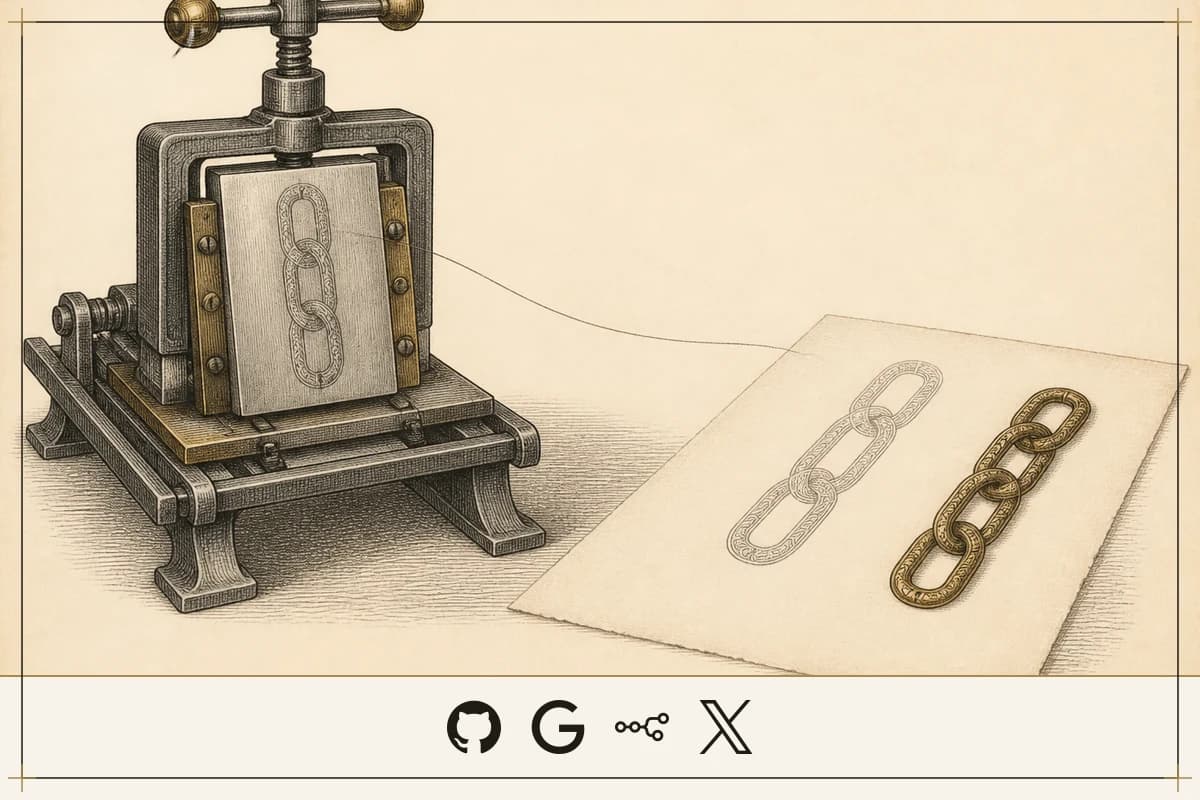
You spend a week on a deep technical write-up. You post the full thing to Dev.to because that's where the developers are, you forget one line of frontmatter, and three weeks later you search for your own title and the result that ranks isn't your site — it's Dev.to. Google picked the copy. Not out of malice; out of arithmetic. Dev.to carries a domain rating reported around 90, and a page with no signal saying otherwise loses to the stronger domain every time. You wrote the original and got filed as the duplicate.
That single line is the whole game on Dev.to, and it's almost trivially easy to get right. This is the deep dive into doing exactly that: full reach on a developer-only platform, the AI-citation surface that comes with a high-authority domain, and your own site keeping every scrap of the SEO credit. (For why you syndicate everywhere with your name attached in the first place, the parent playbook is Where to publish in 2026; this note is only about wringing the most out of Dev.to specifically.)
CONTENTS
CH.01
Does canonical_url actually tell Google your site is the original?
Yes — and it's documented, current, and the single most important field you'll set. Dev.to's editor guide (updated May 2026) lists canonical_url as a first-class frontmatter field, and when it's present Dev.to emits a <link rel="canonical" href="..."> pointing back to your URL. Set it to your pravda.systems page and Google is expected to credit your domain as the original.
The mechanism is plain. Add canonical_url: https://pravda.systems/notes/slug to the frontmatter, and Dev.to writes the canonical link tag into the published page's head. A 2026 Dev.to submission guide spells out the flip side too: skip the field, and Google usually treats Dev.to as the original — precisely because of that stronger domain rating. So the field isn't a nicety. It's the difference between Dev.to working for you and Dev.to quietly outranking you for your own words.
Two caveats decide whether it actually holds:
The canonical target must be a real, indexable page — not a 404, not
noindex. A canonical pointing at a page Google can't crawl is a canonical Google ignores.
And the cost of getting it wrong is concrete, not theoretical: forget or misconfigure it, and Dev.to's domain rating means it will likely outrank your site for that note. Blog-first, full cross-post, canonical set — that's still the safest play in 2026, and the order matters. Publish on your own site first so yours is the page that's been the original all along.
CH.02
What does Dev.to actually reward in 2026?
Early engagement above everything. Reactions and real comments in the first hour or two heavily influence whether your post surfaces in the "Relevant" feed — and a post that lands silent gets buried no matter how good it is. Dwell time, readable structure, and useful code do the rest.
Dev.to doesn't publish a formal ranking spec, so this is evidence-based inference from the platform's own guidance and repeated 2025–2026 playbooks — not a leaked formula. But the signals point the same way consistently enough to plan around:
| Signal | Reported importance | Why it matters |
|---|---|---|
| Early comments and replies | High | Tells the system the post started a conversation |
| Genuine reactions / upvotes | High | Indicates value and relevance |
| Dwell time / reading depth | High | Long, useful reads keep readers on the page |
| Formatting clarity | High | Good structure cuts bounce, lifts completion |
| Shares / external distribution | Medium | Seeds the initial off-platform momentum |
| Saves / bookmarks | Medium | The evergreen-utility signal — strong for technical posts |
The practical reading: a technical post earns its reach by being immediately useful enough to comment on, not by being clever.
CH.03
Which of your topics land with Dev.to's developers?
The hands-on, failure-mode, code-and-logs stuff. Dev.to is a developer community — "Medium for devs" — read by front-end, back-end, DevOps and AI engineers, and it rewards posts that solve a concrete problem. Business-only and generic AI-tool listicles underperform and get downvoted.
Mapped onto what you actually build:
- Agentic / multi-agent engineering — strong fit, but only as a build log. "Here's the pipeline, here's the code, here's the failure mode I hit" outperforms a conceptual piece on agents every time. Tags live around
#ai,#machinelearning,#agents,#llm,#python,#typescript. - n8n and workflow automation — a natural fit when framed as a real problem solved: "using n8n + X to keep Y infra sane." Dev.to leans toward practical debugging and optimization stories, not orchestration theory.
- Infra and operations — the archetypal Dev.to winner is a performance or cost story with a number in the title: "how I cut query time from 2s to 80ms." Your infra-heavy work fits cleanly as long as it stays concrete and code/logs-driven, never product-sales-driven.
The through-line across all three: the post that wins is the one where a reader could follow your steps and reproduce the result. The moment it reads like a pitch, the audience turns on it.
CH.04
Full article or a structured summary?
Post the full article with canonical_url set — for almost everything. Full text on a high-authority developer domain is what maximizes reach, daily.dev pickup, and AI-corpus visibility, and the canonical tag is what makes it SEO-free. Reserve the summary-only pattern for pillar content you genuinely need read on your own site.
The two patterns, and when each one is right:
| Pattern | Use it when | The trade-off |
|---|---|---|
| Full article + canonical | Most technical notes | Maximum reach + citation surface; near-zero SEO risk if canonical is correct |
| Structured summary + "read the full version" link | Pillar pieces, or when you gate a tool/asset | More clicks home; less full text living on Dev.to, so less to be discovered/cited |
For the full version, close with one honest CTA in the footer — something like "Canonical version, live updates, and more agentic-engineering notes at pravda.systems/…" The summary pattern is a deliberate traffic play, not an SEO fix: lead with problem, approach, key results, one or two code excerpts, then send them home for the live diagrams and full code. The mistake to avoid is the worst of both — a thin teaser that starves the Dev.to post of value while pretending to be a real article. Readers feel that instantly, and so does the feed.
One thing the full-vs-summary debate doesn't change: the AI-citation angle is probabilistic, not guaranteed. Dev.to's authority and long-lived, Google-ranking posts make it a high-likelihood source for AI training corpora relative to a small solo blog — but a canonical tag governs search consolidation, not which copy an LLM crawler ingests. The honest assumption is that both copies live, Dev.to points back to you, and that combination maximizes discoverability while preserving your SEO. There's no public guarantee past that, and anyone who promises one is guessing.
CH.05
How many tags, and which ones?
Exactly four, all lowercase, all real Dev.to tags. The cap is four per post; tag one should be a broad high-traffic bucket and tags two through four should narrow the topic. Hype or off-topic tags actively hurt reach — Dev.to folds or flags mismatched tags.
The constraints are hard: maximum four tags, comma-separated in frontmatter, each tag must already exist on Dev.to, and there's a name-length limit around 20 characters, so an over-specific long tag gets rejected. Within that, default tag sets for your clusters:
| Content cluster | Default four tags |
|---|---|
| Agentic systems (Python) | ai, python, agents/llm, automation |
| Agentic systems (TypeScript / web) | ai, javascript, agents/llm, webdev/backend |
| n8n automation in production | automation, n8n, devops, api |
| Infra / performance debugging | backend/devops, cloud/kubernetes/docker, performance, observability |
| Developer tooling / workflow | productivity, devtools, python/javascript, automation |
Before you lock a tag, open its Dev.to tag page and sanity-check two things: that there's real existing activity, and that the community vibe matches your content. Tag ecosystems shift; agents may or may not be an active tag on any given month, which is why the sets above carry an /llm fallback. The rule underneath all of it: tags describe the content honestly, or they cost you reach.
CH.06
How do you get pulled into daily.dev?
You don't apply — you earn it. daily.dev already sources from developer blogging platforms including Dev.to, and it picks up a post only once that post has crossed its internal traction thresholds (upvotes, views). The lever you control is the same one that wins on Dev.to: quality plus early engagement.
daily.dev aggregates from a large set of dev blogs and explicitly treats "developer blogging platforms" as a primary source class, so Dev.to is already a recognized source — there's no separate integration to chase. What gets a specific post promoted is traction: it's more likely to be picked up when it's clearly technical, on a trending topic (AI, agents, infra, performance), and pulling reactions and views early on Dev.to. The same engagement work, paying out twice.
Two practical notes. daily.dev has hundreds of thousands of users and bills itself as a personalized dev feed in the Chrome store, so a pickup meaningfully widens both your developer reach and your odds of AI-training exposure — and it exposes creator features like claiming ownership of your picked-up posts and tracking their analytics. The thing not to do:
Don't spend a minute trying to become a daily.dev "company source." That onboarding path was discontinued — they moved to squads and community-driven sourcing. Focus entirely on making Dev.to posts that earn organic traction, and the aggregation follows.
CH.07
How do you push one markdown file to Dev.to automatically?
Three real patterns, and for your single-markdown-source workflow the API route wins. You write the note once in your repo with full frontmatter, and a script or GitHub Action maps it to Dev.to's fields — canonical_url, tags, series, cover_image — and posts it. You own the canonical behavior end to end.
| Option | Effort | What it is | The catch |
|---|---|---|---|
| A — RSS import | Low | Dev.to's "Publishing from RSS" with "Mark RSS source as canonical URL by default" checked; it uses your feed's <link> as canonical |
Less per-article control over tags/series/covers; you curate the feed so only Dev.to-bound posts flow in |
| B — REST API + your script | Med–High | Dev.to API v1 takes title, body_markdown, tags, series, canonical_url, cover_image, published in a JSON payload |
You own maintenance — rate limiting, error handling |
| C — Multi-destination pipeline | High | One GitHub Actions pipeline fans a single markdown file to Dev.to, Hashnode, Medium and your blog, handling canonical per platform | More moving parts; overkill until you actually want multi-platform |
Option A is the zero-code path: one toggle guarantees consistent canonical behavior, and pravda.systems stays the clear origin. Its weakness is granularity — Dev.to infers tags and covers from the feed, so you'll still hand-edit some posts.
Option B is the recommendation for you, because it fits a Python toolchain and a Git-first workflow and gives you full control of the frontmatter-to-Dev.to mapping — including keeping a post a draft on Dev.to until you flip published: true in Git. The shape of the payload:
{
  "article": {
    "title": "Cross-Posting to Dev.to with API",
    "body_markdown": "Example markdown content",
    "published": false,
    "tags": ["devto", "technical"],
    "series": "Optional Series Name",
    "canonical_url": "https://pravda.systems/notes/slug",
    "cover_image": "https://url-to-cover-image.jpg"
  }
}
And you don't have to build it from scratch — there's tooling to borrow or run as-is:
- publish-devto (GitHub Action, sinedied) — publishes markdown files as Dev.to articles from an API key, reading title/tags/canonical from frontmatter.
- blogpub (GitHub Action) — multi-platform publish to Dev.to and Medium, with explicit
canonicalUrlsupport. - publish-markdown (Python CLI) — publishes a chosen markdown file with a
--canonical-urlflag at publish time. - Dev-CLI / devto-cli — publish markdown files directly, mapping by
canonical_urlor title. - markdown-for-dev.to — normalizes site-specific markdown quirks into Dev.to-friendly
body_markdownbefore you POST.
The sane progression: start with publish-devto or blogpub for the fastest path, graduate to a small Python script wrapped in a GitHub Action when you want full control, and only reach for the multi-destination pipeline once Hashnode and Medium are actually on the table. Keep pravda.systems as canonical at every step.
CH.08
What shape holds a developer reader to the end?
A sharp problem-first hook, four to six tight sections, code placed right next to the explanation that needs it, and a cover image — because covers visibly lift feed clicks. Process narratives beat listicles: "I tried A, it broke, then B, then C" is the format that earns comments and saves.
The structure that performs:
- Hook — one to three sentences. State the real pain point or the measurable result immediately. Cut "In this article I will…"; lead with the number or the failure.
- Context — the stack, the constraints, what broke and why it mattered. Concrete, not abstract.
- Core walkthrough — short subsections with descriptive headings, code blocks and logs and screenshots where they clarify, numbered steps when sequence matters.
- Results / lessons — outcomes, edge cases, what you'd do differently. This is where the reader banks the value.
- One CTA — a single natural link home, after the value is delivered.
On length: Dev.to publishes no official optimal count, but every current guide favors substantial, concrete posts — roughly 1,200–2,500 words for a serious technical note, with the 2026 playbook pointing at 1,500–3,000 for hands-on pieces. If the topic is bigger than that, split it into a series rather than compressing it into one oversized post. The series: frontmatter field groups posts, and a reader who finishes one installment sees the rest — a built-in retention loop for "agentic systems in production" or "n8n in real infra."
Two more mechanics that move numbers. The cover_image field takes a URL and renders the preview; the recommended size is about 1000×420, which Dev.to crops to by default — and posts without a cover get significantly fewer feed clicks than posts with one, titles held equal. And visuals exist to cut cognitive load, not to decorate: architecture diagrams, benchmark tables, a small number of annotated screenshots, each one explained. Short paragraphs, plain headings, code sitting next to the prose that depends on it.
CH.09
What about money — is there any?
None directly, and that's fine because it was never the point. Dev.to is free, not paywalled, with no writer-payment program. Its links are generally nofollow, so it's no backlink farm either. The payout is reach, developer trust, and long-lived posts that rank — top-of-funnel, not a revenue line.
So the monetization model routes entirely through your own site: lead capture on pravda.systems — the newsletter, the consultation, the productized service — fed by Dev.to as the discovery surface. The one edge Dev.to gives you toward money is social proof. A post that performs becomes an "as seen on Dev.to / daily.dev" line, and high-performers earn a place in an "As featured in" strip on your site. Treat Dev.to as the thing that makes a stranger trust you enough to click home. The transaction happens at home.
CH.10
What should you skip?
The moves that either waste your effort or actively damage your own SEO. One of them is the single worst thing you can do on the platform.
- Never post without
canonical_urlwhen the note already lives on pravda.systems. This is the one move that actively harms your blog's ranking — Dev.to becomes the original by default. Non-negotiable. - Skip "Introducing my product / tool" launch posts. Those titles are explicitly called out as underperformers. Reframe as "here's a real problem we solved, and how," with the code in the post.
- Skip raw AI-generated or machine-translated text. Dev.to readers and mods push back hard on obvious AI writing and listicles; anything generated needs a heavy human rewrite before it ships.
- Skip off-topic tags chasing traffic —
#career,#productivitywith no real tie-in. Misaligned tags get flagged and cut your distribution. - Skip the daily.dev "company source" chase — discontinued, as above.
- Don't rephrase your blog intro and call it repurposed. The Dev.to version needs a more direct, developer-first opening and more practical detail than the canonical page — same substance, reshaped for the audience.
CH.11
The full tactic table — effort vs. payoff
Here's every move scored on the five axes that matter for your priorities — developer reach, AI-citation value, and SEO safety, in that order. Heuristics are Low/Med/High, read from the 2025–2026 sources and Dev.to/daily.dev behavior, not from my own measurement.
| Tactic | Effort | Reach | AI-citation value | SEO risk to your site | Audience fit |
|---|---|---|---|---|---|
Blog-first, full cross-post + canonical_url |
Med | High | High | Low (if canonical correct) | High |
| Blog-first, summary-only + canonical | Med | Med | Med | Very low | High |
| RSS import + "mark RSS as canonical" | Low | Med | Med | Low–Med (depends on feed control) | High if feed curated |
| API publish from repo (script / Action) | Med–High | High | High | Low (you control canonical) | High |
| Strong covers + sharp titles | Low | High | Indirect | None | High |
| Organizing posts into a series | Low | Med–High | Indirect | None | High |
| Engaging in the first 1–2h post-publish | Low | High | Indirect | None | High |
| Chasing Dev.to for direct money | Low | Low | Low | None | N/A |
| Posting with no canonical | Low | High (Dev.to ranks) | High (Dev.to visible, you aren't) | High (your blog loses the ranking) | Med |
That last row is the trap drawn in full. It "works" — Dev.to ranks, the content gets seen — but the domain that benefits is Dev.to's, not yours. Every other row keeps the credit at home.
CH.12
Your per-note Dev.to cross-post checklist
One repeatable loop per note: confirm the canonical page is live and indexable, set the four fields in frontmatter, push via your automation, verify the canonical link rendered, then seed and reply. Run it the same way every time and the SEO never leaks.
- On pravda.systems — the note is live at its final URL, indexable (no 404, no
noindex), with its own self-canonical tag pointing at itself (normal good practice). - In your repo frontmatter — set the publish-ready block:
title: ... description: ... tags: ai, python, agents, automation # ≤4, all valid lowercase Dev.to tags canonical_url: https://pravda.systems/notes/slug cover_image: https://pravda.systems/assets/slug-cover.png series: agentic-engineering-in-prod # optional published: true - Push via your chosen path — API/Action sends
body_markdown,tags,canonical_url,series,cover_image,publishedto/api/articles; or, on RSS, confirm the post is in the feed and "Mark RSS source as canonical URL by default" is checked. - Before publish on Dev.to — double-check
canonical_urlis set (the gear icon in the editor, or the frontmatter line), and preview to confirm code blocks render and images load. - Immediately after — share the Dev.to URL where your dev network lives to seed early reactions, and reply to comments with substance for the first hour or two.
- Within a week — check Dev.to analytics (views, reactions) and any daily.dev pickup; if it performed, update the note or write the follow-up.
The whole discipline reduces to one habit: your site goes live first, the canonical line points home, and you spend your human minutes on the launch window and the replies — the two things a script can't do for you. Get that right and Dev.to is pure upside: a developer-only audience, a domain rated near the top of the web echoing your work back with a link, and not one point of SEO lost in the trade.
No comments yet — start the conversation.
Sign in to join the discussion — it's free.