AI infrastructure — 2026-06-18PUBLIC
Owning your AI stack: local inference, sovereign compute, and the open-source tools that replace paid SaaS
Heavy AI users are replacing ~$5,280/year in subscriptions with owned hardware — Mac Mini clusters and a 128GB Ryzen box running Qwen3 235B locally — plus open-source tools like n8n and Vaultwarden. The hardware, the four-layer stack, the security, and the honest break-even.
≈ 23 min read
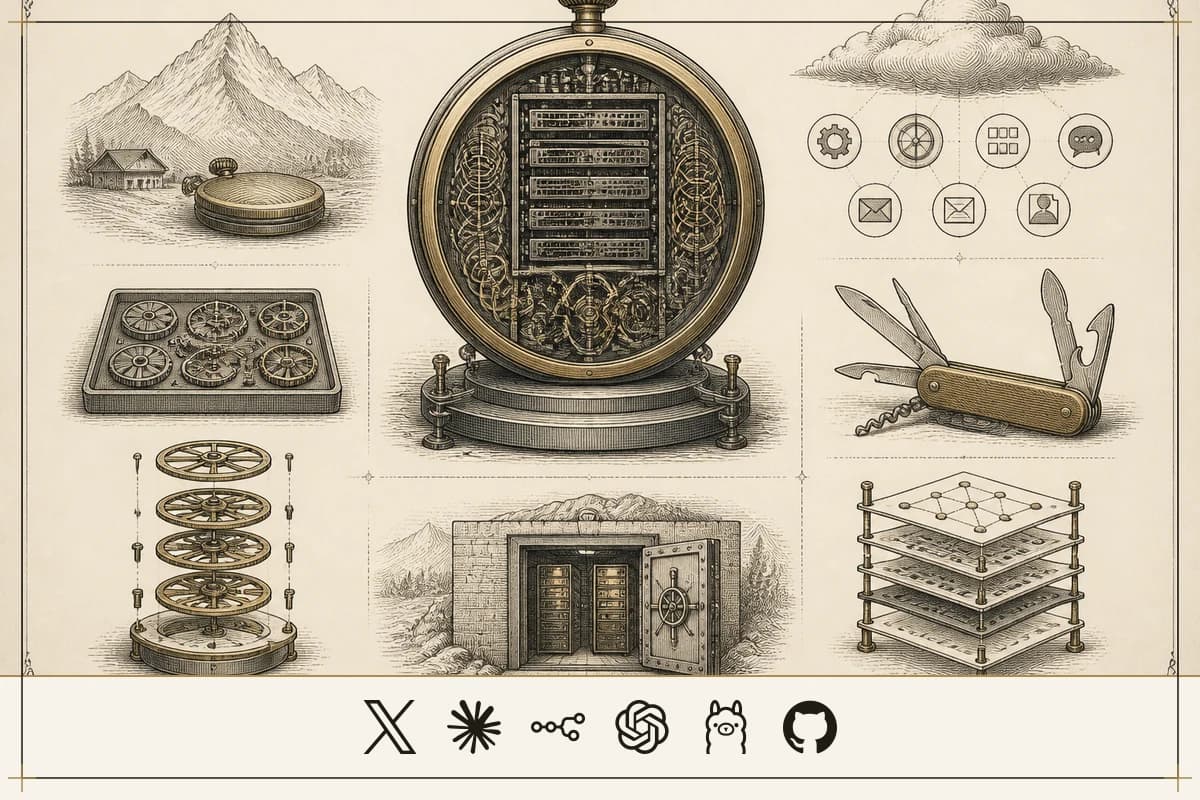
A Japanese developer stacked four Mac Minis on a wooden desk and watched a $249-a-day AWS inference bill collapse into twelve dollars a month of electricity. He paid $2,400, once. Across the Pacific, a Chinese developer strapped two toaster-sized cooling fans onto a single $599 Mac Mini, ran DeepSeek 14B on it around the clock, and canceled his Anthropic subscription outright. A third builder loaded a 128GB AMD Ryzen box, pulled Qwen3 235B through Ollama, pointed Claude Code at localhost — and now nothing he types ever leaves the machine. None of these are hobby builds. They are the leading edge of a quiet decision a lot of heavy AI users are making: stop renting the compute layer, and own it. The hardware is cheap. The engineering to make it run 24/7 is where the real work hides.
CONTENTS
CH.01
Why own your AI stack instead of renting it?
Three forces push you off the subscription treadmill — cost, sovereignty, and privacy — and only the first one is about money.
Start with the bill, because it is brutal for heavy users. @adiix_official adds it up: Claude Code, ChatGPT Pro, Cursor, and Gemini Pro run roughly $5,280 a year in subscriptions, and @Sprytixl lands on the same figure independently. The average professional or small team is bleeding $300–$500 a month across AI and SaaS tools they don't fully control. Run multi-agent workflows — hundreds of agents in parallel, the way @0xKnzo describes, or autonomous coding loops that burn tokens overnight — and the API meter scales linearly past $249/day.
But cost is the shallow reason. The deeper one is sovereignty. When the US government issued an export-control directive targeting Anthropic's Fable 5 and Mythos 5 models, Anthropic couldn't surgically block foreign nationals — so it pulled the models globally. Every user on the planet lost access overnight. @adiix_official's point is uncomfortable and correct: if your business runs on a model a government can recall in hours, you don't own your infrastructure. You rent it under political terms you never got to negotiate.
The third reason is data. @Sprytixl's 128GB rig exists for exactly one sentence — "nothing leaves the machine." For anyone touching client data, proprietary code, or regulated information, local inference doesn't just cut a bill; it deletes a whole category of exfiltration risk. As @AtsuyaYamakawa frames it, once agents gain autonomy the question becomes who the agent is representing — and the infrastructure underneath becomes a compliance surface. Local gives you an audit trail a cloud API never will.
CH.02
What hardware actually runs models at home?
Three proven paths, and they differ less in raw speed than in how big a model they can hold in memory.
| Path | Example build | Memory ceiling | Best for | The catch |
|---|---|---|---|---|
| Mac Mini M4 cluster | 4× $599 (16GB each) | ~14B per node | low-friction entry, silent at idle | 16GB soldered, non-upgradable |
| AMD Ryzen AI Max+ 395 | 1× ~$1,700 (128GB unified) | 200B+ (110GB to GPU) | running Qwen3 235B locally | desk-heater heat and noise |
| 4-node AMD Beowulf | ~$4,000 (8U rack) | multiple large models at once | small teams, max density | 400–600W, needs rack airflow |
Mac Mini M4 clusters — the entry point. A base $599 Mac Mini M4 (16GB unified memory) runs Ollama or LM Studio out of the box. @0xKnzo stacks four on a wooden desk behind a gigabit switch and claims the cluster replaced $249/day in AWS bills: $2,400 up front, ~$12/month electricity. @humzaakhalid confirms the $599 floor and names the software: Qwen 3.6 14B for coding, DeepSeek R1 14B for reasoning, Gemma 4 4B for quick tasks — all through Ollama, with Claude Code aimed at localhost. The hard constraint is that 16GB: it comfortably runs 14B models at Q4/Q5 quantization, but won't touch 70B+ without crushing quality. The saving grace is 120 GB/s memory bandwidth, which keeps generation fluid even when RAM is tight. And the memory is soldered — you buy your ceiling once.
AMD Ryzen AI Max+ 395 — the power-user path. This is where the corpus gets specific. The chip shares 128GB across CPU, GPU, and NPU; on Linux you can hand 110GB straight to the GPU for model loading. @adiix_official's sequence is three steps — install Ollama, pull Qwen3 235B, point Claude Code at localhost — for the only consumer-grade route to a 235B model on your desk. @gippp69 sources it as a GMKTEC EVO-X2 for about $1,700. The unified pool is the whole trick: a discrete GPU gives you fixed VRAM islands (24GB on a 3090, 48GB on a 4090, 80GB on an A100), but here the GPU reaches 110GB with no copy overhead while the CPU shares the same memory. For inference where model size is the bottleneck, that beats raw compute. The tax is thermal and acoustic — at a 55W TDP it's manageable for bursts, but sustained loads make it a space heater the Mac Minis never become.
Multi-node AMD Beowulf — the scale play. @MyWestLord runs the most ambitious build: four AMD desktop nodes in an 8U rack, gigabit switch, wired together with Ansible into a "Beowulf cluster," each node with its own fan, CPU cooler, and PSU. Four desktops plus cooling at full load likely pulls 400–600W continuous — at $0.12/kWh, $35–$50/month. Still trivial against cloud GPU rental, but not the $12/month of a Mac Mini stack.
Whichever you pick, the wiring is the same. Ollama serves an OpenAI-compatible endpoint at localhost:11434, and any tool that speaks that API can be redirected to it. Per @Voxyz_ai: . For multi-node clusters, a reverse proxy (nginx or HAProxy) fans requests across machines.
CH.03
Why is cooling the cost nobody budgets for?
A Mac Mini's thermal design assumes email and browsing, not 24/7 inference — skip the cooling and your $599 machine becomes a $599 space heater running at half speed.
Every source running sustained workloads ends up talking about heat. @0xKnzo's "giant coolers" the size of a toaster are, in practice, 120mm or 140mm USB fans on custom brackets. The M4's stock thermals are built for bursty loads; pin the GPU at 100% and it throttles, token speed drops, and you simply don't get the hardware you paid for. The Ryzen box, with 128GB working hard, wants enhanced airflow or an undervolt. The Beowulf rack needs real front-to-back airflow or the units cook each other.
The test is the same everywhere and worth burning into a checklist: . Use powermetrics on a Mac, lm-sensors on Linux, amd-smi for AMD GPU utilization.
CH.04
When does owning actually pay back?
For sustained workloads, local hardware breaks even in about four months — but only if you're honest that you'll still keep a cloud model for the hard 20%.
| Setup | Upfront | Annual operating | Equivalent cloud | Break-even |
|---|---|---|---|---|
| 4× Mac Mini M4 (16GB) | $2,400 | ~$150 (electricity + cooling) | @ $249/day | ~4 months |
| 1× Ryzen AI Max+ 395 (128GB) | ~$1,700 | ~$200 | $5,280/year (subscriptions) | ~4 months |
| 4-node AMD Beowulf | ~$4,000 | ~$600 | $15,000+/year (equivalent GPU) | ~4–6 months |
The honest read: the math works for exactly two profiles — heavy daily users already spending $200–$500/month on cloud AI, and privacy-first teams that legally can't ship data to an API. Total outlay runs $2,400–$6,000 and amortizes over 12–18 months of otherwise-paid subscriptions. Nobody serious runs only local. They run a hybrid: local for volume, cloud for the frontier edge cases. @Sprytixl's router holds context across the switch, sending routine work to the cheap model and reserving Opus for complex work . @0xLogicrw shows the same pattern at company scale: Lindy moved all client-side traffic off Anthropic to open-source models, saving millions, but kept Claude Opus wired in as an automatic fallback for the 2–5% of tasks where the open model fails. @gippp69 says it plainly — this covers "daily work (writing, coding, summarizing) and private workflows," and you "keep one cloud model as a backup." Anyone promising total replacement is selling.
CH.05
What are the four layers of a serious agent stack?
The hardware is a brain in a jar until you wire it into a coordination layer — and the durable pattern, from a widely-followed AI-automation creator, is four specialized layers that map onto how a real business is staffed.
Hand one monolithic model the whole job — plan strategy, click through a browser, research a competitor, remember the brand voice — and the context window bloats, tool calls collide, and the system "gets dumber as the day goes on." Splitting the load is what keeps each piece sharp. The creator brands it the "Mission Stack," but strip the branding and it's sound systems design:
| Layer | Business role | Canonical tool | What it does |
|---|---|---|---|
| 1 — Intelligence | CEO | Claude Desktop + Claude Code | plans, prioritizes, runs clarifying-question loops, writes the code that ships the system |
| 2 — Execution | COO | OpenClaw (or Agent Zero) | routes work, manages sessions, drives a real browser for clicks, logins, captchas |
| 3 — Research | workhorse | Hermes | long multi-step jobs: Kanban workflows, scheduled skills, multi-source briefs |
| 4 — Self | memory spine | Obsidian + OMI | persistent business-specific context every agent reads on every prompt |
The rule that makes this a buying filter, not a wish list: every tool you consider has to earn a seat in one of those four layers — if it doesn't map, it's a duplicate, skip it. The same creator's most quotable line is the discipline behind it: "the biggest mistake is collecting ten of these and using none." And the test of whether something has earned the name "agentic OS" is three non-negotiables — a Mission Control dashboard (one screen to view, pause, and redirect every agent), a coordination layer (the routing logic between agents), and shared memory. Missing the dashboard, you're flying blind; missing coordination, you're back to a tab pile; missing memory, your agents repeat themselves on every run.
Which brain belongs in the Intelligence seat? The creator ran a six-week test — same dashboard, four different brains (Claude, GPT, Gemini, a strong local model) — against a concrete and genuinely useful spec: hold a thread through 13 sub-steps on a competitor dossier; make 47 tool calls with only two redundant re-calls; ship working code from a one-paragraph brief on the first try; and recall a detail seeded at token 1,000 of a 22,000-token context at the end of a long session. He reports Claude winning all four, with the surprise that Gemini missed more early-context details than GPT despite the bigger window — a reminder that a larger context number is not the same as using it. The local model (a Llama variant) failed the hard three and tended to truncate. Treat the win/loss as his testing, not a benchmark, but the conclusion is durable: a frontier cloud model in the Intelligence seat, local models for volume and for hard-privacy workflows only. Claude Code runs $20–$200/month depending on whether you live on Pro tiers or burn API tokens; skip the expensive seat for bulk, mechanical work like generating 500 SEO variants, where per-token cost beats nuance.
Two pieces of wiring turn the layers from silos into a system. The Claude CLI bridge — a small local Node process — is the difference between "intelligence behind glass" (a chat window) and "intelligence at the wheel" (real access to the filesystem, terminal, MCPs, downstream agents, and the memory vault). And Hermes exposed as an MCP server (hermes mcp enable) lets any MCP-aware client fire research jobs at it directly; without it, Hermes is trapped inside its own dashboard. On the Execution layer, the same creator's most stealable operating rule is a measured switch: run Agent Zero for general autonomous work to stay stable, delegate OpenClaw for the channel-based and complex browser tasks it alone handles — and if more than 20% of your OpenClaw tasks need manual debugging, move that work to Agent Zero. A failure rate triggering a tool swap is a real heuristic, not a vibe.
CH.06
Why is the memory spine the part you must not skip?
Without the Self layer, every agent in your stack produces the same generic slop as everyone else's — with it, the system knows your file structures from Monday's build and the reasoning behind a decision you made six weeks ago.
This is the layer that's hardest to replicate, which is exactly why it's the moat. The vault is a local Obsidian directory — typically named something like "Agent OS Memory" — filled two ways: every agent prompt and reply auto-saves, and the OMI wearable records screen and mic through the day, exporting transcripts to the vault overnight. Every agent reads from it on every prompt. One operator described asking the system "based on my Obsidian vault, give me ideas on what I should automate today" and getting recommendations drawn from their own agency notes and current build work. This isn't prompt engineering. It's memory engineering, and it compounds.
For OpenClaw specifically, the implementation is refreshingly low-tech and worth copying outright:
- an append-only
memory.mdwith timestamped headers for episodic history; - a persistent
user.mdinjected into every system prompt for preferences and voice; - procedural memory stored as skill files in a
skills/folder.
The discipline that keeps the token bill from exploding is on-demand recall instead of auto-loading everything — slash commands like /sessions and /resume, plus semantic compression that summarizes the last ~90 days of memory.md into a condensed version (keeping names, projects, decisions, lessons; dropping the small talk). Once a quarter, you prompt the agent to refactor the whole file to prevent decay.
Security here is not optional. The vault holds your most sensitive business intelligence, so keep it strictly local, exclude it from cloud backups, encrypt the disk (FileVault or LUKS), and if you back up with git, use git-crypt. A leaked memory vault is worse than a leaked password — it's the context, not just the key.
And when output comes out weak, the single most useful habit is the trace map: don't rebuild the whole prompt chain. Open the trace, start at the bad result, and walk backwards until you hit the step that pulled the wrong source or made the wrong tool call. Nine times out of ten the weak link is one or two steps before the final answer. Fix that one component. This transfers to any multi-agent system, branded or not.
CH.07
Which open-source tools replace your paid SaaS?
The clearest wins aren't models — they're the infrastructure and automation tools where a self-hosted project is a line-item elimination on your P&L.
@exploraX_'s mapping is the most concrete and verifiable in the corpus, cross-referenced here with @Nayak__Ai's 12-category swap list and @DAIEvolutionHub's GitHub-alternatives index:
| What you're doing | Open-source replacement | Paid tool it kills | Monthly cost eliminated |
|---|---|---|---|
| Automation / workflow | n8n (also Activepieces, Pipedream) | Zapier, Make | ~$103/mo (Zapier Team) — up to $20K/yr at scale |
| Scheduling / booking | Cal.com | Calendly | ~$12/mo |
| Newsletter / blog | Ghost | Substack, Ghost Pro | Substack's 10% take |
| Password manager | Vaultwarden | 1Password, Bitwarden Cloud | ~$7.99/user/mo (1Password Business) |
| Photo / video backup | Immich | Google Photos, iCloud | $24.99/mo (Google One 5TB) |
| CRM | Twenty | Airtable, HubSpot | — |
| Database backend | Supabase | Airtable, Firebase | — |
| Multi-model chat | LibreChat | ChatGPT Plus, Claude Pro | $20 + $20/mo |
| AI coding | OpenHands, Aider, Codex CLI | GitHub Copilot, Cursor Pro | — |
| Video generation | HyperFrames, MoneyPrinterTurbo | Runway, Pika | — |
| Financial terminal | Fincept Terminal | Bloomberg | — |
| Email / voice | Agentic Inbox (Cloudflare), VoxCPM | paid email assistants, voice cloning | — |
| OSINT / API glue | Flowsint, Nango | paid research / API tools | — |
| Web analytics | Plausible | Google Analytics | — |
A few that deserve their names spelled out: n8n carries 400+ integrations and native LangChain support. @MiteshJ71069's head-to-head is blunt — "Triggers: n8n dominates. Integrations: n8n connects to 500+ tools and any API. Models: n8n lets you swap between OpenAI, Anthropic, or local Ollama." @dashboardlim built a guide specifically to replace $20K/year of Zapier with it. OpenHands carries 76,500 GitHub stars and is used at Apple, Google, and Amazon. And per @FelixAix, "OpenAI's Codex can now run locally through Ollama — completely free," pairing the Codex CLI with DeepSeek V4, Gemma 4, or Qwen 3.6.
For the creative stack, the same one-paid-one-free dedup applies:
| Tool | Cost | Best for | Skip it when |
|---|---|---|---|
| ChatGPT Image 2 | in ChatGPT Plus (~$20/mo) or API | design assets, diagrams, thumbnails, UGC ad creative | you need human art direction or real motion video |
| Sora / Runway | paid tiers | prompt-to-video | budget is tight — Remotion (free, code-based) does programmatic video |
| HeyGen / Synthesia | free tier up | AI avatars for faceless content | your real face is the brand |
| ElevenLabs | free tier up | voice cloning, narration | Kokoro TTS (local, free) covers basic narration |
| CapCut | free | short-form editing with auto-captions | you need pro color grading — use Premiere/Final Cut |
One technique worth lifting out of the media list because it transfers anywhere: the Image 2 "Prompt Engine." Feed a brief into a reasoning model to expand it into a ~300-word structured image prompt, then feed that into Image 2 with thinking mode on. The two-model relay — reasoning model writes the prompt, image model executes it — produces movie-poster, diagram, and thumbnail quality far above a one-line prompt, and costs nothing but the relay.
A coding-tools footnote: Claude Code has a free, real fix for the terminal-strobe bug on long runs — . Treat the exact memory figures as creator-reported. And skip Cursor / Windsurf / GitHub Copilot entirely if you're already doing autonomous engineering through Claude Code in the terminal — at that point they're redundant overlap, not capability.
CH.08
How do the tools become a system, not a junk drawer?
The real cost saving isn't replacing tools one by one — it's wiring them into one system where they share context, memory, and orchestration. That's where most "open-source alternatives" lists quietly fail.
The backbone is a three-layer architecture, articulated by @Goodness065: "n8n — where the real work happens; Airtable [or Supabase] — not just a spreadsheet, this is my backend; Claude — my digital team member." n8n is the nervous system, a database is the memory, an LLM is the brain. Every replacement tool slots into one of those three. The integration pattern from @AliAlkhuzaee_ shows it in motion: n8n Form Trigger → Gemini 2.5 Flash with a LLaMA 3.3 fallback → Tavily search → PDF conversion → email + Telegram notification. Production-grade automation that costs API fees only on the AI calls, never on the orchestration.
On top of that runs the multi-model router — open-source as default, proprietary as fallback — the same pattern @Sprytixl and @0xLogicrw describe from the cost chapter, just generalized: cheap model first, frontier model only for the slice it can't handle. @bonsaixbt pushes furthest, with a CEO Agent, CMO Agent, Lead Pipeline Agent, Outreach Agent, and Market Research Agent all reading and writing one shared persistent memory layer. Without shared memory your agents are amnesiacs; with it, every interaction makes the system smarter.
Then there's the part most people miss — the control plane is a messaging app, not a monitor. @0xKnzo texts his cluster from his iPhone "like messaging an employee"; @SolaraAi77792 "moved my entire dashboard to Telegram. 1 bot now runs 13 AI agents — sales alerts, deploys, finances. I literally check revenue from the bathroom." @humzaakhalid runs OpenClaw as a Telegram daemon; @MyWestLord runs "4 headless machines, 4 copies of OpenClaw, dummy HDMI plug in" — a fake monitor that tricks the Mac into rendering so OpenClaw keeps working — streamed back via Jump Desktop; @Sprytixl bought a separate Mac Mini, "gave it full computer access, connected it to Telegram and started texting it commands." Your sovereign cluster needs no keyboard. It needs an endpoint.
The business overlay, where owning the stack stops being a cost story and becomes a margin story, is the white-label agency pattern (@heynavtoor): take Cal.com, Ghost, and n8n — self-host them, rebrand them, sell the integrated system. Concretely: . The mechanism is proven enough that Cal.com's own founders reportedly hit $5M ARR in three years doing the managed-service version, and n8n raised $14M on the back of the same agency model. A widely-followed creator's margin reframe says the same thing from the operator's side: a content-automation retainer that cost £2,000–£8,000/month with a human team becomes deliverable at £1,000–£3,000/month with one operator plus the stack — and the marginal cost of the next client is tokens and hosting, not another payroll line. Treat those figures as creator-reported shape, not audited fact; the inversion of the cost structure is the real point.
The durable insight underneath all of it, from @DeRonin_, @sairahul1, and @plainionist: the advantage isn't which model you use, it's how you structure the system around it. @DeRonin_ is sharp about the graveyard — "AutoGen/AG2: moved to community maintenance, releases stalled, dead for production. CrewAI: demos well, breaks in production." The skills that compound are "context engineering, tool design, orchestrator-subagent pattern, eval discipline, the harness mindset." When you self-host n8n you're not just saving money — you're building the harness that lets you swap models, add verification, keep audit trails. Even @exploraX_'s note that n8n runs a "sustainable use license, not OSI open source" points the same way: the value is the operational pattern, not the license.
CH.09
How do you stop an agent from leaking everything?
Running agents with filesystem, network, and tool access on bare metal is a security catastrophe waiting for a prompt-injection attack — Docker isolation is the floor, not a nice-to-have.
@0xKnzo is blunt: "Hermes runs in isolation. Every agent sandboxed in its own container." Each agent gets restricted permissions; the host's emails, bank accounts, and SSH keys stay invisible from inside. @AiCamila_ layers defense in depth on top: sandbox tool execution, validate and sanitize every output, implement data-loss prevention, run adversarial testing, and enforce runtime policies with OPA or Kyverno. @Sprytixl adds the physical version — a separate Mac Mini for the agent so even a fully compromised one can't reach your primary workstation.
And the nightmare that makes all of this concrete: @bonsaixht documents a student who "incurred a $55,444.78 Google Cloud bill after pushing a Gemini API key to a private GitHub repository." Three non-negotiable safeguards fall out of that:
- Never hardcode API keys. Use environment variables backed by a vault.
- Set spending alerts on every cloud dashboard before you deploy anything.
- Implement the fallback pattern. Every open-source model needs a defined fallback — another open model or a proprietary API — that auto-activates on failure. @0xLogicrw's DeepSeek-V4-primary, Claude-Opus-fallback is the production standard.
CH.10
How do you build this without it becoming a disaster?
Don't build the home data center first. Build the smallest loop that proves the system works, then add paid and physical layers only against a trigger. The honest timeline matters: a dashboard scaffolds in about an hour, but a working system — agents wired, vault connected, one recurring business task automated — is a 30-day build at roughly 30 minutes a day.
- Audit (Day 1). List every AI and SaaS subscription, its cost, and whether it touches sensitive data. @alchemyofmax's audit surfaced $47,000/year of AI spend producing "organized chaos" — yours will reveal redundancies too.
- Quick wins (Week 1). Swap the mature, low-friction tools first: 1Password → Vaultwarden (same client apps, new server), Google Photos → Immich, ChatGPT Plus + Claude Pro → LibreChat with your own API keys, Calendly → Cal.com. After each, use only the replacement for three days; if you hit a blocker you can't clear in 30 minutes, keep the paid tool and revisit later.
- Infrastructure (Weeks 2–3). Get a $5–$20/month VPS (Hetzner, DigitalOcean, or a decentralized option like FluxCloud for jurisdictional diversity, per @Flux_Indonesia_). Install Docker, deploy n8n, deploy Supabase/Postgres, and wire every workflow to write its state to the database. Master plain API integrations before AI workflows (@ViolentBearr's path). Verify with one end-to-end automation that replaces a daily manual task — @ViolentBearr's canonical example: "Email arrives → AI replies in my tone → Saves as draft for approval."
- Orchestrate (Week 3–4). Stand up the four layers — Claude Desktop, OpenClaw or Agent Zero, Hermes on a free OpenRouter or local Ollama model, and an Obsidian vault seeded with your real business context. Wire exactly one workflow: the Morning Intel Sweep (Hermes pulls fresh content in your niche → Claude summarizes → the digest lands in your Obsidian inbox), which exercises memory, coordination, and context at once. Add an approve flow so a human signs off before anything irreversible.
- Local compute (Month 2+, optional). Only if your monthly API spend tops $200. Buy the hardware, install Ollama, pull your models, and point n8n and LibreChat at the local endpoint. Route routine traffic locally, reserve API calls for the hard cases.
The verification gates, stated pass/fail:
- Day 7 — Ask the system about work you did three days ago. Correct, contextual answer? If no, the Self layer is broken.
- Day 14 — Trigger a multi-agent workflow from the dashboard and watch it finish unattended. If no, the coordination layer is broken.
- Day 21 — Do you have a recorded demo of a real task automated end to end? If no, you're not ready to sell.
- Day 30 — Have you invoiced one client for an AI-automated deliverable? If no, you're still consuming, not producing.
And the hard numbers to hit on the hardware side: 20–40 tokens/sec for 14B models on an M4, 10–20 t/s on Ryzen for larger models; an ~80% drop in cloud spend; and a network monitor confirming zero outbound traffic to Anthropic, OpenAI, or Google during local inference. Track these against real logs, not vibes:
| Metric | Target | How to verify |
|---|---|---|
| Time saved per week | >5 hours | task logs, before vs after |
| Cost per output | falling month over month | tokens per deliverable, from the analytics panel |
| Revenue from AI services | >2× total tool cost | invoice tracking |
| Agent reliability | >85% first-try success | manual interventions per 100 tasks |
The frame that makes the cost panel useful: watch cost-per-output, not cost-per-token. If your weekly spend is up 30% but output is up 60%, the economics are working. Watching tokens in isolation makes you ration prompts and starve the work.
CH.11
Where does paid still win — and what's hype?
This whole thesis is hype if it doesn't flag the real costs, and several of the loudest numbers in the corpus are unverifiable.
Self-hosting means you are the ops team — Linux admin, Docker, DNS, SSL, security patching, backup verification. @exploraX_ is honest about Vaultwarden: "You become your own backend provider. If the server dies without backups, the vault dies." @dashboardlim's 4-question discovery is the antidote — before building, ask "What happens when it breaks?" If you don't have an answer, you're not ready. The UI gap is real too: @MiteshJ71069 admits "AgentKit's ChatKit is beautiful, n8n still looks 2019," and a tool your team won't adopt has zero ROI. Immich is "still pre-1.0" — keep a second backup. Plausible "lacks multi-touch attribution and deep funnels."
Where paid still wins outright: for teams under five people who value speed over control, @WasimShips' ~$175/month solo-founder stack (Figma free + v0.dev $20 + Midjourney $10 + Cursor Pro $20 + Claude AI $20 + Supabase + Vercel + Upstash $25–50 + Typefully $15 + Intercom AI $50) beats spending 40 hours building a self-hosted equivalent. Your time has a cost. The break-even for self-hosting n8n versus Zapier is roughly when you'd pay Zapier more than $600/year — below that, setup time eats the savings.
And the claims to distrust: @0xKnzo's "$380,000 in savings" from a Mac Mini cluster is presented without evidence and won't generalize; treat it as marketing. "Free, no API keys" tools that promise keyless access to frontier models (FreeBuff and similar) are almost certainly fragile free-tier proxies that will rate-limit or vanish — verify before you build on them. Local models genuinely fail on complex multi-step reasoning, tool reliability, and long-context retention; they cover roughly 80% of tasks and are disqualified from the critical 20%. There's a quiet caveat worth holding too: DeepSeek processing "internally in Chinese" is both a subtle-bug risk and a data-residency question. The running-it-for-free stack is real, but every income, click-count, and time-saved figure attached to it — the four-figure retainers, the "1,134 clicks a day" — is creator-reported and unaudited. Use them as shape, never as fact. And re-check every model version number and price against current models before you reuse it; they age in weeks.
CH.12
The bottom line: own the harness, rent the model
The desk-sized data center isn't a replacement for cloud AI — it's a hedge against subscription volatility, a privacy control, and, at sufficient scale, a genuine cost advantage. But the deeper lesson across every source is one sentence: own the harness, rent the model. The orchestration layer, the memory spine, the dashboard, the routing logic — those are your IP, and they last for years. The models are rented by the token and cycle every six months; when one gets recalled or repriced, you swap a config line instead of rebuilding workflows. The hardware proves you don't have to rent the compute. The four-layer stack proves you don't have to rent the coordination. The open-source map proves you don't have to rent the software. The difference between an AI hobbyist and an AI operator in 2026 isn't the number of subscriptions held — it's whether there's an operating system underneath that you actually own.
No comments yet — start the conversation.
Sign in to join the discussion — it's free.