Field research — 2026-06-18PUBLIC
What separates winning X authors from losing ones: the data behind reach in AI-automation
An analysis of 23,234 posts from 7,526 AI-automation X accounts finds winning authors hold about a third the followers of losers yet earn far more follower-normalized reach. The edge is behavioural — Blue, video, long-form, original posts over replies and hashtags — and it replicates across niches.
≈ 19 min read
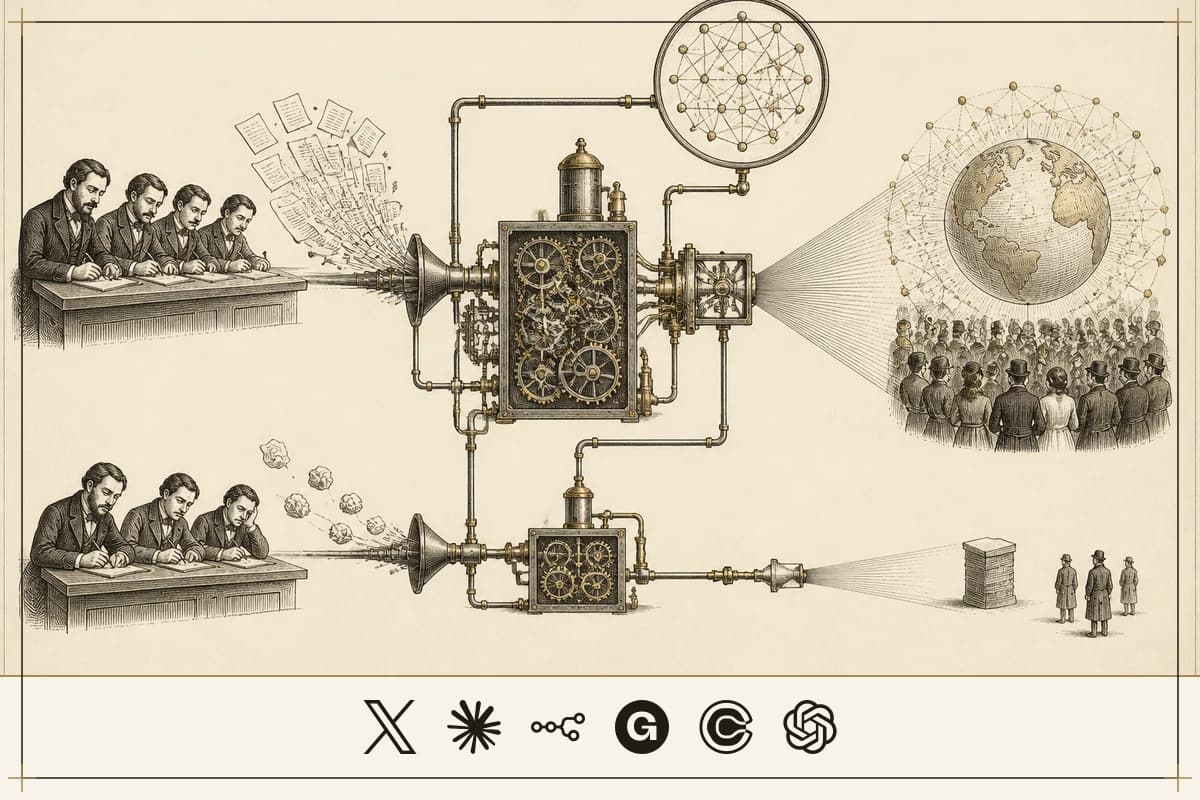
You have 15,000 followers. The account quietly out-reaching you has 5,000. You post more than they do, you reply to all the big names, you ride every trending tag — and your post dies at 37 views while theirs clears four figures on a third of the audience. That stings because it feels like a betrayal of the obvious deal: build the audience, earn the reach. In AI-automation on X, that deal does not hold. Across a mined corpus of 23,234 posts from 7,526 accounts, the top quartile of niche authors carries a median of 5,048 followers against the bottom quartile's 15,270 — roughly a third the audience — and wins anyway. This note is the evidence behind that one uncomfortable fact: the base rates, the feature lifts, the per-account trait deltas, the same pattern stress-tested in two sub-niches, and the mechanism under each one.
A word on the numbers before we start, because the honesty of the method is the whole point. Base rates and feature lifts are computed on the Latest denominator only — the Top-selected winners are excluded, which is the survivorship-bias fix. View counts on freshly-pulled recent posts undercount, because they have not finished accumulating; medians dampen this but do not erase it. And "$" / money is a proxy throughout — there is no revenue data anywhere in this corpus. "Money" means follower-normalized reach plus monetization signals in bios and posts plus audience size. Every time money comes up, read proxy.
CONTENTS
CH.01
How brutal is the base rate, really?
The median AI-automation post on X earns 37 views. Out of 6,489 posts on the honest denominator, only 12.31% cross 1,000 views, 2.62% cross 10,000, 0.52% cross 100,000, and 0.03% cross a million. Half of everything in this niche dies with fewer views than a small group chat has members.
That is the floor every tactic below is measured against. A "lift" only means something relative to a median of 37. The distribution is savagely top-heavy — a tenth of posts get 4 views or fewer, a quarter get 10 or fewer, half get 37 or fewer, and the curve only goes vertical at the very top.
| views percentile | value |
|---|---|
| p10 | 4 |
| p25 | 10 |
| p50 (median) | 37 |
| p75 | 202 |
| p90 | 1,435 |
| p95 | 4,568 |
| p99 | 36,761 |
The gap between p50 (37) and p99 (36,761) is roughly a thousandfold. This is not a niche where small edges compound gently. It is one where a handful of structural choices decide whether you live in the 37-view graveyard or the four-figure tier. The rest of this note is which choices.
CH.02
Which format levers move reach — and which quietly tax it?
Five levers carry almost all the measurable lift, and two of the most common tactics actively suppress reach. Blue verification lifts median views 4.12x, video 3.44x, quotes 3.12x, and long text (280+ chars) 3.09x. Replies cut reach to 0.42x and hashtags to 0.46x — both worse than doing nothing. Links are dead neutral at 1.0x.
| feature | ON n | ON median | OFF n | OFF median | lift |
|---|---|---|---|---|---|
| Blue | 4,107 | 70 | 2,382 | 17 | 4.12x |
| has video | 455 | 117 | 6,034 | 34 | 3.44x |
| is quote | 606 | 106 | 5,883 | 34 | 3.12x |
| long text (280+) | 2,837 | 71 | 3,652 | 23 | 3.09x |
| short text (<100) | 753 | 40 | 5,736 | 37 | 1.08x |
| has link | 2,639 | 37 | 3,850 | 37 | 1.0x |
| has hashtags | 1,372 | 21 | 5,117 | 46 | 0.46x |
| is reply | 2,174 | 22 | 4,315 | 53 | 0.42x |
One mechanism explains all eight rows: the ranking layer rewards native, dwell-generating content and penalizes low-effort distribution hacks. That is not my assertion — it is the documented behaviour of X's open-sourced recommendation pipeline, where the heavy-ranking model scores predicted dwell, video completion, and reply-likelihood, and demotes signals it reads as off-platform or spammy. The public note "How X/Twitter growth actually works in 2026" walks that pipeline stage by stage; I read the corpus against it rather than re-derive it. And the corpus fits. Video captures visual attention without leaving the platform (3.44x). Long text forces a scroll-stop and delivers payload — the winning long posts are not essays, they are dense lists, internal-email pastes, or high-stakes hooks where the length is the value, not filler (3.09x). Quotes let you publish a standalone, algorithm-eligible post while inheriting the context of whatever you quote (3.12x). Blue, whatever the exact causal split, sits on top of it all at 4.12x.
The two penalties fit the same frame. Replies are architecturally buried in sub-threads, invisible in the main feed, and they spend the same author-diversity budget your real posts need — the 0.42x is consistent with that. Hashtags are the one place I am guessing at the why: my working hypothesis is that the ranker now routes by inferred semantic topic rather than literal tag-string match, so a hashtag adds nothing retrievable and reads as a 2014 discoverability move. The corpus only proves the 0.46x penalty, not the cause — treat the topic-routing story as a hypothesis. The penalty is real either way.
Links deserve a verdict, because two camps are loudly wrong about them. The "links kill your reach, never post one" camp and the "always drive traffic off-platform, links are free" camp both assume links do something. The measurement says they do not: 37 median views with a link, 37 without — a flat 1.0x. So here is the stance the data supports. The link itself is not a tax; the demotion people blame on links is really the demotion on what usually accompanies a link — a thin "check this out 👉" post with no native payload. Put the value in the post, then add the link if you have one. The link will not cost you reach, and withholding it will not buy you any.
One honest caveat on these lifts: the denominator excludes the Top-selected winners, so these are what typical successful posts do, not a virality guarantee. Video is necessary far more often than it is sufficient.
CH.03
Why is a big follower count actually a trap?
Follower-normalized reach collapses as accounts scale. Nano accounts squeeze 0.2093 views per follower; by the macro tier that craters to 0.0016 — a 130-fold efficiency drop. The algorithm does not reward the size of your audience. It rewards how much of it actually watches.
| tier | posts | median views | p90 views | eng rate | views/follower |
|---|---|---|---|---|---|
| nano | 3,228 | 20 | 191 | 0.0095 | 0.2093 |
| micro | 1,954 | 61 | 2,076 | 0.0223 | 0.0225 |
| mid | 994 | 171 | 7,720 | 0.0151 | 0.0071 |
| macro | 301 | 295 | 9,767 | 0.0107 | 0.0016 |
| mega | 12 | 5,925 | 11,772 | 0.0093 | 0.0021 |
Read the views/follower column top to bottom: 0.2093 → 0.0225 → 0.0071 → 0.0016, then a faint recovery to 0.0021 at the mega tier. Follower growth outpaces reach growth at every step, which makes early-stage attention disproportionately efficient and a bought or inflated audience disproportionately worthless. The mega tier is a real but tiny sample — n=12, so treat its 5,925 median and 0.0021 ratio as directional, not load-bearing. The honest reading: absolute median views rise with followers (20 → 295 from nano to macro), but the return on each follower falls off a cliff — and that return is the thing winners optimize for.
CH.04
What separates the winners from the losers?
On a per-account comparison of 427 niche accounts — top quartile vs bottom quartile, 106 accounts each, ranked by follower-normalized median reach — the winners post like publishers and the losers post like audience members, despite the winners having a third the followers. Every behavioural delta maps to a feature lift from the table above.
| trait | WINNERS (top 25%) | LOSERS (bottom 25%) |
|---|---|---|
| median followers | 5,048 | 15,270 |
| % Blue | 93.4 | 83.0 |
| median follower-normalized reach | 1.0089 | 0.0117 |
| median engagement rate | 0.0185 | 0.0153 |
| mean % posts with video | 33.1 | 10.7 |
| mean % replies | 4.4 | 23.7 |
| mean % with link | 38.1 | 44.2 |
| mean % with hashtag | 4.5 | 18.1 |
| median text length | 298 | 215 |
| % money signal (proxy) | 27.4 | 8.5 |
The follower-normalized reach row is the whole story compressed: winners at 1.0089, losers at 0.0117 — an ~86-fold difference on the exact metric that controls for audience size. Underneath it, every behaviour points the same way. Winners put video on a third of their posts (33.1% vs 10.7%), keep replies near 4% (vs 23.7%), keep hashtags near 4.5% (vs 18.1%), and write meaningfully longer (298 vs 215 chars). Each is a deliberate step toward the levers that lift and away from the ones that suppress.
The mechanism is a single posture: broadcast beats conversation, and authority is built through abstention. Losers act like members of the audience — they spend their budget replying up at bigger accounts (the 0.42x penalty, run 23.7% of the time) and spraying hashtags (the 0.46x penalty, 18.1% of the time), hoping to siphon traffic the architecture never sends them. In the agentic-engineering cut of the corpus, the loser pattern is almost a caricature: replying to @narendramodi, debating pension economics, offering "depression tips" — each interaction filing them as audience, not authority. Their text aggregates where winners originate: @ollobrains quotes MIT research without adding a proprietary frame; @Amun3345 writes a generic "autonomous systems" overview indistinguishable from raw GPT output; @Thorium_Labs ships an "AI Daily Digest" that competes with every other digest.
Winners do the opposite. They post monologues, not replies. @AnthropicAI announces government export controls as a statement. @claudeai introduces "Claude Fable 5" as an event. @bindureddy demos an "Agent Swarm" as a capability reveal — on video, because in a field where you cannot judge an agent from its description, the running clip is the proof. Even @elonmusk's throwaway "Put 'Never Went to Therapy' on my gravestone" works as mythology — unanswerable, unreplyable, pure broadcast. The engagement rates barely differ (0.0173 vs 0.017 in that segment); what differs is where the engagement is pointed. Winners aim it at content that scales. Losers scatter it across replies that fragment.
The losers, with three times the followers, built an audience that does not watch. The winners built a smaller one that does.
The hashtag delta is the same instinct in miniature. Winners' content is referenceable — quoted, embedded, discussed about rather than within. A @ClaudeDevs suspension announcement or an @xai plugin recommendation propagates through authority networks, not tag networks, so the hashtag is dead weight. Links are the one near-tie (38.1% vs 44.2%, consistent with their 1.0x lift) — neither group's link habit decides anything.
CH.05
Does the pattern survive in your corner of the niche?
Yes — the core inversion replicates in every sub-niche measured, but two of the "winner traits" actually flip depending on the segment. The shape (smaller audience, more reach, video-forward, reply-and-hashtag-averse, long-form) is rock solid. Blue verification and money-signaling are not universal laws — they are context-dependent.
Here is the headline trait set across the global cut and the two deepest sub-niches, winners vs losers:
| trait | Global niche (W / L) | Agentic engineering (W / L) | AI content & media (W / L) |
|---|---|---|---|
| median followers | 5,048 / 15,270 | 8,104 / 15,544 | 6,283 / 19,554 |
| follower-normalized reach | 1.0089 / 0.0117 | 1.2839 / 0.0121 | 1.2227 / 0.0357 |
| % posts with video | 33.1 / 10.7 | 37.7 / 10.3 | 34.1 / 7.4 |
| % replies | 4.4 / 23.7 | 4.5 / 22.8 | 0.5 / 13.9 |
| % hashtags | 4.5 / 18.1 | 4.9 / 16.6 | 0.3 / 18.3 |
| median text length | 298 / 215 | 304 / 231 | 565 / 142 |
| % Blue | 93.4 / 83.0 | 96.3 / 81.5 | 85.7 / 92.9 |
| % money signal (proxy) | 27.4 / 8.5 | 25.9 / 1.9 | 21.4 / 28.6 |
The reach gap is even more violent inside the sub-niches than across the whole. Agentic-engineering winners out-reach their losers 106-fold per follower (1.2839 vs 0.0121); content-and-media winners by 34-fold (1.2227 vs 0.0357). In content and media the behavioural extremes get almost comic: winners post 28× fewer replies (0.5% vs 13.9%), 61× fewer hashtags (0.3% vs 18.3%), and write four times longer (565 vs 142 chars — a mini-essay against a context-free hot take). Same physics, dialed up.
Now the two flips, because this is where a lazier merge would lie to you. In agentic engineering, winners over-index hard on Blue (96.3%) and on money signals (25.9% vs the losers' 1.9% — a 13.6× gap). In AI content & media, winners do the reverse: fewer of them are Blue-verified than losers (85.7% vs 92.9%), and fewer of them talk money (21.4% vs 28.6%). Both can't be a universal rule, so neither is.
The reconciliation is the mechanism. Agentic engineering is a credence good — you cannot assess an agent's quality from a description, you have to witness it operate. So the market resolves the uncertainty with three substitutes for trust: institutional affiliation (Anthropic, xAI, Coinbase), demonstrative video, and explicit commercial stakes. There, the 96.3% Blue rate is minimum viable legitimacy — unverified voices are presumed non-practitioners — and stating money is skin-in-the-game, structural honesty. AI content and media runs on prestige-velocity instead: the work speaks in the video, so Blue becomes table stakes that losers over-buy as a substitute for craft (the 7.2-point gap is small but directionally damning), and loud monetization — "$5K/month," "$47K spent" — marks you as a vendor selling the dream rather than a creator whose revenue is assumed.
The takeaway with teeth: the format levers are universal; the status-and-commerce signals are segment-dependent. Copy video, length, and original-over-reply everywhere. Decide Blue and money-talk by which game you're actually in.
CH.06
Which archetypes win — and which one's a trap?
Agencies and tool-promoters lead on follower-normalized reach (0.2141 and 0.1692), educators follow (0.1635), and builders trail badly (0.1092). Selling the shovels beats building in public. The archetype you adopt is itself a lever.
| archetype | n | median followers | median fnorm reach | median eng rate | % money signal (proxy) |
|---|---|---|---|---|---|
| agency | 10 | 12,932 | 0.2141 | 0.0273 | 40.0% |
| tool-promoter | 117 | 3,849 | 0.1692 | 0.0184 | 23.9% |
| educator | 58 | 15,693 | 0.1635 | 0.0240 | 27.6% |
| builder | 29 | 2,572 | 0.1092 | 0.0159 | 6.9% |
| other | 213 | 6,461 | 0.0878 | 0.0183 | 18.3% |
Two findings carry weight. First, the builder is the cautionary tale: despite the romance around "building in public," builders post the lowest follower-normalized reach (0.1092) and by far the weakest money proxy (6.9%) on the smallest median audience (2,572). The market does not automatically reward raw construction over promotion. Second, the winner/loser archetype mix confirms it from the other side — tool-promoters make up 37 of the 106 winner accounts versus 21 of the 106 losers, while the generic "other" bucket swells from 49 (winners) to 59 (losers). The accounts solving an acute, monetizable problem and saying so beat the ones narrating their path. Mind the samples: agency n=10 is small, so its category-leading 0.2141 and 40.0% are directional; the tool-promoter row (n=117) is the most reliable positive signal in the table — conveniently, also the most replicable posture for a working builder.
Three accounts make it concrete. The agency posture, lived: @mikefutia carries 76,182 followers at a median 48,768 views per post, with a bio that does every job the archetype table predicts — "Building AI systems for ads + ecomm | Clients include Kitsch & MAELYS | Join 600+ creative marketing teams 👉 [link]." Named clients, a stated service, a funnel link. His top post (399,611 views) is textbook tool-promotion: it names the exact stack — Nano Banana + Veo 3 + n8n — and quantifies what it replaces, "Each video costs pennies to generate," with the API version spelling it out.
The pattern does not need a big audience. @trybagel has 65 followers and a median of 106 views — which is a follower-normalized reach north of 1.0, squarely winner territory, on the smallest imaginable account. Same posture: name a specific competitor, draw the line, position your product in the gap.
"We kept hearing 'why can't we just use Claude for this?'... Claude writes a great summary. Your product team still ships the wrong thing." — @trybagel
Contrast both with a builder-archetype account like @axisrobotics (21,873 followers): strong individual posts, but the feed is weekly build-logs and event recaps — "Axis Weekly... separating real user signals from bot traffic, expanding TaskGen" — narration of construction, no named offer. Exactly the 0.1092-reach, 6.9%-money posture the builder row warns about.
CH.07
When does posting actually pay off?
The timing signal is weak but real: mid-week posts earn the highest median views, Monday is a high-volume low-reach trap, and the weekend is a dead zone. Tuesday (233 median) and Wednesday (237) lead; Monday sits at 15 on enormous volume. Treat this as a tiebreaker, not a strategy — it is the softest finding in the note.
| weekday (UTC) | n posts | median views |
|---|---|---|
| Monday | 3,160 | 15 |
| Tuesday | 267 | 233 |
| Wednesday | 289 | 237 |
| Thursday | 395 | 102 |
| Friday | 553 | 112 |
| Saturday | 574 | 90 |
| Sunday | 1,251 | 42 |
The likely mechanism is supply and demand for feed attention. Monday carries by far the most posts (n=3,160) and the lowest median (15) — everyone dumps content at the start of the week, diluting each post. Tuesday and Wednesday pair lower supply with higher medians; the weekend slumps (Saturday 90, Sunday 42). But note how thin the high-median days are: Tuesday and Wednesday rest on a few hundred posts each (n≈270–290), so the effect is sample-sensitive. The honest action is small — if you have one post that matters this week, ship it Tuesday or Wednesday rather than Monday.
CH.08
How does any of this turn into money?
Money is a proxy here — there is no revenue data, only follower-normalized reach, monetization signals in bios and posts, and audience size. With that proxy, the link to reach is direct: 27.4% of winners carry a money signal versus 8.5% of losers, and the archetypes most likely to be selling (agencies at 0.2141 reach, tool-promoters at 0.1692) command the most reach. The behaviours that drive reach and the behaviours that signal commercial intent are run by the same accounts.
So the 27.4% vs 8.5% is not a black box. Concretely: @mikefutia's "Join 600+ creative marketing teams 👉 [link]" is a money signal; a bio that just says "AI enthusiast, sharing what I learn" is not. It is a binary presence-of-intent flag — which is exactly why it is a proxy. In agentic engineering the same flag shows up as transactional transparency: @Polymarket capping a "vibe-coding" budget, @nypost tying pricing to AI-boom economics, @ClaudeDevs announcing paid Claude plans.
Hold the caveats firmly. A 27.4% money-signal rate among winners does not mean 27.4% are profitable — it is a proxy, not a P&L. The agency 40.0% does not mean 40% of agencies make money; it means agencies position for it more often. And the causal arrow is genuinely unknown: commercial intent may sharpen content, or sharper content may attract commercial framing, or a third trait (seriousness, time invested) may drive both. What the data establishes cleanly is that winners are not merely collecting views — they convert attention into stated commercial intent at roughly three times the loser rate, on a third of the followers. (And remember the segment flip: in AI content and media, the winners talk money less, not more — there, restraint signals the higher-trust position.)
CH.09
Where does this read break down?
Everything above is honest, which means naming what it cannot carry. The biggest limit: no revenue data anywhere, so every money claim is proxied — read proxy on all of it. The lifts have a subtler trap. Blue at 4.12x, video at 3.44x, long text at 3.09x all correlate with reach, but the causal arrow is not measured and self-selection is rampant — serious accounts may adopt these features because they are already serious, not become serious by adopting them. Copy the features because the behaviour and the outcome travel together, but do not read a guarantee into a correlation.
Two things skew the magnitudes rather than the shape. Recent posts undercount, because freshly-pulled tweets have not finished accumulating views; medians dampen it but absolute numbers still skew low. And the eye-popping top of the niche is dominated by mega-celebrities whose 100M-follower amplification you cannot replicate — the structural lifts survive when you strip those accounts out, but the magnitudes shrink, which is why every action here is measured against the 37-view base rate, not the outliers. Finally, three samples are too thin to lean on and were flagged where they appear: the mega tier (n=12), the agency archetype (n=10), and the mid-week timing days (n≈270–290). None undo the central finding; they bound how hard you can push it.
For the record, these fresh numbers line up with an earlier snapshot in "How X/Twitter growth actually works in 2026," which cited a median around 19 views, Blue roughly 5x, and video roughly 3.8x. This corpus measures 37 median, Blue 4.12x, video 3.44x. Different pull, same shape — a brutal base rate, Blue as the largest single multiplier, video close behind. The agreement across two independent pulls is itself a small mark of confidence; these numbers supersede the older ones.
CH.10
What do you change this week?
Everything below is derived strictly from the measured deltas — no motivational filler, only moves the corpus backs. Each line ties to a number above.
- Audit your archetype, then drop "builder." Builders post the lowest follower-normalized reach (0.1092) and the weakest money proxy (6.9%). Reposition toward tool-promoter — demonstrate the specific tool, compare the alternative, sell the shovel. Tool-promoters hold 37 of 106 winner slots for a reason.
- Cut replies and hashtags to near zero. Replies run at 0.42x, hashtags at 0.46x — both below baseline. Losers spend 23.7% of posts on replies and 18.1% on hashtags; winners hold both near 4.5%. If your strategy is "engage in conversations" and "ride trending tags," you are paying to be seen less. If you must engage, quote-post your own content with a substantive addition — never a bare reply.
- Put video on your highest-stakes posts. The 3.44x video lift is the largest content effect measured (Blue is larger but is a subscription, not a craft). Winners run video on 33.1% of posts versus 10.7%. You do not need production value — a screen recording of the thing working clears the bar. Loopable and rewatchable beats polished.
- Write long and dense, not long and padded. Winners' median post is 298 characters versus 215, and long text lifts 3.09x — and in content/media the winners run to 565. Length only works as payload: a specific list, a high-stakes hook, a concrete demonstration. Front-load the tension in the first 100 characters.
- Match your Blue and money-talk to your segment. Selling a credence good (agents, systems, services)? Get Blue (96.3% of those winners carry it) and state your commercial intent loudly. In content and media, the reverse wins — over-buying Blue and shouting "$5K/month" marks you as a vendor; let the work and the off-platform funnel do the selling.
- Get Blue, or price in the penalty. Blue lifts 4.12x and 93.4% of global winners carry it versus 83.0% of losers. If you are serious about this channel, the subscription pays for itself in reach. If you won't pay, scale expectations to the floor: the median post earns ~37 views, only ~12.3% clear 1,000, only ~2.6% clear 10,000 — a "good" unverified post is a few hundred views, not the four-figure result the loud posts make look normal.
- Measure follower-normalized reach weekly, with a spreadsheet and a rule. One row per week: date, followers, median views of everything you shipped; add
fnorm = median views ÷ followers. That number is the scoreboard — winners sit at 1.0089, losers at 0.0117, the micro-tier baseline is 0.0225. - If a post matters, ship it Tuesday or Wednesday. Weak signal, but free: mid-week medians (233–237) beat Monday's 15 and the weekend slump. A tiebreaker, nothing more.
The floor is 37 median views. Twelve percent of posts crack 1,000. The winners are not typical and their results are not guaranteed — but the differences that separate them from the losers are measurable, repeatable, and almost entirely behavioural: Blue, video, long-form specificity, original posts over replies, no hashtags, clear commercial intent — run by accounts with a third the followers, and confirmed in two sub-niches at 106× and 34× the per-follower reach. The audience is not the moat. The behaviour is.
No comments yet — start the conversation.
Sign in to join the discussion — it's free.