AUTOMATION — PRODUCTION —
Fabryka
An e-commerce listing factory that cannot invent a claim: facts-checked copy, pixel-true images, human-gated exports.
≈ 3 min read
AT A GLANCE
- STATUS
- PRODUCTION
- TIMELINE
- 2026-07 — 2026-07
- LANGUAGES
- TypeScript / Python / SQL
- CATEGORY
- AUTOMATION
FIRST-PASS FACTS-GATE RATE
OUTCOME
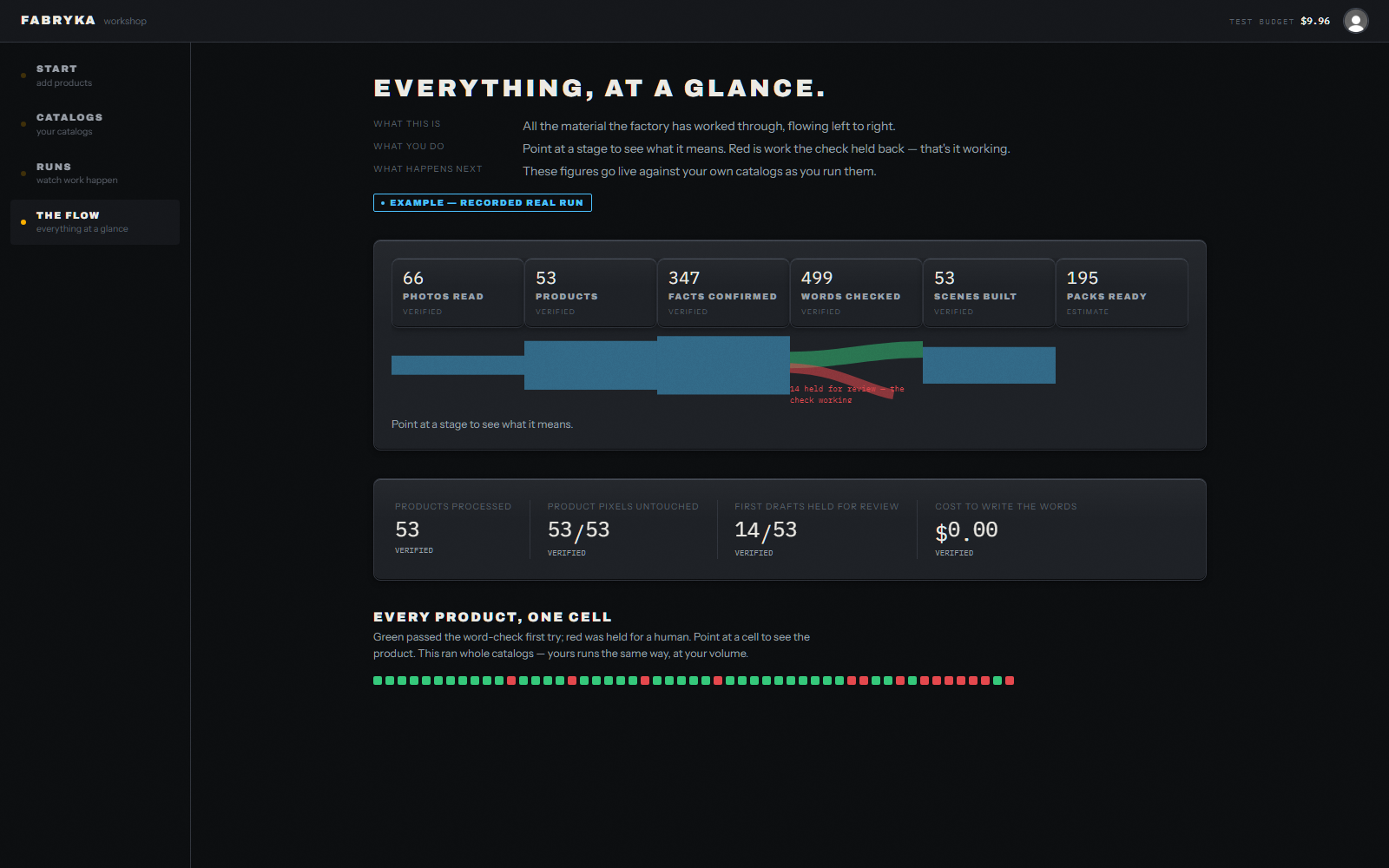
51 products across three catalogs ran the full line on production: 58.8 percent passed the facts gate first try, 51 of 51 scenes kept every product pixel byte-identical, 1,424 claims cross-validated, about 93 seconds of machine time per finished listing.
METRICS
M.01 — FIRST-PASS FACTS-GATE RATE
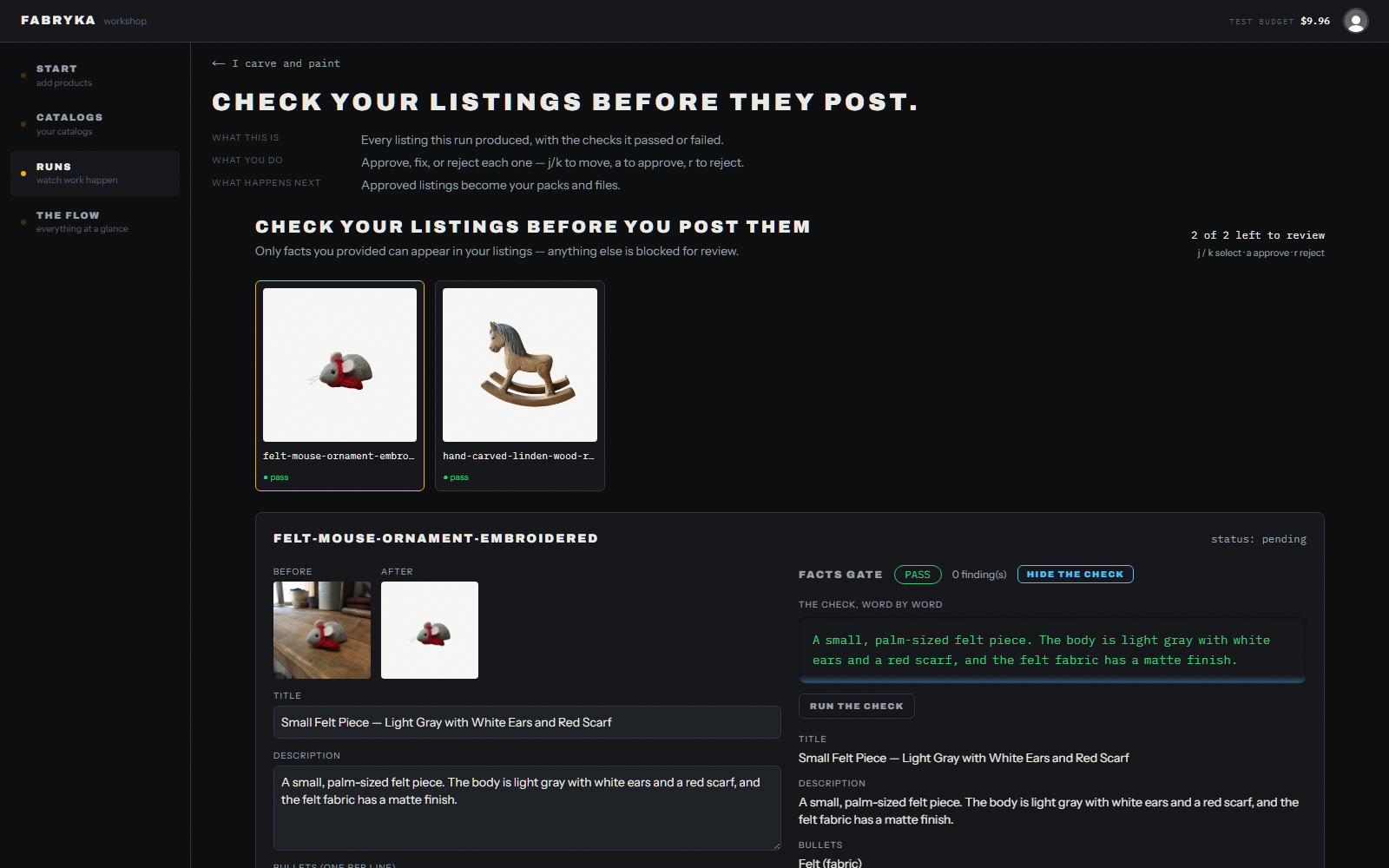
30 of 51 products passed the deterministic facts gate on their first draft. The held 21 are the check working, kept visible with reasons, and a held draft is fixed and re-checked in seconds.
M.02 — PIXEL TRUTH HELD
Every generated scene re-overlays the original product pixels byte-exact. The AI can style the background, never the product.
M.03 — CLAIMS CROSS-VALIDATED
Individual copy claims checked word-by-word against the merchant's provided facts across the 51-product fleet.
M.04 — MACHINE TIME PER LISTING
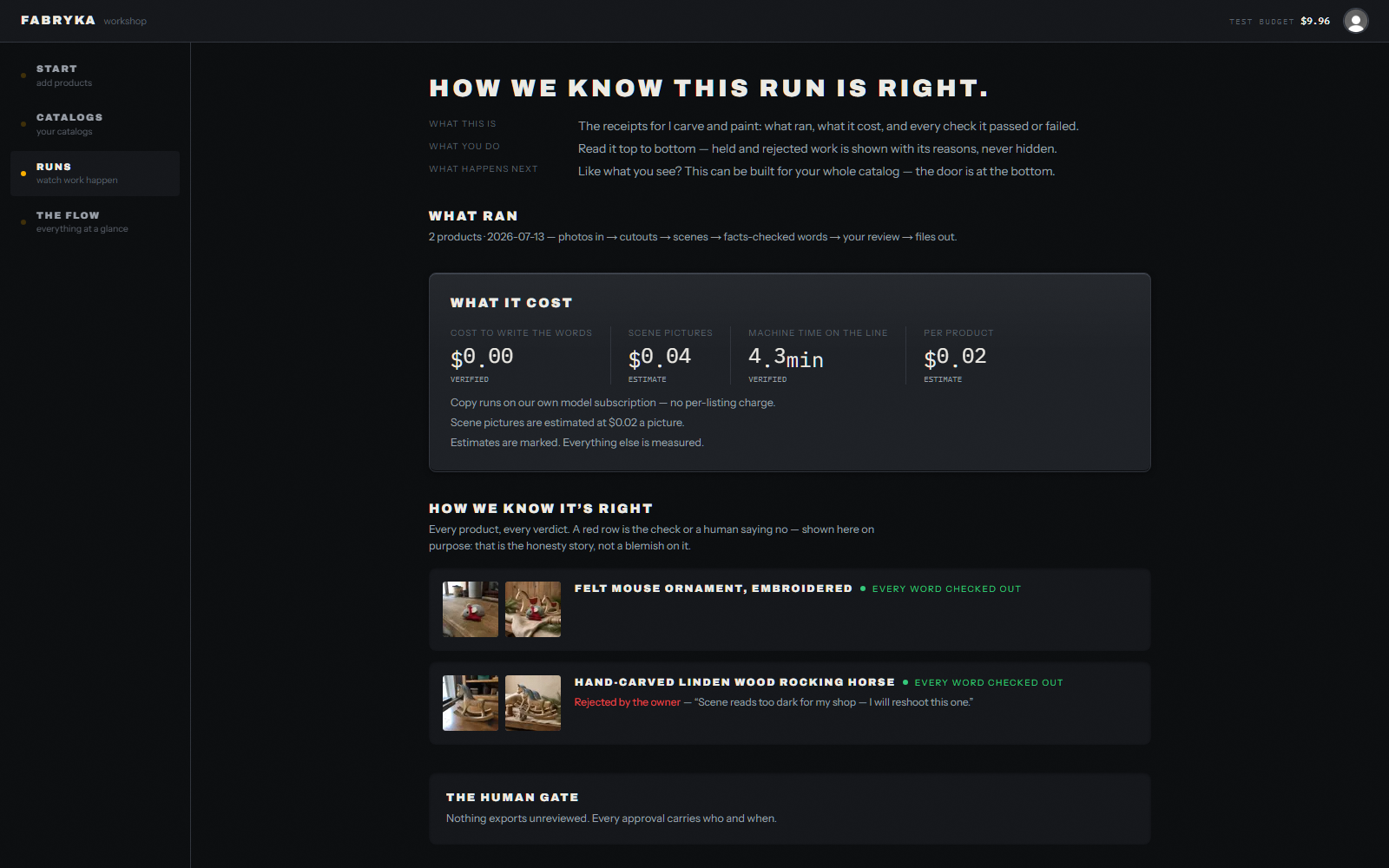
Productive machine time per finished, checked, multi-platform listing (cutout, scene, re-overlay, copy, gate), measured per job attempt, not wall clock.
M.05 — DUPLICATE ARTIFACTS ACROSS 3 CRASH TESTS
An organic native segfault, a deliberate mid-batch kill, and a real unplanned PC reboot: the queue resumed every time with no duplicates and no double charges.
CH.01
The problem
A scaling brand produces listings in the worst way possible: a studio shoot per collection, a copywriter's week per hundred products, then days of reformatting for each marketplace. Industry practice puts one done-well listing at 45 to 90 minutes of skilled time. A 200-product drop is 150 to 300 person-hours. The AI tools that promise to fix this stop at the picture or skip the truth. No product in the field traces a claim to a verifiable source, and a copy tool that invents "stainless steel" on a product page is a return wave and a false-advertising problem, not a time saver.
CH.02
What I built
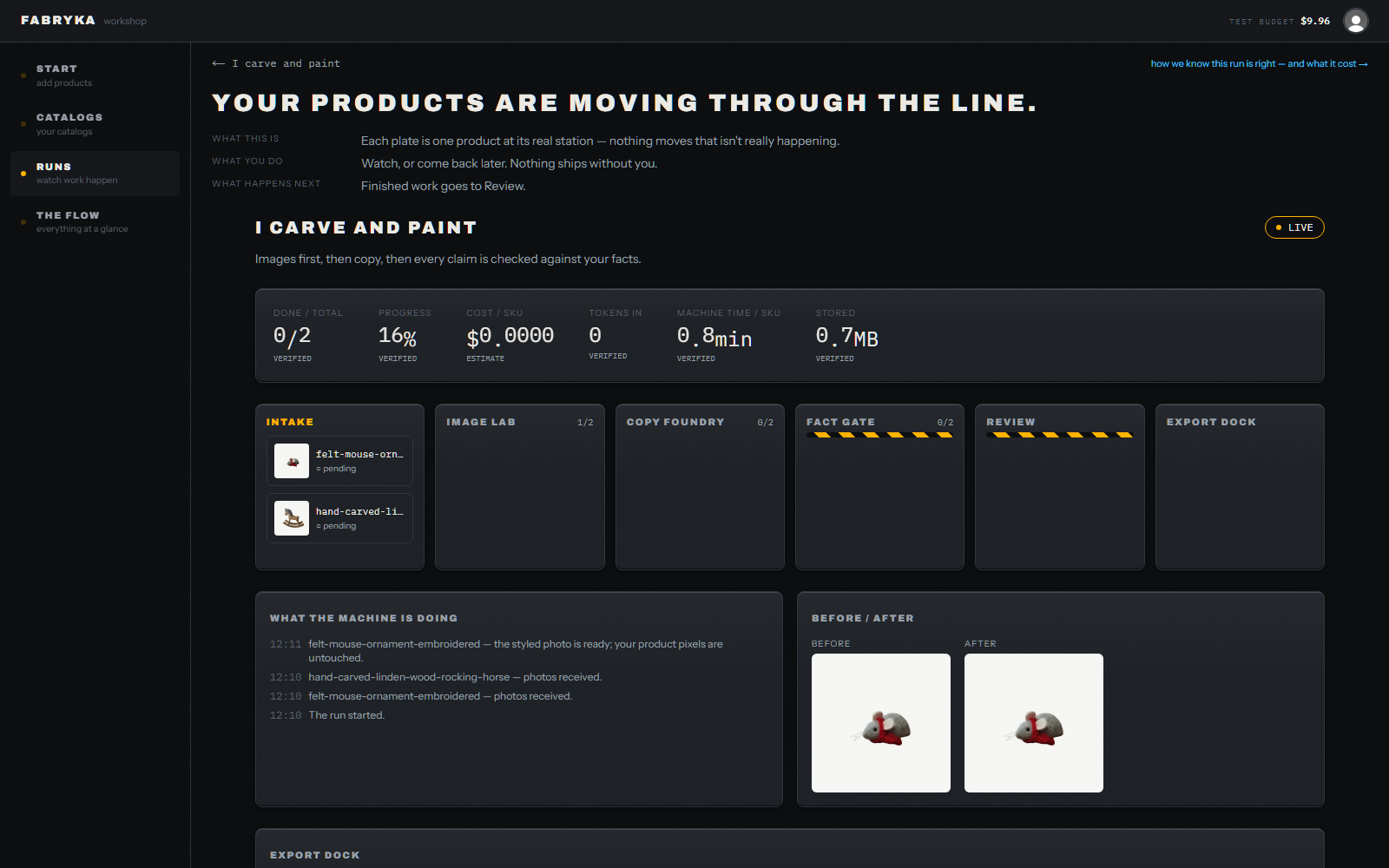
Fabryka is a listing factory that treats truth as a structural guarantee, not a score. A merchant drops in phone photos and describes the products in their own words. The machine groups the photos, proposes the facts it can actually see, and waits: every guess needs a yes, a fix, or a no on one confirm screen before any paid compute runs. Then the line runs: a local GPU cuts the product out, an image model builds a styled scene around it, and the original product pixels are deterministically re-overlaid, byte-exact. Copy is drafted from the confirmed facts and passed through a deterministic whitelist gate that checks every word. Any claim it cannot trace fails the product into review. A human approves, fixes, or rejects each listing, and only approved work becomes per-platform packs for Etsy, eBay, Amazon Handmade, Facebook, and Shopify, plus store import files.
CH.03
How it works
The UI is the production floor made visible: products travel through named stations and every number on screen is a live instrument, marked verified, estimate, or market research. The runtime splits across Vercel (UI and thin API) and an always-on PC (GPU cutout sidecar, scene calls, Claude-drafted copy through a local model router), joined by a Neon Postgres job queue with per-process leases, mid-job lease renewal, and crash-safe resume. Idle, the worker polls a wake flag and never touches the database, so infrastructure cost sits at zero between batches. Access is by invite with an owner-funded test budget: a real ledger meters every paid call, pauses the batch gracefully at zero, and resumes on top-up. Balances reconcile to the cent.
CH.04
Results
Three fictional-maker catalogs (51 products, 63 photos) ran the full line on production. 30 of 51 passed the facts gate on the first draft, 58.8 percent. The 21 held products are the check working, shown with reasons, and a hold is not a dead end: fix the words or add the fact that backs them and the same check runs again in seconds. All 51 scenes kept product pixels byte-identical, 1,424 claims were cross-validated, and measured machine time is about 93 seconds per finished listing at roughly three cents of image compute (estimate, with copy on a flat model subscription). That first-pass figure is the current measurement, not the best one recorded: an earlier engine path scored 84.3 percent, and moving every model call onto one local router redistributed which drafts get held rather than degrading them, with the weakest catalog becoming the strongest. The published number is whichever one was last measured. The sharpest proof came from Marta's candle catalog: her sparse facts passed only 2 of 15, because the gate honestly blocked the words "fragrance" and "scent" that she never provided. Enriching her own description licensed those words and the rerun passed 13 of 15, with the gate untouched. The pipeline survived an organic segfault, a deliberate mid-batch kill, and a real unplanned reboot with zero duplicate artifacts and zero double charges. The whole acceptance path (fresh account, real invite, real budget, one fix and one rejection verified downstream) was run by an agent on production, screenshots committed, no human in the loop.
FROM THE OPERATOR'S SCREEN

STACK
SKILLS DEMONSTRATED
Fail-closed verification architecture (whitelist gate, no ML in the authoritative path) · Deterministic image compositing with byte-exact integrity guarantees · Crash-safe distributed job queue (leases, mid-job renewal, resume-aware stages) · Hybrid cloud + local-GPU runtime with zero idle infrastructure cost · Money ledger with atomic balance ops and graceful mid-run exhaustion · Agent-run end-to-end acceptance on production (real accounts, real spend, screenshots) · Honest metrics methodology, every number traced to a logged run or labeled