GEO & AI search — 2026-06-27PUBLIC
How to get cited by AI answer engines in 2026
Answer engines don't rank pages. They pick a citation set of three to five sources. This is the full 2026 playbook for getting into it: index fast, stay crawlable, write liftable passages, build entity authority, and prove the citation, with every number sourced or flagged.
≈ 23 min read

A buyer has something they need automated, and they don't open Google. They ask ChatGPT, Perplexity, or Google's AI Overview: who can build this for me? The engine reads the question, pulls from a handful of sources it judges authoritative, and hands back a finished answer with three to five citations underneath. That's the whole transaction. There is no position one to win anymore.
There's a citation set, and you're in it or you're invisible.
Getting into that set is a different sport from the SEO you learned. It's Generative Engine Optimization (GEO), and almost every habit the old playbook taught is now working against you. This is the full playbook two ways: every lever I wired into this site while making it AI-citable, reconciled with the sharpest operator frameworks going around in 2026. The conventions:
- Numbers are attributed to their sources and flagged when they're self-reported.
- Levers are ranked by impact-for-effort.
- Take the architecture. Check the scoreboard yourself.
CH.01
Why is there no "#1 ranking" to win anymore?
Answer engines don't pick pages, they pick passages, and they don't rank, they cite. They expand a query into sub-questions, retrieve passages that cleanly answer each one, then assemble a conclusion attributed to three to five sources. So optimize for "a model can lift this paragraph and attribute it to me," not "this page ranks first."
flowchart TD
  Q[Buyer asks the engine a question] --> X[Engine expands it into sub-questions]
  X --> R[Retrieves passages that answer each sub-question]
  R --> A[Assembles one finished answer]
  A --> C[Cites three to five sources underneath]
  C --> V{Is your passage in the set}
  V -->|yes| W[You are the recommendation]
  V -->|no| N[You are invisible]
That single shift breaks the inherited toolkit, because the old toolkit optimizes for the click and almost every habit it teaches is now harmful. You write a headline to win the scroll. You bury the answer mid-page to hold time-on-site. You spray internal links to pass authority around your own domain. You pad with keywords. An answer engine renders all of it useless: it reads the page, extracts the factual core, and leaves. If your real answer sits under four hundred words of throat-clearing, the model either skips you or extracts the wrong fragment and cites that. It does not care about your dwell time. It cares about one thing, whether your page delivers a dense, verifiable, structurally clean answer to the question it's resolving right now. Optimize for the click and you forfeit the citation.
CH.02
What actually gets you cited: the short version
Four levers do most of the work in 2026: get indexed fast in Bing and Google, let AI crawlers actually read your HTML, shape a small set of pages so the answer is liftable, and build entity authority. Everything below ranks roughly in that order.
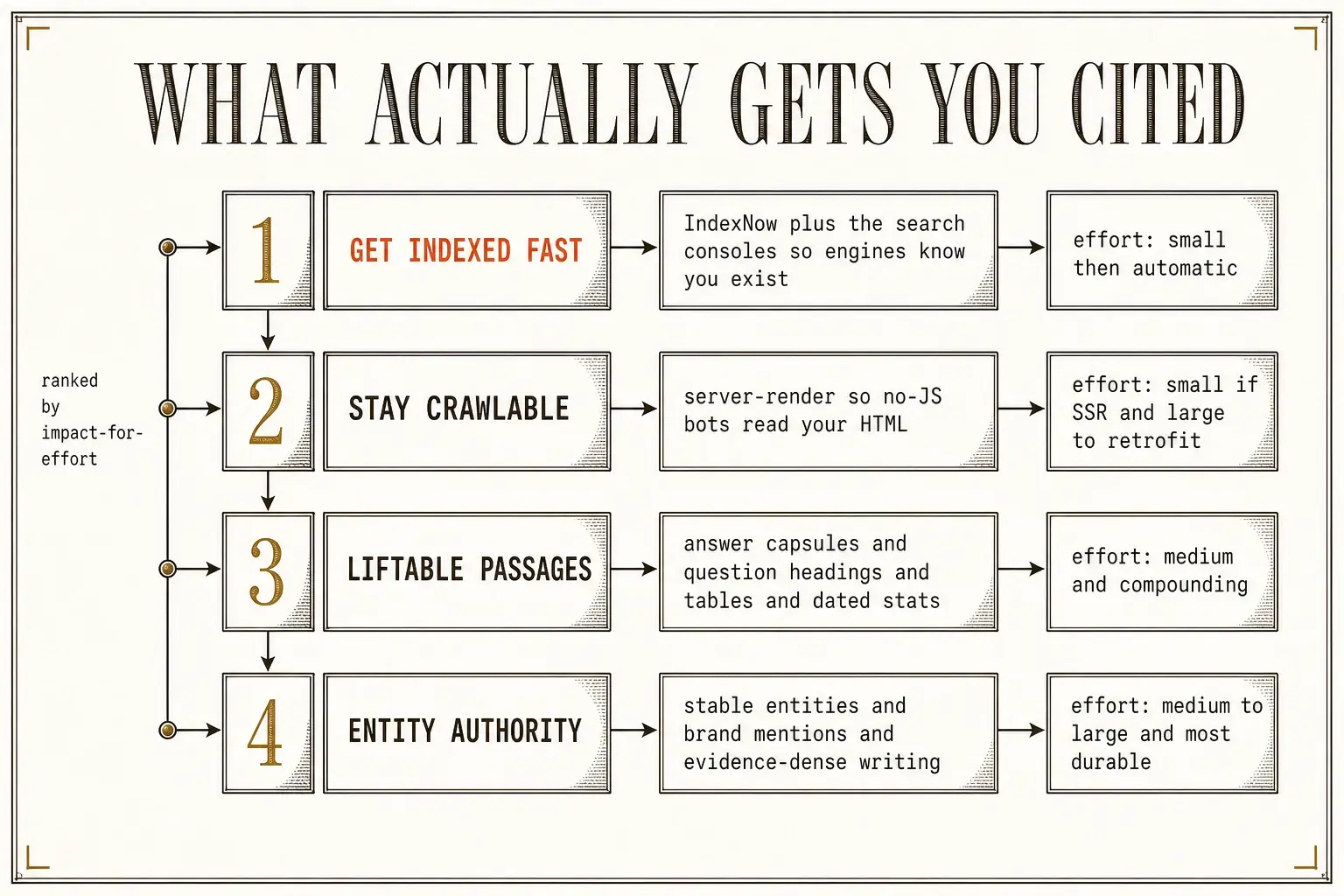
| Lever | What it does | Effort |
|---|---|---|
| Get indexed fast | IndexNow + Search Console + Bing Webmaster so engines know you exist | Small, then automatic |
| Stay crawlable | Server-render so no-JS bots read your HTML. Don't get WAF-challenged | Small if SSR, large to retrofit |
| Liftable passages | Answer capsules, question headings, tables, dated stats | Medium, compounding |
| Entity authority | Stable entities, brand mentions, evidence-dense writing | Medium–large, most durable |
Caching and llms.txt are real but secondary. The reverse-engineering loop and the cluster strategy are how you turn the four levers into a repeatable machine.
CH.03
How do you find the queries that actually get cited?
Go three layers deep and target hyper-niche queries with sharp intent, because the head terms are already locked up by the high-authority domains engines fall back on by default. "Fitness" is the worst possible entry point for a new site. "Kettlebell training for over-50s in the UK" is the opening. At that depth, Perplexity has very few authoritative sources to choose from, which is exactly why a well-structured page on a low-authority domain can break into the citation set.
The weak-SERP wedge
The competitive logic is inverted from classic Google SEO. You're not trying to outrank a strong source. You're trying to exist in a space where strong sources haven't shown up. There's a sharper version worth isolating: hunt for weak-SERP queries where Perplexity's existing citations are broken, thin, or off-topic. It's the lowest-effort wedge in the whole framework.
Depth before volume
But volume is downstream of depth, not a substitute for it. A new site that publishes a hundred thin articles across a hundred broad keywords gets ignored, full stop. Topical depth comes first: ten to thirty pages on one tight cluster before you expand to the next. Without that cluster you have no entity coherence, the signal that tells the model you actually know the subject rather than having keyword-stuffed a page about it. You don't scale your way into citations. You earn the right to scale by proving depth on one topic first.
CH.04
How do you get indexed fast?
The fastest legitimate path for a new domain is IndexNow plus the search consoles, and Bing matters far more than its market share suggests, because ChatGPT Search and Microsoft Copilot are grounded in Bing's index. If you're not in Bing, those engines literally cannot cite you.
Concretely, the setup steps:
- Verify in Google Search Console: submit the sitemap, and use URL Inspection → Request Indexing for key URLs.
- Verify in Bing Webmaster Tools and submit the sitemap.
- Implement IndexNow so every publish pings the index.
Bing reports 80M+ sites using IndexNow, ~5B URLs submitted per day, and a share of newly-clicked URLs that has climbed to 22% by late 2025 (up from ~17% in 2024),1 so it materially shapes what Bing knows. Google still recommends sitemaps + URL Inspection for fast recrawl.
Force-indexing and the Perplexity dependency
There's a non-obvious dependency worth knowing: Perplexity leans heavily on the mainstream search indexes (Google and Bing) it reads from. You don't optimize Perplexity directly. You optimize the indexes it reads from. The practical move is force-indexing. One practitioner claims four to eight weeks to land citations on a winnable query. Treat that as a creator-stated timeline, not a guarantee. Effort: small, then automatic.
CH.05
Can AI crawlers actually read your page?
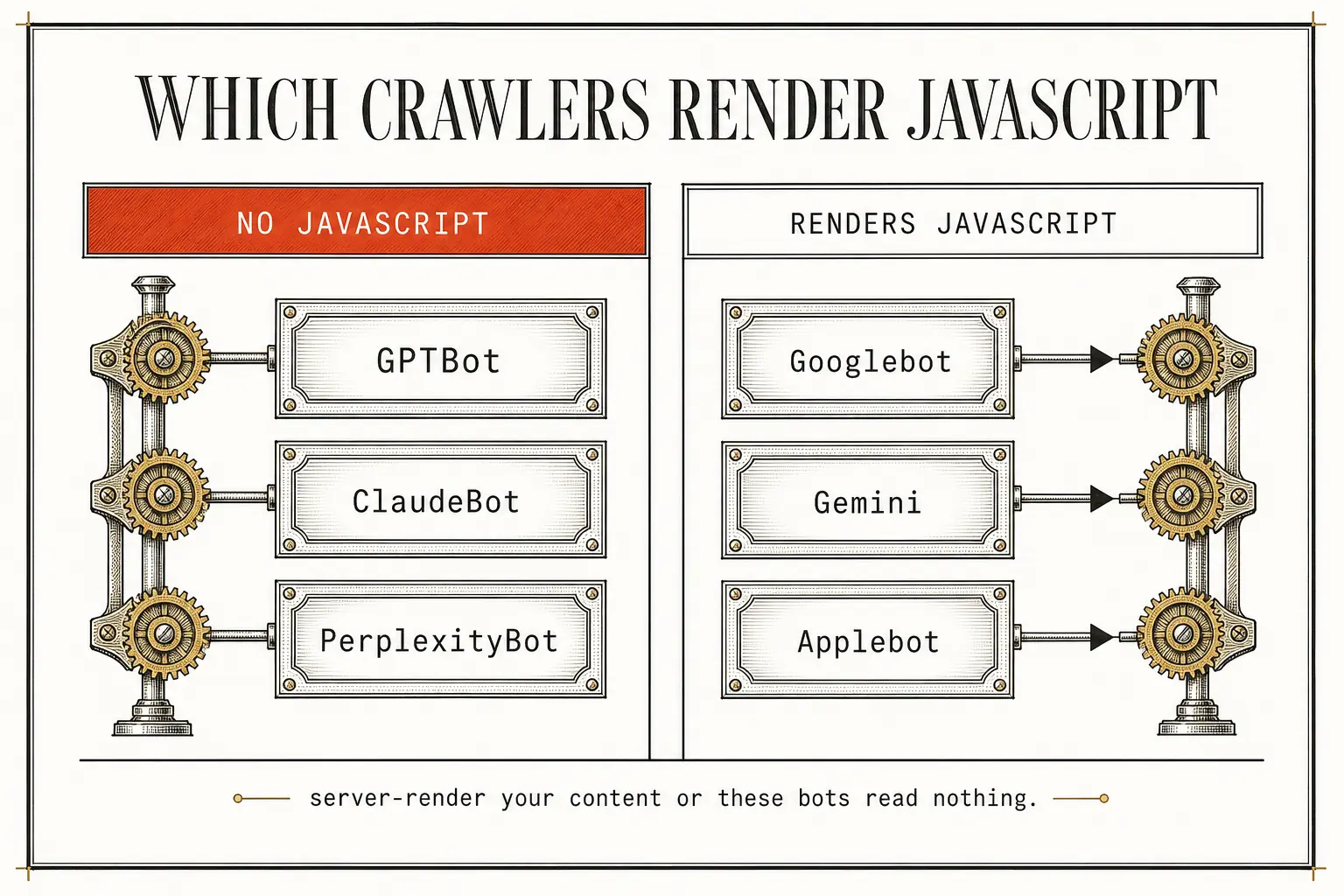
The most common reason a page "can't be fetched" isn't a block. It's a JavaScript-only shell, a WAF challenge, or a redirect. Independent benchmarks (Vercel + Merj, searchVIU) consistently find that GPTBot, OAI-SearchBot, ChatGPT-User, ClaudeBot, PerplexityBot and CCBot do not execute JavaScript,2 they read raw HTML and stop. Only Googlebot/Gemini and Applebot render JS reliably.
Keep it server-rendered
So keep core content server-rendered (SSG/ISR/SSR), with all text and schema in the initial HTML, never client-only. Allow the AI user-agents in robots.txt. Confirm your CDN or WAF isn't silently challenging them or their IP ranges. When something returns 200 in your browser but an engine "fails to fetch," it's almost always one of those three. Test each key URL with the bot's user-agent and confirm 200 HTML with the body text present. Treat SSR as non-negotiable. Regress to client-only rendering and you go invisible to most AI crawlers. Effort: small if you're already SSR, large to fix later.
Two myths die here:
- Blocking GPTBot does not leave ChatGPT Search untouched. GPTBot and OAI-SearchBot both feed ChatGPT's retrieval, so block one and you can lose search visibility too.
robots.txtis not a reliable block for AI training. Many training bots ignore it, so real enforcement needs WAF-level controls.
CH.06
How do you shape a page so the answer is liftable?
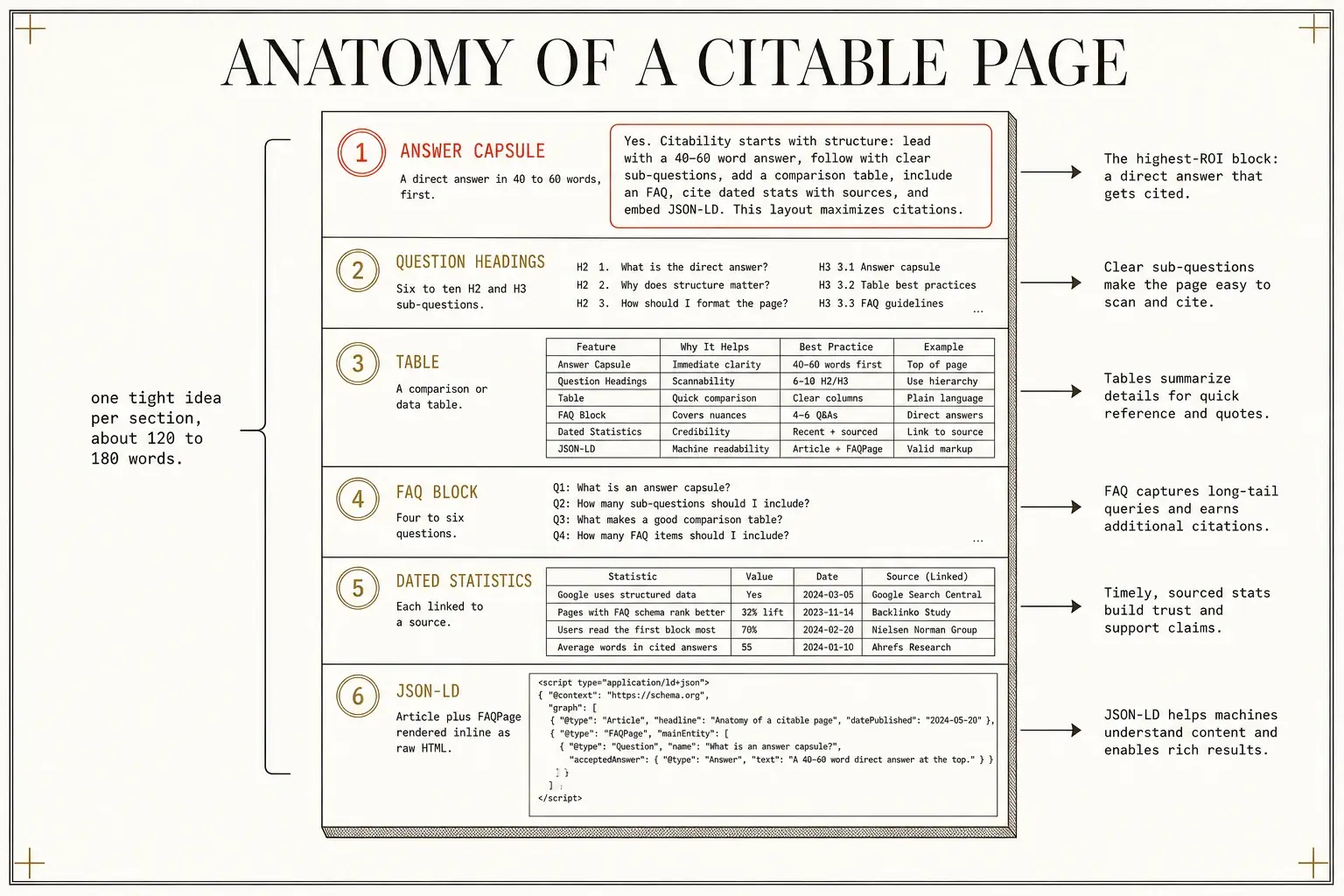
Open every section with a 40–60 word answer capsule that directly answers the question in its heading, keep each section to one idea in about 120–180 words, use question-style H2/H3s, and add tables, an FAQ, and dated statistics with sources. This is the highest-ROI editorial change you can make.
The evidence is unusually concrete. The Princeton GEO study (Aggarwal et al., KDD 2024) found that adding citations, quotations, and statistics raised a source's visibility in generative answers by up to 40%, with adding statistics, citations, and authoritative quotes among the highest-impact tactics.3 Vendor analyses report pages built from short answer blocks plus question headings get cited far more than dense prose, and that pages appearing in AI Overviews are roughly 3.2× more likely to carry FAQ schema.4 Read that as correlation, not cause: a controlled study tracking 1,885 schema-added pages found citations barely moved, because engines lift visible HTML and ignore JSON-LD during retrieval.5 The answer-block writing does the work. The schema is cheap insurance.
The mechanical architecture, stripped of funnel theatre:
- Open with the answer. A direct, declarative response to the target query in the first fifty words, no preamble. Wrap it in schema so the extractable fragment is unambiguous.
- Mirror the next questions in your headings. Build the body as H2/H3 headings phrased as the sub-questions a reader logically asks next: six to ten deep H2 sections plus a four-to-six-question FAQ block. Engines read depth as authority.
- Make it entity-aware. Weave specific named brands, people, places, and products through the prose so the parser registers concrete data, not generic copy. One practitioner's heuristic ("generic content without real entities gets flagged as spam") is directionally right: named entities are how the model grounds your page in a real subject.
- Cite outward, link inward. Every factual claim links to a credible external source. Every internal concept links to another page in your cluster (four to six internal links per article). The first builds verifiability, the second builds the depth signal.
- Add the JSON-LD stack.
Articleschema for author, date, and publisher.FAQPagefor snippet eligibility. Rendered inline as raw HTML.
There's a more aggressive structural move worth knowing even if you choose not to run it: That's GEO crossing into influence engineering: not just getting cited, but trying to control the sentence the model emits. Know the move so you recognise it when a competitor runs it on your queries.
Automated freshness
The last requirement is automated freshness. Answer engines filter hard for recency, so a page citing 2023 statistics gets deprioritised even when the information is still accurate. The fix is a scheduled workflow (an n8n automation or similar) that refreshes dates, current statistics, and live links on a cadence so the page never ages out of the set. That's the difference between content as a published artifact and content as a maintained asset. Effort: medium, very compounding.
CH.07
Which pages should you actually build?
Answer engines need query-aligned landing pages, not just a strong homepage narrative. Define the 3–5 jobs a buyer would phrase to an AI ("who can build AI agents to automate reporting for a B2B SaaS?") and build a page per job.
Each page wants: an H1 in the language of the query, a top capsule answering who / what / for whom / where / how-fast in 40–60 words, one flagship case-study excerpt with hard metrics linking to the full study, a short FAQ (cost, speed, how to start), and Service/Product JSON-LD with areaServed, serviceType, and provider linking back to your Person/Organization entity. AI Overviews and ChatGPT Search expand a query into fan-out sub-questions and prefer pages that clearly match intent over a generic homepage. Effort: medium, mostly repackaging material you already have.
CH.08
How should you handle structured data and paywalls?
Use Article/BlogPosting (with author, publisher, and dates), FAQPage for Q&A, and HowTo for genuine step-by-step workflows, and for gated content, mark the page free and only the locked block gated.
The myth to kill: isAccessibleForFree: false on the whole article reads to an answer engine as "paywalled, don't cite." Google's own guidance treats the flag as anti-cloaking metadata, not a reason to drop you. Correctly-marked paywalled publishers still get cited. The real failure mode is flagging a mostly-free page as entirely gated. For passages you genuinely don't want quoted, use data-nosnippet / max-snippet / X-Robots-Tag, not the paywall flag. Effort: medium.
CH.09
How do you reverse-engineer the citation set?
Structuring the page is only half the work. The other half is actively copying the structural patterns of whatever the engine is already choosing. This is the most genuinely useful mechanism in the playbook, and the loop is concrete:
- Query Perplexity for your target keyword.
- Read which sources it currently cites.
- Map the patterns those sources share: how they open, how they structure data, which entities they reference, what schema they use.
- Update your page to match those patterns.
- Re-submit and re-query.
flowchart LR
  Q[Query Perplexity for your keyword] --> S[Read the sources it cites]
  S --> M[Map the patterns they share]
  M --> U[Update your page to match]
  U --> RS[Re-submit and re-query]
  RS --> Q
This is alignment, not plagiarism. If Perplexity consistently cites pages that open with a bulleted list of statistics, you restructure your opening to lead with one. If it favours pages with clearly marked author bios and linked references, you add them. You're teaching the model that your page speaks the same structural language as the sources it already trusts. A far more tractable target than guessing what "quality" means in the abstract.
One hard rule makes or breaks the loop: publish to a real owned domain. Subdomains, Medium, and Substack underperform because they lack the domain-level entity coherence engines reward. The citation accrues to the platform, not to you.
CH.10
How do you scale beyond one page?
Once a page is cited, you scale by deepening the cluster, not by chasing a new topic. Build a second page targeting a related hyper-niche query inside the same cluster, same architecture, cross-linked tightly to the first. The engine now sees a domain with deep, interconnected coverage of one subject, which raises the odds it cites you for adjacent queries you never explicitly targeted. Depth bought once pays out across the neighbourhood.
Scaling as a pipeline
At volume this becomes programmatic SEO on an agent stack. The engine is a keyword-to-article pipeline: feed it a list of keywords overnight and it chains three skills: web research for live SERP data, drafting against a brief and a brand voice, and publishing to WordPress or Netlify, to produce structured, internally linked drafts ready for review. One practitioner's model tiering runs a mid-tier model as the workhorse, a frontier model for high-level strategy, and a coding agent to automate the clustering itself.
flowchart LR
  K["Keyword list, fed overnight"] --> R["Web research: live SERP data"]
  R --> D["Draft against brief + brand voice"]
  D --> P["Publish to WordPress or Netlify"]
  P --> Rev["Structured, linked drafts for review"]
The non-negotiable piece is the quality gate: either a second automated pass that checks the draft against a checklist, or a lightweight five-to-ten-minute human review. This is the honest centre of the whole approach. Pure AI content with zero human review is the fastest way to earn a sitewide quality demotion, but the human layer is deliberately light, minutes per article, not hours. The split operators settle on is roughly 80% agent-produced content and 20% human deep-expertise and editorial, and when something is off, the instinct is to fix the skill, not the article. You refine the system that produces a thousand outputs, not the one in front of you.
"You're better off shipping 100 great AI-assisted articles than 10,000 thin ones."
The most credible head-to-head sharpens why this works. On a coding-agent SEO setup, one operator reports manual production at roughly six hours and £300 per article against the agent's thirty minutes at around $50/month all-in, and frames the win not as better writing but as throughput: "Rankings improved because I had more shots on goal, not because the agent's writing was magic," and "The agent isn't going to win a Pulitzer, but it ranks." That candour is the tell that this part is substance, not pitch. He concedes the agent loses outright in high-trust niches (medical, legal, financial), original interviews, and creative prose, which is exactly where the human 20% belongs.
CH.11
Caching and llms.txt: the secondary levers
Serve public pages with shared-cache-friendly headers (Cache-Control: public, plus ETag/Last-Modified), and keep an llms.txt, but treat both as hygiene, not as ranking magic.
On caching: no-store is about caching, not indexing. Engines can still index a no-store page, but AI-crawler references note that crawlers use ETag, Last-Modified, and Cache-Control to prioritise freshness and avoid needless refetches, and private on a public page confuses that logic. Keep private, no-store only for genuinely authenticated endpoints.
The llms.txt file
On llms.txt: treat it as an AI-oriented sitemap, not a lever. A 300K-domain study found ~10% adoption and no statistically significant citation lift once you control for content quality and authority.6 Prerender's 2026 guide is blunt that it "does not control indexing." Ship it anyway. List your primary sections and point to clean Markdown exports, because it's nearly free and dev-facing AI tooling does read it. Just don't expect ranking magic. Effort: small.
CH.12
Why is authority the real moat?
Entity clarity and brand mentions predict AI citations more strongly than backlinks do. One Ahrefs study of 75,000 brands put the correlation of unlinked brand mentions with AI-citation probability at ≈0.664 versus ≈0.218 for backlinks.7
For a solo brand, four things:
- Stable
@identities in your JSON-LD, withsameAsto every profile (GitHub, LinkedIn, talks, interviews). - One name, everywhere. Consistent brand, a real author bio, no variants.
- Third-party mentions that name you as the builder. Slow, and the part you cannot fake.
- Claims phrased to be quoted. "In our btc-bot system we processed N events/day at Y µs" survives being lifted out of context. "Industry-leading performance" does not.
Non-promotional, evidence-dense writing correlates positively with citation. Salesy copy correlates negatively. Write like a source, not a brochure. Effort: medium–large, but the most durable lever.
That "slow accumulation" has no shortcut. It is earned one surface at a time, and each has its own physics:
- Where the mentions actually land, ranked by signal per hour. Start here, because most of the list is not worth your Tuesday.
- The channel you own instead of rent. Every other surface on this list can change its mind about you overnight.
- LinkedIn without the brochure voice, which is the specific problem a technical founder has there.
- The same compounding on X, where the loop is faster and the failure mode is posting into a void.
- Keeping the right to republish, which quietly decides how far a single piece can travel.
CH.13
How do you prove it worked, and keep measuring?
The metric that proves the framework is the citation itself. Does your domain appear in the source list when you query Perplexity, Google AI Mode, or ChatGPT for your target keywords? Everything else is a proxy. And you can't use a rank tracker, because there's no position one to track.
The verification workflow
The verification workflow is manual at first, automated as you scale. Manually: query the engine, check the citations, log whether you appear and where, and when you're absent, audit the three legs:
- was the page structured wrong,
- was the supporting content thin,
- was the topical depth missing?
At scale, a scheduled query-runner hits the engines on a cadence and logs which domains land in the citation set over time, supplemented by referral traffic (Perplexity shows up as a distinct source in analytics). Commercial trackers, Otterly.AI, Peec AI, Profound at the enterprise tier, do the same across ChatGPT, Perplexity, AI Overviews, Gemini and Copilot.
I built the query-runner instead of renting one, and it runs weekly on my own brand. Two properties are the whole reason to own it:
- Verbatim answers, not scores. A number you cannot reconstruct from the raw text is a proxy wearing a metric's clothes, which is what this chapter says not to settle for.
- History the vendor cannot revise. Each week seals into an append-only snapshot the database itself refuses to mutate. A rented tracker keeps your record on its servers. Pair any of them with server-log analysis of AI user-agents so you can see crawl → citation, and sanity-check against AI-crawler benchmark reports (Vercel, Merj) so a stack change hasn't broken visibility.
Track continuously, then decide
Why bother with continuous tracking? AI citations drift 40–60% month over month (Profound's analysis of 240M ChatGPT citations found 40–60% of cited domains change month to month, and 70–90% over six months),8 so one-off "did ChatGPT mention me" checks are useless. Define a fixed prompt set around your real buyer queries and run it weekly.
The decision rule is clean and usable:
CH.14
What's the 30-day plan?
A 30-day sequence with an explicit decision gate at each step, because the framework only works if you verify at each gate instead of publishing and hoping.
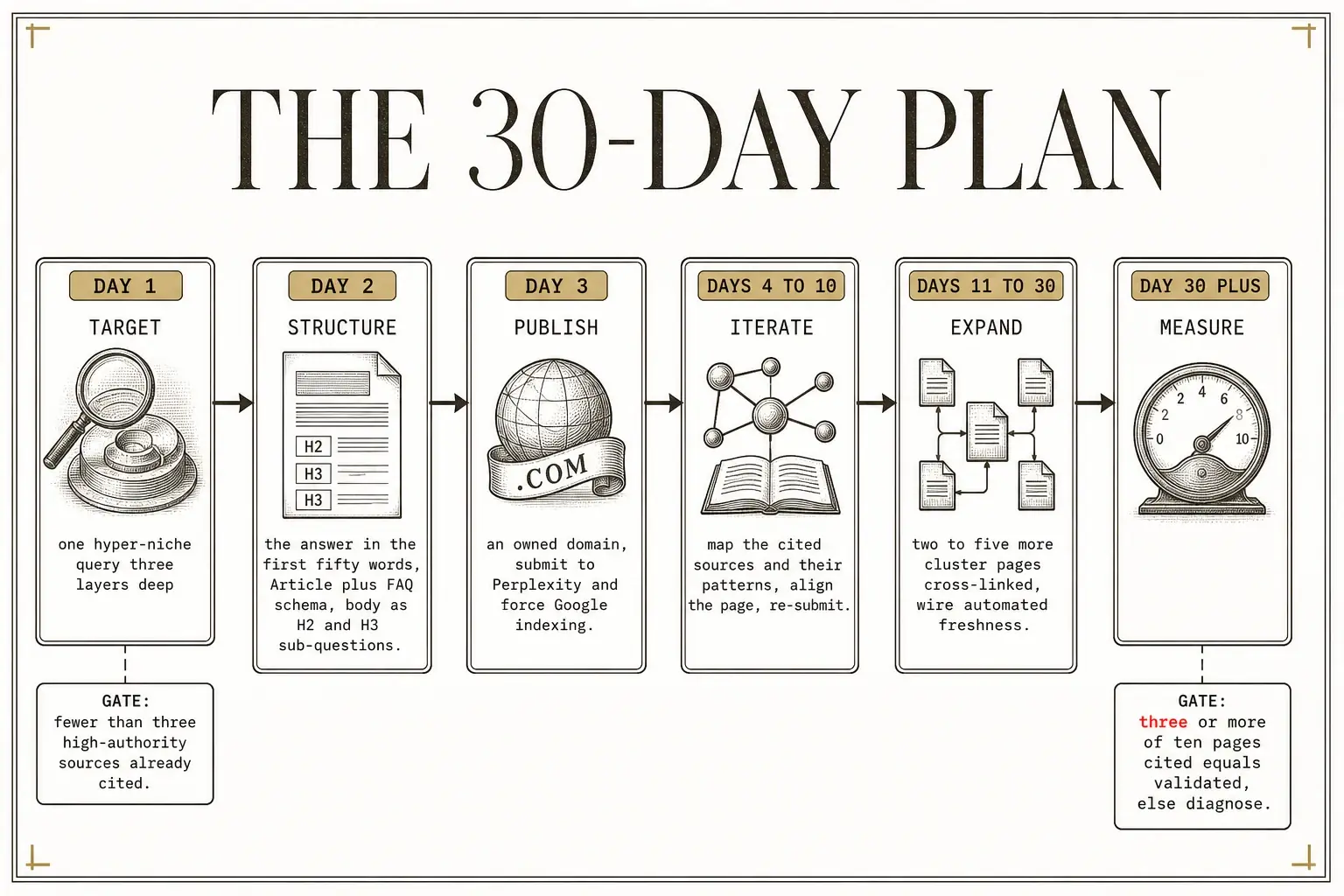
- Day 1: Target selection. Identify one hyper-niche query, three layers deep. Gate: confirm Perplexity currently cites fewer than three high-authority sources for that exact query, and look for a weak existing citation you can replace. If it's already locked up by strong sources, go deeper before proceeding.
- Day 2: Structure the page. Write the direct answer in the first fifty words. Add
Article+FAQschema. Build the body as H2/H3 sub-questions. Link every factual claim outward to a credible source and every internal concept to a cluster page. Create stub pages for concepts that don't exist yet. - Day 3: Publish and submit. Upload to your owned domain (not a subdomain or Medium). Submit the URL to Perplexity's indexing endpoint and force Google indexing.
- Days 4–10: Wait, then iterate. Query Perplexity for the keyword. Map the patterns of the sources it currently cites. Align your page, opening format, schema, author bio, entity density. Re-submit. Verify: if not cited yet, wait three to five more days before assuming a crawl failure.
- Days 11–30: Expand the cluster. Build two to five more pages on related hyper-niche queries in the same cluster, same architecture, all cross-linked. Wire the automated freshness update so nothing ages out.
- Day 30+: Measure and compound. Track citations across the cluster, automating the query-checking once you scale. Gate: three or more of ten pages cited → validated, open a new cluster. Zero cited → diagnose as too-broad, buried-answer, or thin-depth, fix the specific cause, repeat. Only move to multi-site or higher volume after a single cluster shows citation velocity.
CH.15
Which myths should you ignore?
Most "AI SEO" advice is the old playbook with a new label glued on the front, and the relabeling hides what actually changed. Stop believing these.
| The myth | The reality |
|---|---|
"llms.txt is a ranking factor" |
~10% adoption, no measurable independent effect once you control for content quality. A convenience file, not a lever. |
| "Rank #1 in Google → AI Overviews cite you" | The share of AI-Overview citations from top-10 organic results fell from ~76% in mid-2025 to roughly 17–38% in early 2026.9 Structure and authority now matter as much as rank. |
| "Backlinks are the main driver" | Brand/entity mentions and factual density correlate more strongly (≈0.664 vs ≈0.218). |
| "AI crawlers render JS like Googlebot" | They mostly don't. SPA-only content is invisible to them. |
| "Blocking GPTBot doesn't affect ChatGPT Search" | GPTBot and OAI-SearchBot both feed ChatGPT's retrieval. Block one and you lose search visibility too. |
"isAccessibleForFree: false kills your AI chances" |
Google indexes correctly-marked paywalled content. The failure mode is flagging a mostly-free page as entirely gated. |
"robots.txt reliably blocks AI training" |
Many training bots ignore it. Real enforcement needs WAF-level controls. |
CH.16
What's hype, and what's substance?
Steal the architecture. Discount the scoreboard. The line between them is consistent.
The substance is worth testing wholesale:
- The core reframe: optimize for extraction, not the click, is correct and runs through everything above.
- Depth before breadth (ten to thirty pages on a cluster before expanding) is a real prerequisite, not a slogan.
- The three-layers-deep targeting and the weak-SERP wedge are genuinely low-effort, high-impact moves.
- The citation reverse-engineering loop is the single most useful mechanism here.
- The Perplexity-inherits-the-Google-index insight, and the force-indexing it justifies, is load-bearing and non-obvious.
- The 80/20 hybrid with a lightweight quality gate is the honest centre, and "100 great articles beat 10,000 thin ones" is simply correct in a year that hands out sitewide quality demotions.
- The site-level levers below, IndexNow, SSR for no-JS crawlers, answer capsules, the
isAccessibleForFreefix,llms.txtas hygiene, I've tested directly.
The hype is the scoreboard, and you should discount it heavily. A widely-followed creator's numbers are the representative case, and every figure in them is self-reported on properties nobody else can audit. Read them as a shape, not a measurement:
| Self-reported metric | Value |
|---|---|
| Published articles | 80 |
| AI Mode citations | roughly 140 |
| Monthly organic traffic | 800 rising to 4,200 |
| Click-through on cited links | two to three times typical SERP rates |
| Conversion on those links | 5–15% |
| Funnel: free-to-paid community | converting ~5% |
| Funnel: affiliate links | 2–5% |
| Funnel: high-ticket services | under 1% |
| Funnel: email list | £100–500 lifetime value per cited article |
| 90-day curve | flat through day 30, then +30%, +200%, and +500% by day 180 |
Those four funnels are the monetization model the case layers together. All of it is self-reported on the creator's own unaudited properties, the numbers are round and convenient and drift between tellings, and the headline "faster and cheaper" multipliers (and "100 citations beat 1,000 rankings") age the moment you quote them. The curve's shape is plausible, that's how compounding content behaves. The magnitudes are not bankable.
Use the structure of the measurement. Never the specific figures.
Any named model or tool version ages fast too, reverify before quoting one.
The deeper point: answer-engine optimization is a structural shift from optimizing for the click to optimizing for the extraction. The page that gets cited is the one that makes it trivial for a model to pull a clean, verifiable, entity-rich answer and move on. Build for the machine's convenience and the citation follows.
CH.17
Applied: auditing and fixing this very site
When I ran this playbook against pravda.systems itself, the problem was never whether an AI could fetch the pages. It was three quiet signals telling engines not to bother: structured data that flagged free articles as paywalled, the most AI-relevant pages set to never cache, and clean Markdown exports that nothing pointed to. Build-in-public, so here's the dogfood. The trigger was Perplexity claiming it "couldn't fetch" a page that returned a clean 200 in a browser. A six-dimension audit (crawlability, structured data, metadata, AI-discoverability, indexing, Core Web Vitals) found that access was never the problem. The signals were:
- The structured data was telling AI not to cite it. Every note carried
isAccessibleForFree: false, Google's paywall flag, even though the articles are free. Fixed:trueon the page, with the gated marker only on the actual confidential regions of each note. - The pages most meant for AI were the least cacheable. The field notes were
force-dynamicwithCache-Control: private, no-store(a cold fetch every crawl), while the static case studies were edge-cached. Fixed: public notes prerender viagenerateStaticParamsand edge-cache. Only gated entries stay dynamic. - The clean Markdown exports were undiscoverable. Every page has a
/mdexport, but nothing advertised it. Fixed:llms.txtlists them all, each page exposes atext/markdownalternate link, and/mdisnoindex(no duplicate content) but still AI-fetchable. - The boring wins. A generated OpenGraph card (it was blank),
BreadcrumbList+ enriched article schema,og:type=article+ dates, an Atom feed, IndexNow on every deploy, and LCP images no longer hidden behind anopacity:0reveal. - What no script can do. Verifying the domain in Google Search Console + Bing Webmaster: done. Both sitemaps submitted, all 14 URLs discovered.
The lesson matched the theory: for a content site, "can the AI fetch it" is rarely the real question. It's "is it indexed," "do the signals say it's free and authoritative," and "is the answer easy to lift." The audit didn't find a locked door. It found a site politely telling visitors it was closed. Still on the list: the query-aligned service pages, more entity authority, and a citation tracker. If this note gets cited by an answer engine, the experiment worked.
Sources · 10
Sources
-
Microsoft Bing's IndexNow reporting (via Bing Webmaster and Search Engine Land): 80M+ participating sites and ~5B URLs submitted per day (as of early 2026), with the share of clicked Bing URLs attributed to IndexNow rising from ~17% in 2024 to ~22% by late 2025. https://www.bing.com/indexnow ↩
-
Vercel and MERJ, "The rise of the AI crawler." Across 500M+ GPTBot fetches they observed zero JavaScript execution and concluded none of the major AI crawlers render JavaScript (GPTBot, ClaudeBot, PerplexityBot, and Meta and ByteDance crawlers among those measured). https://vercel.com/blog/the-rise-of-the-ai-crawler ↩
-
Pranjal Aggarwal et al., "GEO: Generative Engine Optimization," ACM KDD 2024. Tested nine tactics across 10,000 queries. Adding statistics, citations, and quotations lifted visibility up to ~40%. https://arxiv.org/abs/2311.09735 ↩
-
Vendor GEO analyses (ZipTie, Frase) on FAQ-schema and answer-block correlation with AI citation, including pages in AI Overviews being ~3.2× more likely to carry FAQ schema. https://ziptie.dev/blog/faq-schema-for-ai-answers/ ↩
-
Ahrefs, "We tracked 1,885 pages adding schema. AI citations barely moved." During retrieval engines extracted visible HTML and ignored JSON-LD. https://ahrefs.com/blog/schema-ai-citations/ ↩
-
SE Ranking's 300,000-domain analysis, reported via Search Engine Journal: "llms.txt shows no clear effect on AI citations." ~10% adoption, no significant lift once content quality and authority are controlled for. https://www.searchenginejournal.com/llms-txt-shows-no-clear-effect-on-ai-citations-based-on-300k-domains/561542/ ↩
-
Ahrefs, "An analysis of AI Overview brand visibility factors" (75,000 brands). Unlinked brand mentions correlated with AI citation at r≈0.664 versus r≈0.218 for total backlinks. https://ahrefs.com/blog/ai-overview-brand-correlation/ ↩
-
Profound, "AI search volatility" (analysis of 240M ChatGPT citations): 40–60% of cited domains change month to month, and 70–90% over six months. https://www.tryprofound.com/blog/ai-search-volatility ↩
-
Ahrefs, "38% of AI Overview citations pull from the top 10," down from roughly 76% in mid-2025 (BrightEdge put the early-2026 figure as low as ~17%). https://ahrefs.com/blog/ai-overview-citations-top-10/ ↩