Distribution & GEO — 2026-06-27PUBLIC
Distribution for a research-first builder: one note into AI-citable video, a white-hat short cascade, and a list you own
YouTube deleted 16 channels for feeling machine-made. The fix for a research-first builder: run one note through a fixed loop, an AI-citable long-form video, a platform-native short cascade kept legally clean by original assets not licenses, ending on an email list you own.
≈ 22 min read
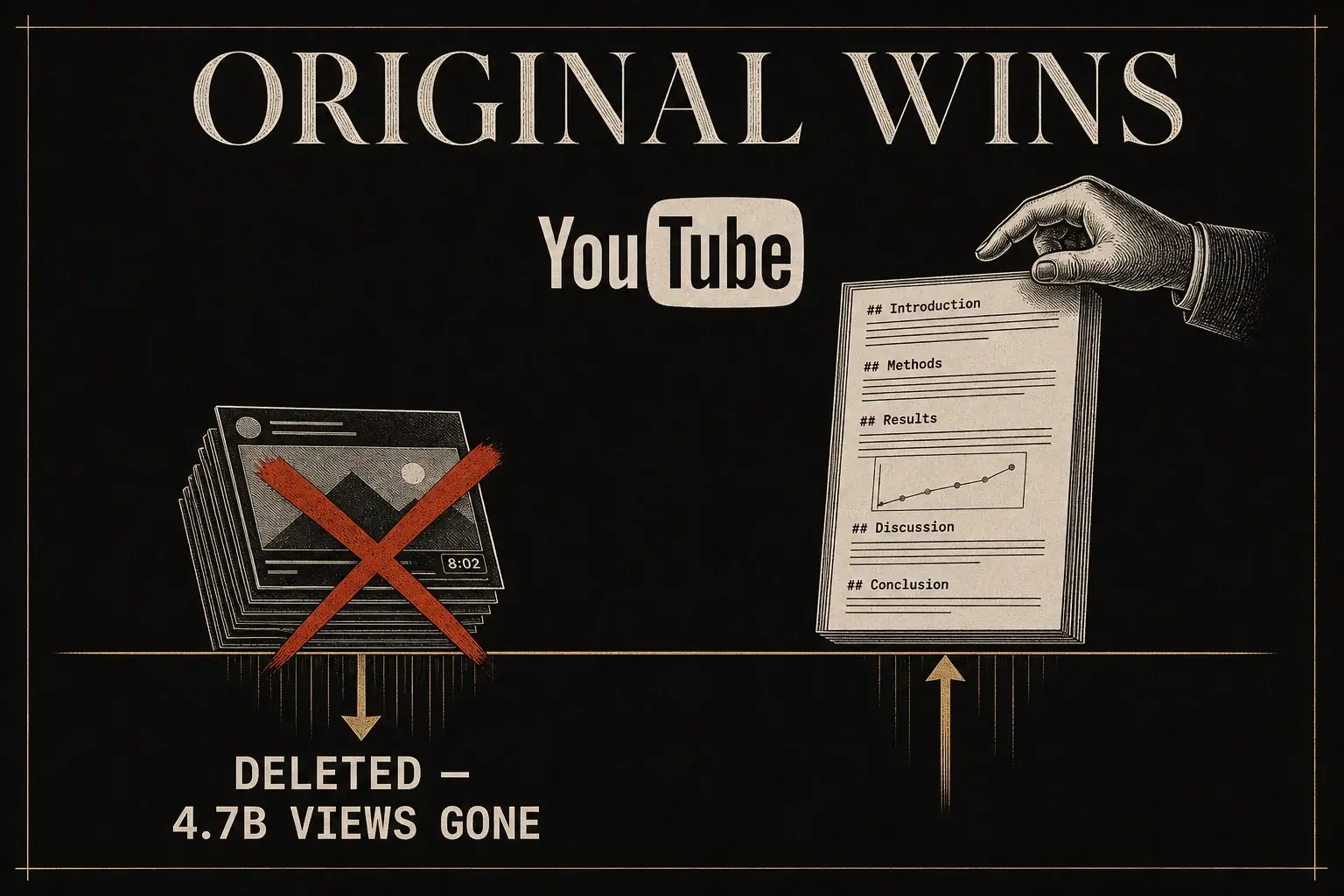
In January 2026, YouTube deleted 16 channels in a single sweep. Between them:
- 4.7 billion lifetime views
- around $10 million a year in revenue
Gone in one decision. Not for piracy, not for strikes, the platform decided the content felt machine-made, that it lacked a human creative fingerprint.1
That one event is the whole game, compressed. If you already publish deep research and you're thinking about turning it into video, the real risk isn't the AI you use to make it. It's three other things:
- whether a human is visibly behind the work
- whether you own the legal trail under every asset
- whether any of the reach you earn actually reaches you
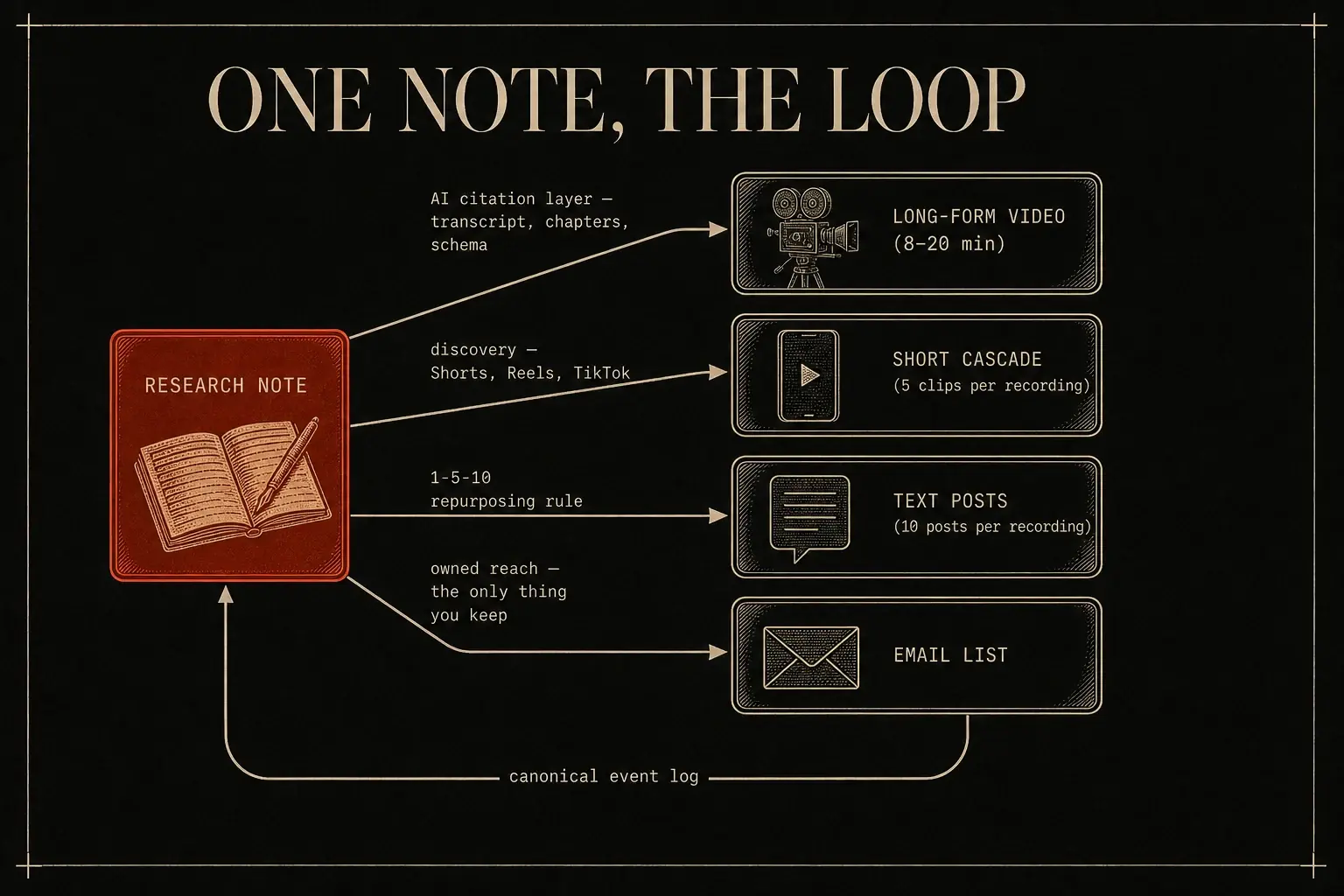
So here's the thesis, stated flat. A builder who already writes serious research doesn't win by spinning up a faceless channel. He wins by running one note through a loop:
- The note becomes a long-form video built to be cited by AI engines.
- That long-form fans out into a fixed map of short clips and posts.
- The whole thing stays legally clean because you wrote the script and shot or rendered the visuals yourself.
- And the conversion happens on a list you own, never on the platform.
The platforms are the rented road. The note and the list are the only things you keep.
The rest of this is that loop, stage by stage, starting with the question most people skip.
CH.01
Should you even be making video yet?
Say yes only if you can clear four bars at once: 8–12 strong evergreen "build" topics that map to real queries, roughly 10–15 protected hours a month for 3–6 months, a money path already wired (an offer page plus an email capture), and core queries that already surface video and AI Overviews. Miss any of those and "not yet" is the correct, non-embarrassing answer.
There are two ways this usually goes wrong, and most technical people pick one:
- The first reads that YouTube is the highest-impact channel left, buys a microphone, films three times a week, and burns out at week six with a pile of mediocre videos.
- The second decides video is too much work for a solo operator and skips it entirely, while the answer engines their buyers now open first quietly hand the question to someone else's screen recording.
Both lost the same thing: the one recorded build a buyer (or an AI answering on a buyer's behalf) would have cited for years.
This is the highest-effort surface you have, so the bar to start is genuinely high, and saying "not yet" costs you nothing.
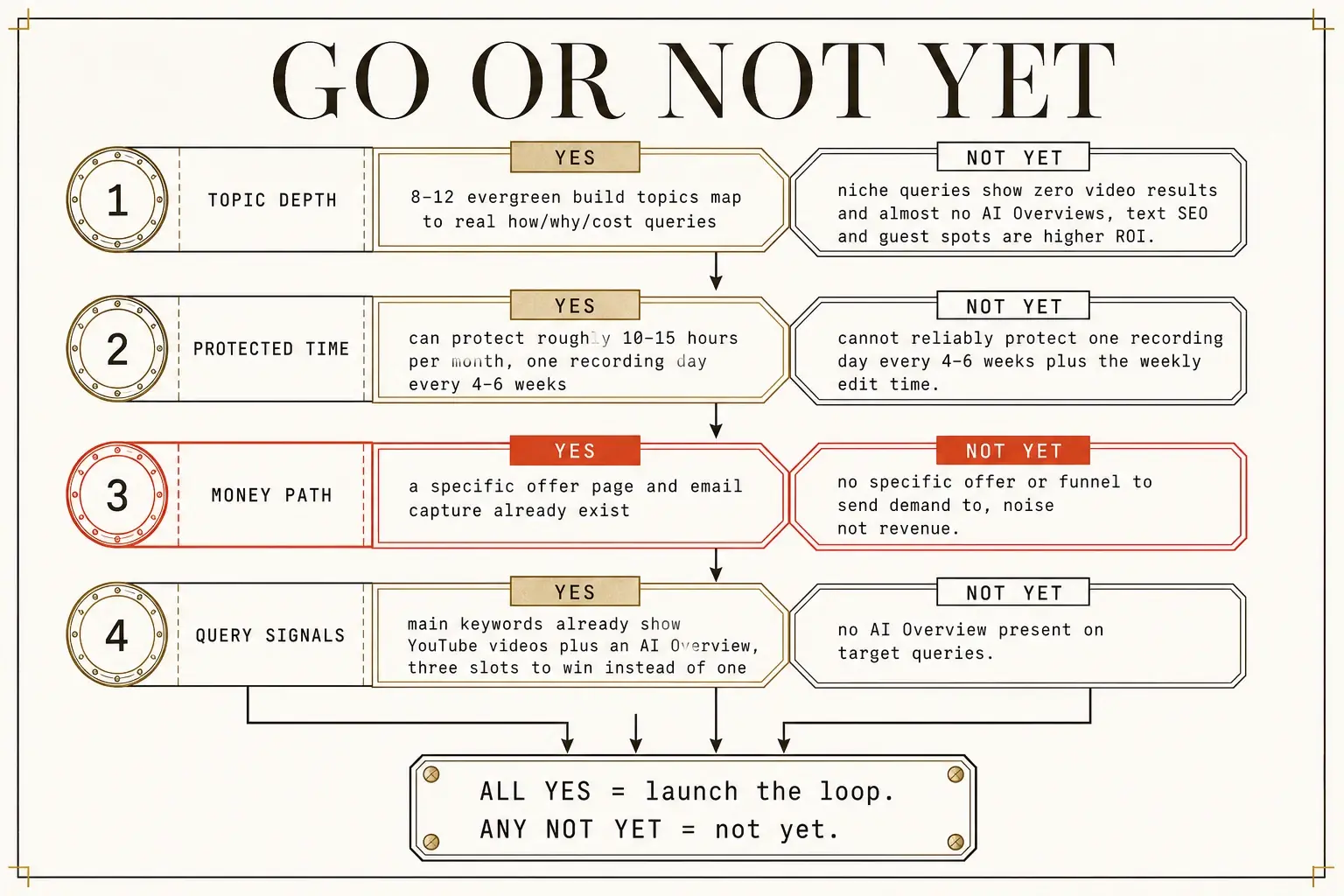
| You say YES when… | You say NOT YET when… |
|---|---|
| You have 8–12 evergreen build topics that map to real "how / why / cost" queries | Your niche queries show zero video results and almost no AI Overviews. Text SEO and guest spots are higher ROI for now |
| You can protect ~10–15 hrs/month (one recording day every 4–6 weeks plus a couple hours weekly for edit/SEO) for 3–6 months | You can't reliably protect one recording day every 4–6 weeks plus the weekly edit time |
| You have a money path ready, a specific offer/service page and an email or newsletter capture | You don't yet have a specific offer or funnel you actually want more demand for. You'd make noise, not revenue |
| Your main keywords already show YouTube videos plus an AI Overview, three slots to win instead of one | none |
Two details make the time bar more forgiving than it looks. One good long-form video a week, or even every other week, is reported to be enough to grow if you stay consistent. And the batching pattern that keeps it sane is to film 2–4 long videos in a single session, then edit and schedule them across the following 2–4 weeks. You're not signing up for a daily grind. You're signing up for one focused day a month plus disciplined follow-through.
If you can't protect that block of time, the better move isn't a worse version of YouTube. It's none of it. Keep building canonical written notes, and appear as a guest builder on other people's channels or podcasts, they handle production, you still earn the citations.
CH.02
Why do AI answer engines reach for video, and why do your notes win?
One recorded build can rank on YouTube, show up as a Google video result, and get pulled into an AI Overview, and engines disproportionately favor video when they pick what to cite. The unfair part: a research note with question-shaped chapters is already the exact structure that gets a video cited, so a pure-text rival can't build the asset you can.
flowchart TD
  A["One recorded build"] --> B["Ranks on YouTube"]
  A --> C["Google video result"]
  A --> D["Pulled into an AI Overview"]
Start with where attention is going. Google's AI Overviews now appear on a large and fast-growing share of US searches, more than doubling in incidence since early 2025 by reported estimates. Those answers pull clicks off the classic blue links: reported studies have seen meaningful click drops on the top organic result when an AI Overview is present. Being referenced inside the box increasingly beats ranking beneath it.
Here's the part that should change your behavior, and treat these as reported industry estimates, not measured fact:
- AI Overviews appear to draw most of their sources from what already ranks on the first page of traditional results, so the AI mostly samples the existing winners.
- The reported pattern across SEO breakdowns is that AI Overviews and LLMs lean on video, primarily YouTube, more readily than on text-only pages, with YouTube referenced far more often in AI answers than TikTok, Vimeo, or Twitch.
- For Gemini the mechanism is explicit: its API takes YouTube URLs as a first-class media source, and in the consumer app you can paste a link and get summaries, quotes, and timestamps when transcripts exist, which tells you plainly that captions are being read as structured text. Analyses from the GDELT Project have documented Gemini retrieving and relying on YouTube metadata and transcripts.
One caveat, said out loud: those same analyses found the summaries vary and sometimes hallucinate. You can structure a video to be quotable. You can't fully control which sentences get lifted. The tactics raise your odds, they don't guarantee the quote.
Now the angle that makes this yours, and it has a short shelf life. In 2026, AI citations became the new backlinks for video, and a research note already has the chapter structure that gets pulled into AI answers.2 Each chapter stands alone as a mini-answer that earns its own timestamp citation, so a 30-minute tutorial can have one relevant chapter lifted straight into a Google answer.2 The production checklist that earns those citations (chapters, transcript, schema, captions) is the next chapter. The point here is that your note is already shaped to win it where a pure-text rival is not.
A note with ## chapters that answer real questions converts, almost mechanically, into a long-form Q&A-chaptered video, and that one source becomes three things at once:
- the citation layer engines read off the transcript
- the script for the short cascade
- a caption track
Your written note is the durable event log. The video, the clips, the citations are streaming outputs you regenerate. That framing tells you where the human judgment lives (the note) and where the automation lives (the cascade). It also fits a builder's constraints with eerie precision. X-Pilot describes research-to-video as a four-stage workflow:
flowchart LR
  A["Abstract extraction"] --> B["Storyboard mapping"]
  B --> C["Code-rendered visualization"]
  C --> D["Synchronized narration"]
And it makes the point that matters most: unlike generative tools producing approximate imagery, code-rendered visuals preserve equations, figures, and citation formatting with zero hallucination risk.3 For anyone whose numbers are sacred and who renders visuals from code, that's the difference between a tool that lies and one that doesn't. This didn't exist in 2024. It does now, and almost nobody is building this way yet.
CH.03
How do you make a video an engine will actually quote?
Feed the machine the text it reads, an accurate transcript, a description that stands alone as a summary, query-named chapters, and spoken "answer blocks" you'd be happy to see copied verbatim. Aesthetics don't get you cited. Structured language does.
For a solo engineer selling expertise, the efficient formats aren't "creator" content. They're the things you'd explain to a client anyway:
- Screen-share build walkthrough, your core format. Structure each as problem → context → live build → gotchas → final walkthrough. It matches the intent behind "how to automate X," holds attention, and produces exactly the step-wise explanation an engine can lift.
- Anonymized case-study teardown, client-type → bottleneck → architecture → result, without naming the client. The strongest proof for a serious buyer, and the clearest narrative for an AI to summarize.
- Framework / architecture breakdown, walk through one reusable model (the components of an event-driven stack: triggers, orchestrator, state store, observability). Clean definitions get quoted by LLMs.
On the face-cam question, be ruthless about your time. A talking head adds parasocial "I'm hiring a person" trust, but it does nothing to how transcripts are parsed or how AI Overviews cite you. So use screen-share as the main view and add short face-cam only for a 10–20 second hook at the start and the occasional big-point interlude. One camera setup per batch day. Everything else is pure screen capture.
There's no published spec for how Overviews weight transcripts, so hold the rest loosely, but practitioner guidance for 2025–2026 converges hard, and it's cheap to do. The systems read:
- your transcript and captions (auto-generated, but an accurate uploaded SRT/VTT from Descript or Whisper reportedly boosts long-tail matches)
- your description written as a standalone summary an AI could understand without watching
- your chapters
- your topical depth across the channel
Manual chapters beat auto-generated ones, keyword-rich titles like "Setting Up SSH Keys on Ubuntu" feed Google's Key Moments where a flat "Step 2" feeds nothing, and YouTube requires chapters to start at 0:00 with a minimum of three.4
The structural moves that put quotable text into the transcript:
- Lead with the query, out loud, in the first 30 seconds, say something close to the real search term.
- Speak explicit answer blocks, a tight 1–3 sentence answer to each key question, phrased like a featured snippet, present tense, no fluff. Write one for every question your video answers. Here's one I'd be happy to see lifted verbatim: "To keep your automations reliable, you need three things: idempotent jobs, centralized logging, and dead-letter handling. Idempotent jobs ensure retries don't duplicate work, logging surfaces failures, and dead letters prevent silent data loss."
- Signpost sections verbally, "Step 1, Step 2, Step 3", and restate each label in plain language so it maps to a chapter named with a real query.
- Mirror your canonical note in the description (a 2–3 sentence direct answer, then steps, then a link back), which gives the AI a text fallback and feeds your own domain's authority at once.
Not every format earns its hours. The read is blunt:
| Format | Effort | AI-citation value | Lead value | Time-to-payoff |
|---|---|---|---|---|
| Long-form screen-share build (8–20 min) | High | Very high: rich transcript, chapters, deep topical signals, reportedly cited more readily than text | Very high: shows real implementation and decisions | Medium: 1–3 months to compound |
| Anonymized case-study teardown | High | High: clear problem→solution narrative is easy to summarize | Very high: strongest proof for serious buyers | Medium–long: trust builds over several videos |
| Framework / architecture explainer | Medium | High: clean definitions get quoted by LLMs | High: positions you as a systems thinker | Medium: quicker recognition among technical viewers |
| Shorts from long-form | Medium (once long-form exists) | Low–medium: depth wins, Shorts rarely cited as primary | Medium: good top-of-funnel reach | Short: fast view spikes, less durable |
| Talking-head opinion (no build) | Low–medium | Low: shallow transcript, few concrete steps | Low–medium: personality, weak "hire this engineer" proof | Short: quick engagement, weak long-term ROI |
| Highly produced cinematic brand video | Very high | Medium: aesthetics don't drive citation | Medium: impressive, loosely tied to results | Long: slow payoff for the effort |
Put your effort into the builds and teardowns. Let everything else be a by-product or a skip.
CH.04
Why does the loop need both a long anchor and a short cascade?
Short-form owns discovery, long-form owns trust and revenue, and a long-form view earns vastly more than a short-form one (long-form CPMs dwarf Shorts RPMs). Run them as one funnel or you leak most of the value, and never upload the identical cut to every platform.
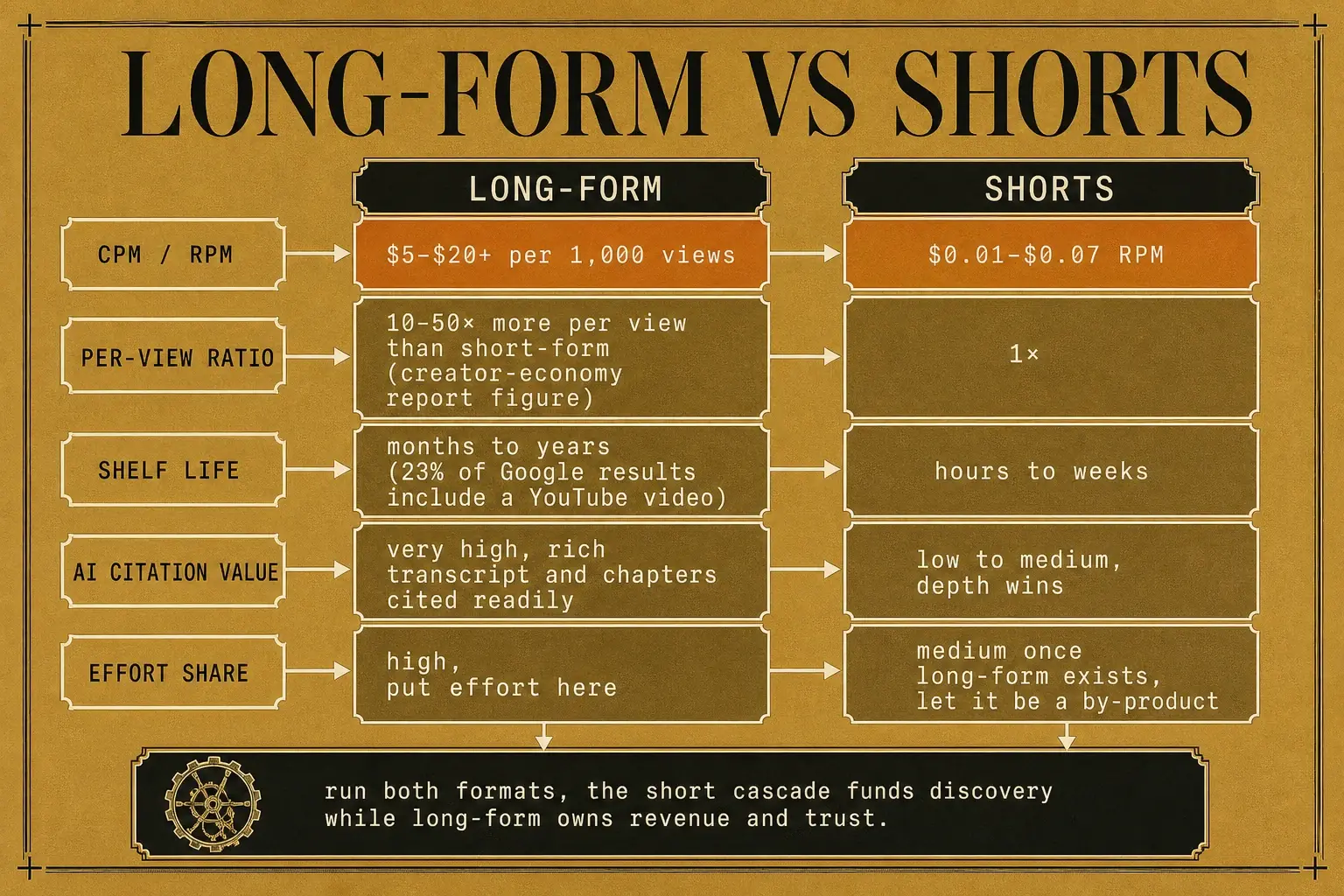
The split is consistent across independent analyses: TikTok, Reels, and Shorts are top-of-funnel attention machines, while YouTube long-form and podcasts own monetization and recurring trust.5 The numbers behind the gap are brutal:
- YouTube long-form CPMs run $5–$20+ per 1,000 views, Shorts RPMs run $0.01–$0.07.5
- One creator-economy report puts YouTube at 10–50× more per view than TikTok.6
- Long-form also lives longer: 23% of Google results now include a YouTube video, giving it a shelf life of months to years against the hours-to-weeks of short-form.5
- And by reported creator-economy estimates, running both formats compounds growth and earnings well beyond either alone, one writeup cites several-fold faster channel growth and a Shorts channel that multiplied its monthly revenue after adding long-form, with reverse-repurposing a viral Short into a deep-dive lifting long-form watch time.7
Keep one idea in your pocket for the end: by marketing analyses, YouTube converts poorly on-platform compared with channels like Instagram and Facebook.8 YouTube is a top-of-funnel trust play, not a direct-response one. The conversion happens elsewhere.
flowchart LR
  A["Short-form: discovery"] --> C["Run as one funnel"]
  B["Long-form: trust and revenue"] --> C
  C --> D["Conversion happens elsewhere"]
Now the most tempting wrong move in all of distribution: "create once, publish everywhere." It's the opposite of free reach. A 35-second video with a 2-second setup might hit 52% retention on YouTube Shorts and 28% on TikTok off the exact same file, the platforms reward different things and punish sameness.9 The fix is one idea in five packages, not one file uploaded five times: re-cut the hook, the framing, and the call to action per platform.10 Two guardrails matter for anyone tempted to bulk-dump:
- stagger releases at one to two pieces per platform per week, at least 48 hours apart, because algorithms read bulk posting as spam
- map a distinct keyword per asset so your own blog, video, and notes don't cannibalize each other in search.11
(Which platforms to prioritize, and why LinkedIn is the under-exploited one for a technical builder, is its own decision, covered in the companion note on where to publish for leads and AI citations. This note is the loop, not the channel map.)
CH.05
How does one note become a month of content?
You don't improvise the repurposing, you run a ratio: one long-form piece becomes roughly five short clips and ten text posts, and a single recording can yield up to fifty assets. Because your notes already exist, the conversion runs the cheap direction.
| Source asset | Fans out into | Per the rule |
|---|---|---|
| 1 research note → long-form video | 5 short clips (Shorts/Reels/TikTok) | a common 1-5-10 repurposing rule |
| Same long-form | 10 text posts (X threads, LinkedIn) | a common 1-5-10 repurposing rule |
| 1 ten-minute video | 2,500-word blog + 10 clips + 20 LI posts + 30 tweets | Moz12 |
| 1 recording | up to 50 assets across 5 visibility layers | Mr. Everywhere13 |
| 1 two-thousand-word blog | email excerpt + LinkedIn post + 5–7-tweet thread + newsletter teaser + 60s video script, in ~30 min | Syxo14 |
The economics favor the writer. Speaking runs about 3.5× faster than typing (150 words per minute against 41), so the recording is cheap and the text falls out of it rather than the other way around, the per-recording asset counts in the table above are what one session yields.12 One method pushes a single recording across Google, Reddit, Perplexity, ChatGPT previews, and LinkedIn newsletters, with Reddit alone reported at 75,000 monthly impressions.13
The workflow that keeps this from becoming a second job is one recording day every 4–6 weeks, scripts pulled straight from notes you've already written:
- Topic & query selection. List 10–20 problems you've solved, use YouTube autocomplete and TubeBuddy or vidIQ to capture real queries, then Google each phrase and check for an AI Overview and ranking videos. Prioritize the topics where an AI Overview already exists and the ranking YouTube results are weak or non-technical, that gap, strong AI demand against thin video supply, is your wedge. You're not out-producing big channels on saturated terms, you're claiming the specific, technical, long-tail queries they never bothered to film.
- Notes into ultra-lean scripts. For each topic define one primary query and 2–4 sub-questions, then write a beat sheet, not a full script: hook (15–30s) → system overview (1–2 min) → step-by-step build (5–15 min) → failure modes (2–3 min) → recap (30–60s, in answer-block form). Drop in the exact lines you want quotable.
- Record day. Set up once. Record the face-cam hook, then switch to screen-share. Aim for 8–20 minutes. Cut mistakes in the edit.
- Post-production. Edit dead air, zoom on code, generate and correct the transcript, write the description from the note, add query-style chapters, make a bold legible thumbnail.
- Repurpose. Cut 2–5 Shorts per video, each on one before/after or one gotcha. If the build evolved while filming, fold the new detail back into the canonical note.
One caution before you scale it. Automation is a force multiplier on quality, not a substitute for it, point a repurposing engine at mediocre work and it just spreads the underperformance faster.15 And to keep the time bar honest, skip the things that trade your scarce hours for burnout or low-intent reach: daily uploads (sustainable beats voluminous), Shorts as your core product (great for reach, weak for the deep transcripts that earn citations), overproduced b-roll and motion graphics (clarity beats cinematic flair for Overviews), generic AI-news commentary (high competition, low intent), and multi-language production on one channel (splitting focus multiplies the work, and the citation surfaces studied here are overwhelmingly English).
CH.06
What keeps you legally safe, and why isn't a paid license enough?
The maximally permissible workflow across every platform at once is: AI writes the script, real or archival footage carries the visuals, and you label only when a synthetic presenter speaks. Cross that line, or lean on music you can't document, and the platform punishes you regardless of what you paid.
Storrito names the asymmetry exactly: a brand that uses AI to write scripts and generate hashtags but shoots real video doesn't need to label anything, while a brand that generates a synthetic spokesperson does.16 The two platforms split the same way:
- TikTok wrote this into policy, it exempts AI-assisted scriptwriting and hashtag generation from labeling, creating a clean lane16, but enforces the other side hard, using C2PA and invisible watermarking to auto-detect AI, with content removal, strikes, and loss of Creator Rewards for a missing mandatory label.17 It has already labeled over 1.3 billion AI-generated videos.16
- YouTube, as of May 27, 2026, moved its AI disclosure labels to more prominent positions and now auto-detects significant photorealistic AI use, labeling it even when the creator doesn't, and you can't remove a label from content made with YouTube's own tools or carrying C2PA "fully AI-generated" metadata.18
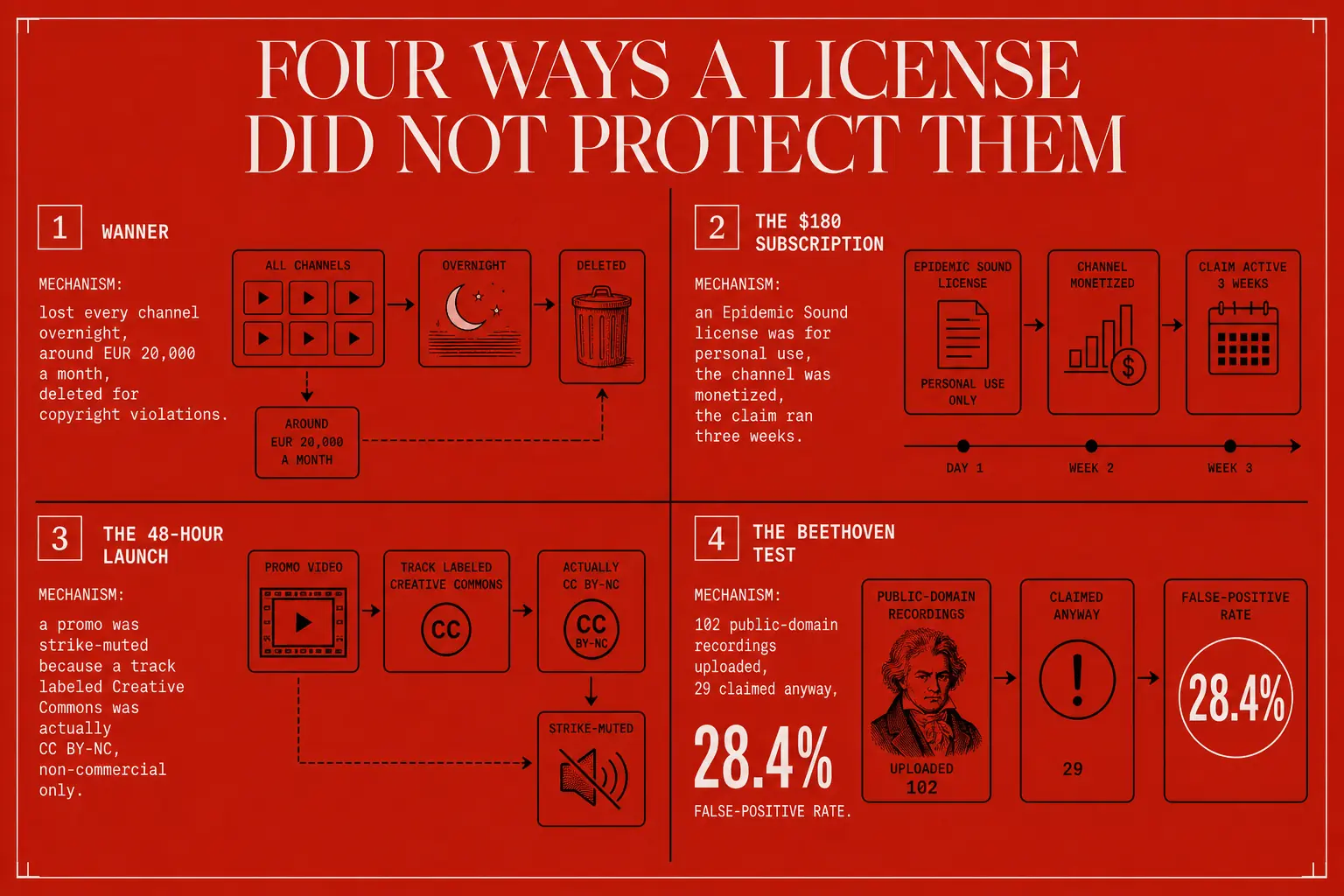
Now the part that costs people real money, because it overturns the belief that paying for a license makes you safe. It does not. Content ID matches audio fingerprints, not license agreements. YouTube processed 2.2 billion Content ID claims in 2024, and rightsholders monetized over 90% of them.19 When researchers uploaded 102 non-infringing Beethoven recordings, YouTube claimed 29, a 28.4% false-positive rate based purely on the waveform.20 The receipts pile up:
- Wanner lost every channel he had overnight, around €20,000 a month, when YouTube deleted them for copyright violations, "rock bottom," and a permanent shift to licensed-only content.21
- A creator who spent $180 on an Epidemic Sound subscription still caught a Content ID claim, the track was licensed for personal use while the channel was monetized, and the claim siphoned ad revenue for three weeks before they fled to Suno Pro at $8/month.22
- Thematic tells the canonical version: 48 hours into a launch, a strike muted the promo's audio because a track labeled "Creative Commons" was actually CC BY-NC, non-commercial, a direct violation for a business promo, forcing a scramble to swap in a cleared track and re-export the master.23
- Creators routinely report videos pulled for copyright even when the music was properly licensed, with appeals quietly ignored. A license is paperwork the algorithm never reads.
AI-generated music isn't the escape hatch it looks like. One creator uploaded a track confident it was original and got a Content ID claim from a major label within hours, then spent three weeks in dispute.24 The detection misfires the other way too: a Suno user uploaded a dozen old, never-released, unsampled FL Studio tracks and had all but 3 rejected as matching an existing upload, then got flagged so hard they cancelled.25 And the helplessness has a UI, upload a performance to Facebook and watch it auto-mute 20 seconds behind a "restore audio" button that stays inoperable for hours.20
So the defensible workflow is built, not bought:
- Document the prompts.
- Keep editor project files with version history.
- Write human-authored scripts.
- Make substantive editorial cuts.
- Mix in human-authored music where you can.
- Save proof of creation (the prompt, the date, the license screenshot).
- Upload important videos as unlisted first so YouTube's Checks can scan for claims before you go public.2627
In 2026 YouTube added a "replace song" tool that lets US creators generate four royalty-free instrumental tracks inside Studio to clear a claim.28 One more landmine: voice cloning. The Tennessee ELVIS Act criminalizes unauthorized AI replication of voices, and a New York court in Lehrman & Sage v. Lovo held that every generation of a clone is a continuing unauthorized use, so cloning a public figure is high-risk and generally prohibited.29 A builder running his own real voice, or a fully-owned local model, sidesteps the entire category. In 2026, your defensibility lives in the paper trail you can produce, not the invoice you paid.
CH.07
Why is the AI-slop crackdown good news for you?
YouTube isn't banning AI. It's demonetizing the absence of a human. The swept channels shared a production fingerprint, the survivors add visible human judgment the algorithm can read. For a builder whose entire product is original analysis, that's a moat, not a threat.
On July 15, 2025, YouTube renamed its "repetitious content" policy to "inauthentic content," explicitly targeting mass-produced, templated uploads that lack original insight.30 That's the lever that wiped the 16 channels from the opening, several high-view faceless channels among them.31 The common thread wasn't piracy. It was the fingerprint:
- heavy AI voice
- templated thumbnails
- slideshow or stock loops
- superhuman output speed32
One analysis frames this as a Trust Score: a weighting of return-viewer rate, comment depth, creator-identity consistency, and whether your upload pattern looks human or like a content farm, so two channels with equal views can see very different RPMs, and a 500K-view shallow video now underperforms a 150K-view loyal one.32
The defenses are concrete and all about legible humanity:
- reply to the first 20 comments in the first hour
- pin a real question
- hold a human rhythm of two to three thoughtful videos a week rather than daily dumps
- keep a consistent face or logo across thumbnails32
The monetization-safe bar is the same human-authorship move from the legal chapter, here for a different reason: 2026 requires "substantial human transformation" to stay monetized, your own scripts, unique commentary, custom pacing.33 The single biggest survival lever is adding original research or point of view to the script.34
Here the policy turns out to be the research builder's ally, not his enemy. Consumer enthusiasm for AI content fell from 60% in 2023 to 26% in 2025, so audiences now actively seek authenticity, even visible mistakes, as proof of humanity.26 Marketers have rushed to generative AI while a large share of consumers report that AI video tools have eroded their trust in social content.
One way to frame the synthesis is augmented authenticity: AI handles research, scripting, captions, B-roll, and editing, while human presence and judgment stay the core value, and the moat against slop is verifiable human expertise.35
The crackdown reads less like a threat and more like the field clearing out the competition for you.
CH.08
Where does the reach actually convert?
Treat every platform as a discovery engine and migrate the audience to assets you control, views are transient, an email list compounds. This is where the funnel closes, and it isn't on YouTube.
Recall that YouTube converts poorly on-platform. Here's why off-platform conversion is structural, not incidental:
- A 10K email list in the business niche can generate $3,000–$8,000 in monthly recurring revenue, against roughly $300–$500 in ad revenue from an equivalent subscriber count.
- Email returns $36–$68 per dollar spent versus $2.80 for social.36
- 93% of marketers already prioritize first-party data as cookies phase out, because owned audience data survives algorithm shifts that erase platform reach overnight.37
The two purge stories that frame this piece are the same lesson from the other side: if your audience lives only on the platform, the platform can delete it.
The mechanics of capture are specific:
- YouTube content runs a 12-to-24-month shelf life, so the strongest call to action is verbal and placed mid-video at the 40–60% mark, not a visual overlay, and because Shorts description links aren't clickable, you funnel viewers through Channel Links panels, pinned comments, or a long-form compilation.38
- High-converting CTAs appear at least twice, a brief benefit-focused mention in the first third and a detailed close at the end, often offering a transcript PDF or checklist that extends the video's value.39
- And the lead magnet itself decides the opt-in rate: generic ebooks fail, while an actionable template that solves a specific problem in under 30 minutes can lift opt-ins from 11% to 41%, as one builder found switching from a 47-page guide to a Notion template.40
The funnel is now fully assembled:
- short-form for cold discovery
- long-form structured for AI citation and trust
- a list-capture CTA on every asset
A realistic target for a solo builder is somewhere between 1,000 and 10,000 engaged followers in 6 to 12 months around a specific niche, growing nonlinearly with plateaus, diversified so no single algorithm change can sink it.
The arc, paid off: before, you published research and hoped it ranked. After, the same note runs a loop, becoming a cited video, a fanned-out cascade, and a stream of traffic into a list you own, defended by a human fingerprint that AI slop can't fake and a legal paper trail that a license alone can't buy. The platforms are the rented road. The note, and the list, are the only things you keep.
Sources · 41
Sources
-
ScaleLab, YouTube's AI content crackdown in 2026 (scalelab.com) ↩
-
ShortVids, The Long Form Video SEO Formula Driving Top Rankings in 2026 ↩ ↩2
-
posteverywhere.ai, Long-Form vs Short-Form Video: 2026 Strategy ↩ ↩2 ↩3
-
InfluenceFlow, YouTube Shorts and Long-Form Video Strategy Guide (2026) ↩
-
Marketeze, Video Retention Rate Benchmarks 2026 by Platform ↩
-
Bloomberry, Repurposing Strategy: One Idea, Five Platforms (2026) ↩
-
Moz, How to Turn One Piece of Content into Multiple for SEO ↩ ↩2
-
r/AISEOInsider, Mr. Everywhere SEO Method 2026: One Video, 50 Pieces of Content ↩ ↩2
-
SocialRevver, Repurpose.io: Features, Pricing, and Best Use Cases (2026) ↩
-
TikTok News Hub, TikTok AI Transparency 2026: What Every Creator Must Know ↩
-
YouTube Blog, Improving AI labels for viewers and creators ↩
-
Foxi, YouTube Content ID For Music: 2026 Guide To Monetization ↩
-
Transactions of ISMIR, Algorithmic (In)Tolerance: Experimenting with Beethoven's Music on Social Media Platforms ↩ ↩2
-
NerdBot, AI Music Generators vs. Stock Music Libraries: A Real Cost Comparison ↩
-
Thematic, Understanding YouTube Content ID and Copyright Rules in 2026 (LinkedIn) ↩
-
Soundverse, How AI Music Is Reviewed by YouTube's Content ID System in 2026 ↩
-
r/SunoAI, Copyright Detection Beyond Broken (>75% False Positive Rate) ↩
-
OutlierKit, YouTube's AI Slop Crackdown: 4.7 Billion Views Wiped (2026) ↩ ↩2
-
Complete Music Update, YouTube to let creators swap out Content ID tracks for royalty-free AI substitutes ↩
-
Skadden, New York Court Tackles the Legality of AI Voice Cloning ↩
-
OutlierKit, AI Copyright Supreme Court Ruling: What YouTube Creators Must Know (2026) ↩
-
MilX, What changes in YouTube monetization policy creators can expect in 2026 ↩ ↩2 ↩3
-
TrueFan, YouTube AI labeling policy: Monetization-safe guide ↩
-
TranscribeVideo, How to Build an Email List from YouTube (2026) ↩
-
r/DigitalProductSellers, I Built a 4,200-Person Email List Selling Digital Products ↩